




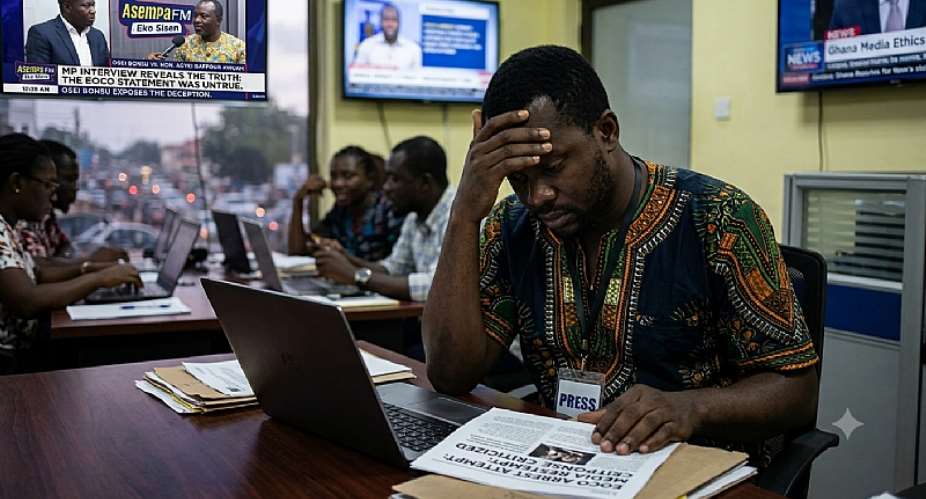
The primary justification for a free press in a constitutional democracy is its duty to serve as a truth-seeking referee. When state agencies, political actors, or private interest groups release public statements, the public relies on newsrooms to test those claims, investigate context, and present an audited truth. However, a troubling trend has increasingly defined mainstream Ghanaian journalism: the uncritical amplification of official narratives without verification. When reputable broadcast houses and state-affiliated platforms behave like engagement-hungry blogs—copying, pasting, and publishing raw assertions as undisputed truth, the line between journalism and institutional propaganda vanishes.
The Anatomy of a Coverage Failure
A stark example unfolded following the September 23 attempt to apprehend Hon. Agyei Baffour Awuah, Member of Parliament for Manhyia South, by an individual who failed to properly establish her identity as an officer of the Economic and Organised Crime Office (EOCO). Rather than independent verification driving the initial news cycle, the subsequent official press statement issued by EOCO became the sole basis of reporting for several major outlets. The agency claimed that the MP had ignored an earlier invitation extended in February. Multiple media houses immediately distributed this claim to the public as established fact. It was only when host Osei Bonsu interviewed the MP on Asempa FM’s Ekosi Sen that crucial counter-evidence and context emerged to expose significant gaps and inaccuracies in the narrative transmitted by the press statement. This sequence highlights a structural defect in contemporary Ghanaian newsrooms, which is the habit of relying on authority figures as self-verifying sources.
Key Distinctions Between Professional Journalism and Unethical Aggregation
The difference between ethical journalism and click-driven blogging comes down to verification prior to publication.
Ethical newsrooms treat official statements merely as claims that require independent verification before publication. Unethical aggregators treat statements from state agencies as established facts that are ready for immediate broadcast.
Professional journalists seek a right of reply from affected individuals before publishing sensitive allegations. Sensational media platforms publish allegations immediately and only add counter-perspectives retroactively or ignore them entirely.
Legitimate news outlets prioritize long-term public accuracy, contextual clarity, and institutional accountability. Unethical blogging operations prioritize immediate publishing speed, social media engagement, and web traffic metrics.
Independent media institutions function as rigorous watchdogs against abuses of power by public authorities. Sensational news outlets act merely as paid/unpaid amplification channels for official public relations campaigns.
The Consequences of Media Failure for Democratic Discourse
When mainstream platforms, including the state broadcaster, Ghana Broadcasting Corporation (GBC) adopt these mechanics, the consequences extend far beyond a single news cycle.
State agencies and political actors quickly learn that they do not need to prove their claims because drafting a formal press release guarantees favorable news headlines.
The public rapidly loses trust in journalism when citizens consistently discover that initial news reports were half-truths or unverified claims from state institutions.
Innocent individuals suffer severe damage to their public reputations because unchecked assertions sway public opinion long before factual counter-arguments emerge.
A Call for Immediate Newsroom Reform
The public does not require newsrooms merely to relay official press releases, because any citizen can read those documents directly on social media. The true value of the press lies entirely in its capacity to verify facts, cross-examine authority figures, and provide balanced context. To restore public trust, Ghanaian broadcast media and print outlets must enforce strict operational standards.
Newsrooms must mandate pre-publication verification so that statements containing allegations are never published without documenting a genuine attempt to obtain a response from the targeted party. Journalists must label unverified claims clearly in headlines to attribute statements as claims rather than declaring them as objective reality. Finally, news organizations must prioritize accurate verification over publishing speed, as delivering an accurate story second is far better than publishing a falsehood first. Ghanaian journalism must step back from the mechanics of viral aggregation and fulfill its primary duty to subject powerful institutions to relentless scrutiny.
Conclusion: Reclaiming the Watchdog Role
The future of Ghana’s democracy depends heavily on the integrity of its fourth estate. When mainstream newsrooms abandon pre-publication verification in favor of copy-paste speed, they relinquish their most vital responsibility: serving as a truth-seeking referee. The incident surrounding the Economic and Organised Crime Office and Hon. Agyei Baffour Awuah is not an isolated misstep, but a clear diagnostic marker of a media ecosystem dangerously blurring the line between public-interest journalism and public relations.
If Ghanaian news outlets continue to mimic the shortcuts of unethical aggregators, they risk converting newsrooms into passive megaphones for the powerful while systematically eroding the public’s trust. Reclaiming institutional credibility will require more than mere rhetoric; it demands a deliberate, operational commitment to verification, balance, and relentless scrutiny before hitting publish. By choosing rigorous investigation over rapid aggregation, Ghana's press can shed the mechanics of viral blogging, hold public authority to account, and fulfill its solemn constitutional promise to the Ghanaian people.
The author is a regular contributor to News Commentary, a current affairs programme by the Ghana Broadcasting Corporation, and a columnist with Modern Ghana, an esteemed online news portal.


 Those behind EOCO ‘abuses’ will be held accountable – Sammi Awuku
 Raymond Archer should have been sacked by now – Kwadaso MP on EOCO-Baffuor Awuah...
 September 24: Cedi sells at GHS12.20 on forex market, GHS11.60 on BoG interbank
 'GMA is monitoring Ghana's marine space blindly’ – Miracles Aboagye
 Alagumgube welcomes Gurene as BECE subject, calls for more teachers and learning...
 Mahama calls for return of Africa’s cultural heritage at UNGA 81 side event
 ECOWAS directors meet in Lagos to align 2027–2029 expenditure plans
 Lordina Mahama urges African leaders to build stronger healthcare systems for wo...
 Speaker Bagbin summons Parliament for September 29 sitting
 Kwesi Pratt warns against abuse of free expression amid Ghana Jollof controversy


