




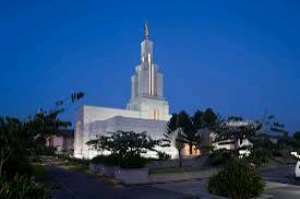
Nearly five decades after its first official baptisms near Cape Coast, The Church of Jesus Christ of Latter-day Saints has grown from a collection of independently organised believers into one of Ghana’s most visible Christian communities.
The Church reported more than 113,000 members in nearly 390 congregations in Ghana in 2025. These figures demonstrate the scale of its expansion, but they do not fully explain its significance. The more compelling story concerns how the faith reached Ghana, how local believers sustained it before the arrival of missionaries and what the institution has contributed to the lives of its members and surrounding communities.
Unlike many foreign religious movements introduced through organised missionary campaigns, the Ghanaian history of the Church began largely through the initiative of Ghanaians themselves. During the 1960s, before official missionaries arrived, individuals obtained copies of the Book of Mormon and other Church publications from abroad and began sharing their new faith with others.
Among the most prominent pioneers were Raphael Abraham Frank Mensah, Joseph William “Billy” Johnson and Rebecca Mould. Mensah corresponded with Church headquarters for religious materials, while Johnson became an energetic preacher and organiser. Mould emerged as an important leader among believers in the Western Region.
These early converts organised congregations, conducted worship services and repeatedly requested that the international Church send missionaries to Ghana. Their activities created an indigenous foundation that existed years before the Church established a formal administrative presence in the country.
Official recognition was delayed partly because the Church then restricted priesthood ordination for men of Black African descent. That policy ended on June 8, 1978, when Church President Spencer W. Kimball announced that priesthood ordination would be extended to all worthy male members, irrespective of race.
The first missionary couples assigned to establish formal Church branches arrived in Ghana on December 5, 1978. Four days later, 125 people were baptised at a beach near Cape Coast. Another 124 converts were baptised in Takoradi on December 12. Billy Johnson was called to lead the first branch in Cape Coast, demonstrating that Ghanaian leadership was central to the Church from the beginning of its official presence.
The Church’s growth since then has been accompanied by investments in education, employment preparation, humanitarian assistance and personal development. These initiatives are especially relevant in a country where many young people face difficulty accessing affordable tertiary education and stable employment.
Ghana played an important role in the international expansion of what later became BYU–Pathway Worldwide, a programme that offers lower-cost online access to certificates and university degrees. Its first international location opened in Accra in January 2011. By 2023, Ghana had 2,849 participating students, and enrolment reportedly increased to 4,211 in 2024.
For students unable to relocate or meet the cost of conventional university education, flexible online programmes can provide an alternative route to professional advancement. The Church’s wider educational and self-reliance initiatives also include employment preparation, business training, financial-management instruction and support for members seeking vocational or tertiary qualifications.
The Perpetual Education Fund, introduced in 2001, was designed to help eligible members in developing countries obtain education and employment-related training. Self-reliance centres and local courses additionally assist participants with preparing résumés, searching for employment, establishing small businesses and managing household finances.
The Church’s humanitarian activities extend beyond its membership. Across Ghana, its charitable programmes have supported projects involving clean water, sanitation, healthcare, emergency relief and community development. Although the scale and long-term impact of individual interventions vary, these projects have strengthened the Church’s public presence and created partnerships with traditional authorities, local communities and government institutions.
There is also a social influence that is more difficult to measure. Church teaching places strong emphasis on family stability, marital commitment, education, personal discipline and abstinence from alcohol and tobacco. Members are encouraged to live within their means, avoid destructive habits and take responsibility for their spiritual and material welfare.
The Church operates largely through an unpaid lay ministry. Ordinary members teach classes, administer congregations, manage budgets, organise welfare programmes and coordinate community activities. Young people are often given meaningful responsibilities at an early age.
These experiences can develop confidence, public-speaking ability, administrative discipline and leadership skills that members later apply in their education, businesses and professional lives. Full-time missionary service, usually undertaken by young adults, can also expose participants to unfamiliar cultures, languages and communities.
The Church’s influence, however, should not be discussed without acknowledging the tensions that sometimes accompany membership.
Latter-day Saint teaching places considerable emphasis on the nuclear family, while Ghanaian society remains strongly shaped by the extended family and its obligations. Converts may occasionally face difficulty reconciling Church expectations with customary practices involving funerals, festivals, marriage and communal celebrations.
Some relatives may interpret a convert’s refusal to drink alcohol, participate in particular rituals or attend certain Sunday activities as a rejection of family tradition. Converts, on the other hand, may feel caught between loyalty to their faith and the expectations of their wider families.
Financial commitment can also become a source of concern. Members are taught to pay tithing, traditionally understood as 10 per cent of their income, while also contributing time to Church service and caring for their families. In households already managing school fees, rent, medical expenses and extended-family responsibilities, these commitments may require significant sacrifice.
The Church attempts to address economic vulnerability through welfare and self-reliance programmes, but the experiences of individual members inevitably differ. For some, the system creates discipline, mutual assistance and new opportunities. For others, the combination of financial and service expectations may feel demanding.
The Church’s progress in Ghana has not always been smooth. Between 1989 and 1990, the Ghanaian government suspended the public activities of several religious organisations, including The Church of Jesus Christ of Latter-day Saints. The period became known among members as “the freeze.”
Church buildings were closed and formal public activities were restricted, forcing members to worship in their homes. Ghanaian believers continued studying, praying and supporting one another until the restrictions were lifted. The survival of the community during this period demonstrated that the Church had become more than a foreign missionary project. It had developed local roots strong enough to withstand institutional disruption.
The Accra Ghana Temple provides the clearest physical symbol of that permanence. Announced by Church President Gordon B. Hinckley during a visit to Ghana in 1998, it was dedicated in January 2004 as the first Latter-day Saint temple in West Africa.
Construction of a second temple began with a groundbreaking ceremony in Kumasi on October 18, 2025. A third temple planned for Cape Coast was announced in October 2023. These developments reflect Ghana’s growing importance within the Church’s West African presence.
Whatever one’s opinion of its theology, the Church’s transformation in Ghana is difficult to ignore. A religious movement first embraced and organised by Ghanaians has become an established institution within the country’s spiritual and social landscape.
Its influence can be seen in education, humanitarian assistance, family teaching, youth development and the preparation of lay leaders. Its history also reveals the complexities that arise when a global religion encounters deeply rooted Ghanaian customs and economic realities.
The most important question is therefore no longer whether the Church belongs in Ghana. Its history and membership have already answered that. The more useful question is how its presence continues to affect the people who join it and the communities in which it operates.
The Saints of Ghana are no longer a religious curiosity. They are neighbours, students, professionals, entrepreneurs and community leaders. Through their faith and institutions, they have become participants in the continuing construction of Ghanaian society.

 Expired driver’s licence attracts delinquency charge of up to GH¢148 – DVLA
 Ghana needs an enterprise economy with African characteristics, not copying othe...
 Court reinstates Bolgatanga Technical University Vice-Chancellor Alnaa, two seni...
 Christian Council demands action against financiers behind drug trafficking
 'Facts don’t support Ghana being a cocaine hub under Mahama's gov't’ – Majority ...
 NACOC arrests surged from 73 in 2024 to 217 in 2025 under NDC – Majority defend ...
 Gov’t drug strategy now targets criminal networks – Agalga
 Akufo-Addo's govt reckless borrowing, not Russia-Ukraine war, caused post-2020 e...
 Rising drug busts due to concrete institutional changes by NDC govt – Majority
 'This is not one man job' — Majority calls for stronger inter-agency cooperation...


