




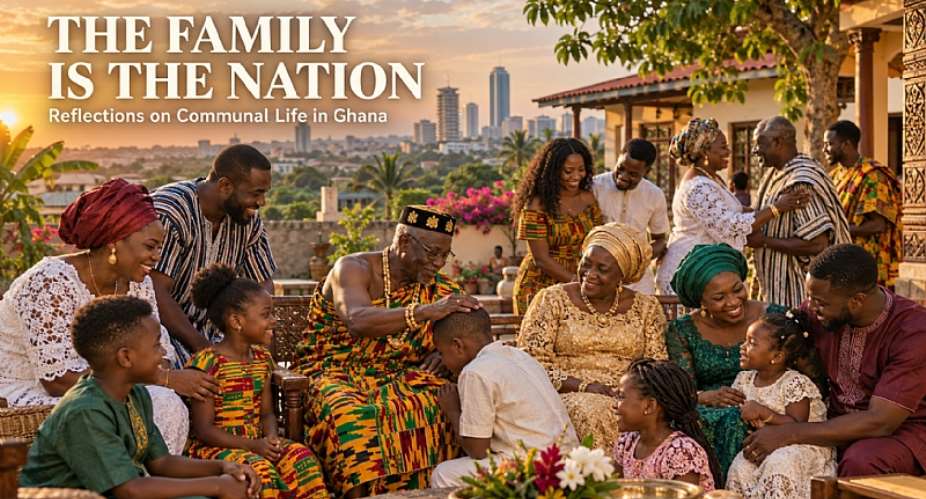
In Ghana, the extended family is not simply a sentimental inheritance from the past. It remains one of the most influential institutions in everyday life, shaping identity, responsibility, belonging and survival. Its importance becomes especially visible during the ceremonies that mark the major stages of human existence.
On almost any Saturday, the roads of Accra, Kumasi, Cape Coast and other communities come alive with people travelling to weddings, funerals, naming ceremonies and family gatherings. Churches and event centres fill with guests dressed in colourful lace, kente and traditional cloth. Family compounds expand temporarily as relatives arrive from different towns, regions and countries.
A funeral may take place in the morning, a traditional marriage in the afternoon and a thanksgiving service the following day. Radio stations announce the events, social-media platforms circulate invitations and family WhatsApp groups coordinate transportation, clothing, accommodation and financial contributions.
To interpret these occasions as mere festivity is to misunderstand their deeper significance. In Ghana, milestone ceremonies are moments when the extended family renews itself publicly. They reveal who belongs to whom, who carries responsibility and how communities support individuals through joy, transition and loss.
Ghana is often described as a country with strong kinship traditions, but this description is more than romantic language. Family relationships continue to organise practical obligations. Among many Akan communities, identity and inheritance have traditionally been traced through the maternal lineage, or abusua, while several other Ghanaian communities place greater emphasis on paternal descent. Despite these differences, the wider principle remains clear: a child belongs to an extended network and is rarely regarded as the responsibility of the biological parents alone.
Aunts and uncles frequently assume parental roles. Cousins are commonly addressed as brothers and sisters, while grandparents and other senior relatives provide guidance, discipline and cultural education. This language of kinship is not merely ceremonial. It carries real expectations.
When school fees become due, a medical emergency occurs or a family member loses employment, assistance is often sought first from relatives rather than from a formal institution. In a society where public welfare systems and insurance schemes do not always reach everyone adequately, the extended family functions as an informal social-protection network.
It provides support through reciprocity. Those who receive assistance today are expected to support others when their circumstances improve. The system may sometimes create heavy financial and emotional demands, particularly for relatives who are perceived to be economically successful. Nevertheless, its stabilising influence remains substantial.
Ceremonies provide the public setting in which these family relationships are affirmed. They are often elaborate communal gatherings involving traditional attire, music, food, religious observance and financial contributions. In many communities, they constitute an important part of the social calendar.
The naming ceremony, often called an outdooring, formally introduces a newborn to the family and wider community. Traditionally held after the child’s first days of life, it may include prayers, blessings and symbolic acts intended to welcome the child and teach values associated with truth, responsibility and good character.
Traditional marriage ceremonies bring two families together rather than simply uniting two individuals. Representatives of both families meet, customary requirements are fulfilled and the union receives collective recognition. Although many couples later hold church or civil weddings, the traditional ceremony remains deeply significant because it establishes a recognised relationship between the two families.
Funerals are often the most elaborate of Ghana’s communal ceremonies. They may continue over several days and attract relatives, friends, colleagues, neighbours and community leaders. Black, red, white or other culturally appropriate funeral clothing may be worn, depending on the circumstances and traditions of the deceased’s community.
Music, obituary posters, tributes, donations and family meetings form part of the occasion. Among some Ga communities, specially designed figurative coffins may reflect the occupation, personality or aspirations of the deceased, transforming craftsmanship into a distinctive expression of remembrance.
These events are not treated as exclusively private experiences. Joy and grief are shared across a broad social network. Relatives, friends, professional colleagues and neighbours contribute money, food, labour and time. Through their presence, they affirm the identity of the family and demonstrate that no individual should face life’s most important transitions alone.
Urbanisation, migration and rising living costs have placed this system under pressure. Ceremonies can be expensive, and the expectation to make frequent financial contributions can become burdensome, particularly for young people and salaried workers supporting several relatives.
Some families are responding by reducing the scale of events, sharing costs more carefully and setting limits on ceremonial expenditure. These changes do not necessarily represent the decline of the extended family. Instead, they show its capacity to adapt to new economic realities.
Technology has also transformed family participation. Relatives living in London, Toronto, New York, Johannesburg and other parts of the world can now join meetings through video calls, follow ceremonies online and send financial contributions electronically. Family WhatsApp groups have become virtual compounds where decisions are discussed, disputes are negotiated and important announcements are shared.
Migration may have increased the physical distance between relatives, but digital communication and remittances continue to connect members of the Ghanaian diaspora to responsibilities at home. School fees, medical bills, funerals, business ventures and building projects are frequently supported through these transnational family networks.
Ghanaian social life offers a powerful reminder that a person is not merely an independent unit but part of a living web of relationships. Individual achievement is usually connected to the sacrifices, expectations and encouragement of many others.
The culture of akwaaba, or welcome, reflects this wider philosophy of belonging. It expresses the idea that people should be received, recognised and included rather than left in anonymity.
Outsiders may initially be attracted by the colour, music and grandeur of Ghanaian ceremonies. What often leaves the deeper impression, however, is the assurance that people are known, remembered and accompanied through the important moments of life.
In an increasingly individualistic world, the extended family should not be dismissed as an outdated institution. It remains a form of social infrastructure—imperfect, demanding and sometimes costly, yet deeply important to the resilience of Ghanaian society.
In Ghana, the family does more than support the nation. In many respects, the family is the n


 Expired driver’s licence attracts delinquency charge of up to GH¢148 – DVLA
 Ghana needs an enterprise economy with African characteristics, not copying othe...
 Court reinstates Bolgatanga Technical University Vice-Chancellor Alnaa, two seni...
 Christian Council demands action against financiers behind drug trafficking
 'Facts don’t support Ghana being a cocaine hub under Mahama's gov't’ – Majority ...
 NACOC arrests surged from 73 in 2024 to 217 in 2025 under NDC – Majority defend ...
 Gov’t drug strategy now targets criminal networks – Agalga
 Akufo-Addo's govt reckless borrowing, not Russia-Ukraine war, caused post-2020 e...
 Rising drug busts due to concrete institutional changes by NDC govt – Majority
 'This is not one man job' — Majority calls for stronger inter-agency cooperation...


