




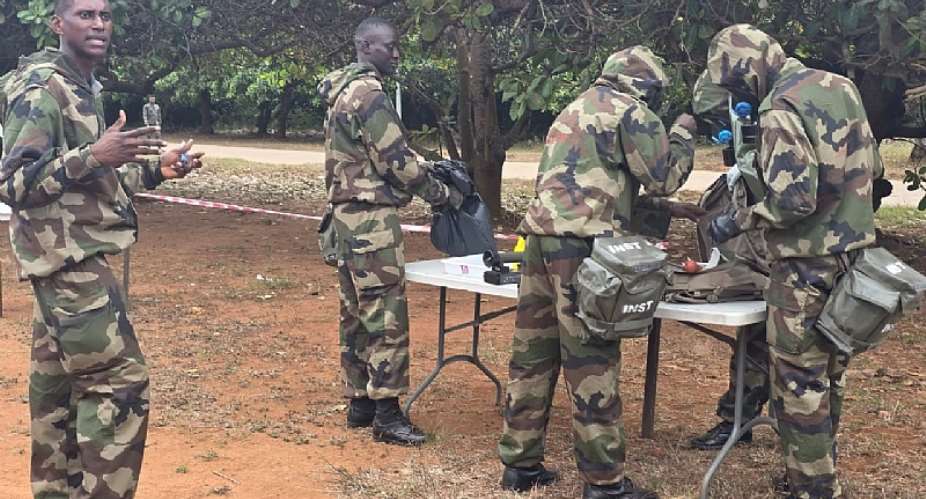
On Monday, 14 September 2026, twenty soldiers from the 851st Explosive Ordnance Disposal Regiment sat down at Michel Camp in Tema for a two-week course in a field once seen as remote from Ghana's security concerns: defence against chemical, biological, radiological and nuclear (CBRN) hazards.
The Intermediate CBRN Course is run by the Ghana Army School of Ammunition and Explosives (GASAE) with the French Armed Forces.
Two instructors from France's 2nd Dragoon Regiment, the French Army's specialised CBRN unit, are delivering the training. It builds on a basic course held from 26 January to 6 February 2026.
Two modules, two kinds of threat
The curriculum has two pillars. The "Green" module deals with CBRN threats in armed conflict and is aimed at EOD personnel, covering reaction to an attack, securing chemical munitions, and reconnaissance.
The "Blue" module deals with technological and industrial risks and targets engineering units likely to be first responders. It covers detection and identification, preparing site dossiers, and commanding an incident.
The organisers say the logic is simple: the faster a hazard is recognised and characterised, the safer the response. Scenario-based exercises are meant to test that under realistic conditions.
Why now
The organisers point to four trends: hazardous materials moving through Ghana's transport networks, denser cities where an incident reaches more people faster, growing industrial use of chemicals, and the spread of radioactive sources in medicine, industry and research. Such incidents, they note, may be accidental or deliberate.
Col. Grégoire Madelin, the French Defence Attaché, said a robust CBRN response has become essential and called the trained personnel "the real key to long-term resilience."
Sovereignty is the message
Lt. Col. Frank Tetteh-Kumah, Acting Commander of GASAE, described the course as a step towards the "sustainable CBRN capability" the Military High Command wants.
Organisers stressed that the aim is lasting capacity rather than a short-term funded response, and that cooperation must not become dependence.
That language matters. France has spent recent years pulling its soldiers out of Mali, Burkina Faso and Niger after coups brought in leaders hostile to its presence, and Chad ended its defence pact while Senegal and Côte d'Ivoire announced French forces would leave.
Ghana, by contrast, has kept its partnership, and France remains one of its key defence partners, with close collaboration on training and regional security. Accra is clearly keen to present this course as skills transfer rather than reliance.
Unanswered questions
First, scale. Twenty trainees is a start, but a national capability needs far more people. The "next steps," including train-the-trainer sessions and joint exercises, are still "to be confirmed."
Second, coordination. The organisers say CBRN is not solely a military matter and requires an inter-ministerial chain spanning Health, Environment, Interior, customs and civil protection.
Yet no civilian agency is named among the partners. A well-trained army team is of limited use if it cannot plug into civilian emergency, health and regulatory structures.
Third, sustainability. Equipment, maintenance and laboratory support cost money, and no figures or timelines for French support have been disclosed.
The bottom line
Ghana is right to invest in people before hardware. The test will be whether this course becomes a pipeline of Ghanaian instructors, integrated with civilian agencies and regularly exercised, or remains a one-off event. A procedure never practised, as the organisers warn, remains theoretical in a real crisis.
Mustapha Bature Sallama
Medical/ Science Communicator,
Private Investigator, Criminal Investigation and Intelligence Analysis,
International Conflict Management and Peacebuilding. (USIP)
[email protected]
+233555275880
Sources
Ghana Armed Forces and Embassy of France in Ghana, Press Kit: Building a Sustainable CBRN Capability Intermediate CBRN Course, Michel Camp, Tema, September 2026.
"France distances itself from West Africa's insecurity," Legalbrief Africa (legalbrief.co.za).
"Côte d'Ivoire says French troops to leave West African nation," Graphic Online (graphic.com.gh).
"Ghana, France deepen defence and security ties," Citi Newsroom, July 2026 (citinewsroom.com).


 Those behind EOCO ‘abuses’ will be held accountable – Sammi Awuku
 Raymond Archer should have been sacked by now – Kwadaso MP on EOCO-Baffuor Awuah...
 September 24: Cedi sells at GHS12.20 on forex market, GHS11.60 on BoG interbank
 'GMA is monitoring Ghana's marine space blindly’ – Miracles Aboagye
 Alagumgube welcomes Gurene as BECE subject, calls for more teachers and learning...
 Mahama calls for return of Africa’s cultural heritage at UNGA 81 side event
 ECOWAS directors meet in Lagos to align 2027–2029 expenditure plans
 Lordina Mahama urges African leaders to build stronger healthcare systems for wo...
 Speaker Bagbin summons Parliament for September 29 sitting
 Kwesi Pratt warns against abuse of free expression amid Ghana Jollof controversy


