




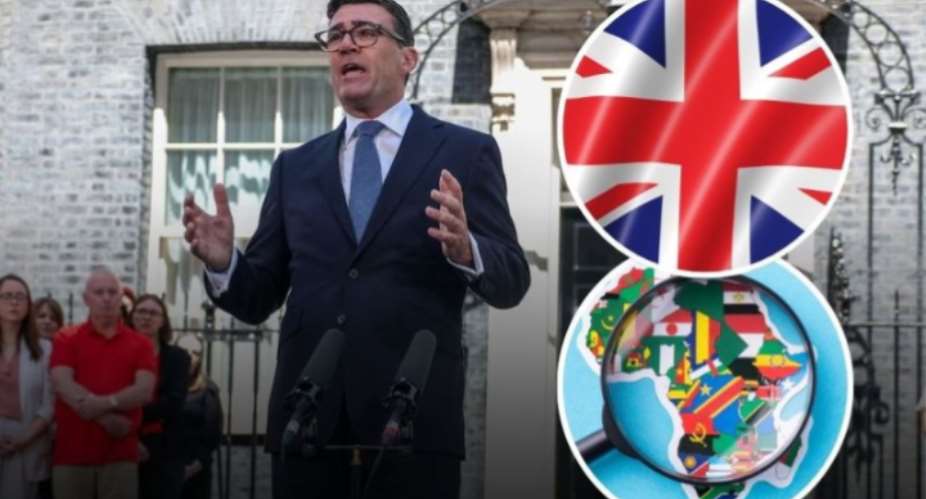
Teachers trained in Ghana and Nigeria can no longer use England's direct application route for Qualified Teacher Status (QTS) since 9 September 2026, and India was removed too. Ghanaian teachers, many of whom see England as a career escape route, have lost a fast track. Whether that slows the flow of educators leaving the country is a different question.
What changed, and why
The UK Department for Education says eligible countries must have a national regulator able to confirm a teacher's professional standing, and must supply references that meet UK verification standards. One report says more than 70 percent of Ghanaian and Nigerian applications used public email addresses for references.
That claim comes from a single outlet and I could not verify it independently. The screenshot circulating on social media points to the same problem, citing Gmail and Hotmail addresses in place of official ones.
The numbers were already discouraging. In 2024/25, Ghana recorded 1,067 QTS applications, of which 196 were approved and 749 declined. By comparison, more than 2,300 Ghanaian teachers were granted QTS between February 2023 and March 2024, the highest of any country. The periods differ, but the direction is plain: the route was already narrowing before it was closed.
Not a ban
The DfE says Ghanaian and Nigerian teachers can still pursue England through assessment-only QTS, International QTS (iQTS) or teacher training in England, subject to eligibility.
QTS itself does not guarantee a job or a visa. The viral post also notes that qualified overseas teachers can work in England for up to four years without QTS. The door is narrower, not shut.
Why the drain will not stop
The reasons Ghanaian teachers leave sit at home. In October 2023, NAGRAT reported that as many as 10,000 teachers had left for developed countries, and a survey found eight in ten trained teachers would migrate if given the chance.
Commentators cite pay, working conditions and the appeal of professional growth abroad, and teacher recruitment in Ghana has not kept pace with enrolment growth since free senior high school began in 2017.
Those pressures are unchanged. A teacher who wanted to leave last month still does. The likelier effects are:
Rerouting. Teachers may turn to the alternative UK routes, or to Canada, the US and the Gulf, which already recruit Ghanaian educators.
Slower, costlier exits. Longer pathways and fees may deter some, especially early-career teachers.
More exposure to exploitation. Whenever official routes tighten, agents selling "guaranteed" placements tend to multiply.
Teachers should check any recruiter carefully.
The real lesson is about credibility
The stated reason for the removal is not salaries or politics. It is that Ghana's professional records could not be reliably verified. That is a governance failure Ghana can fix.
Public institutions should issue references from official domains, and the national teaching regulator should run a credible verification process. The Ghana Teaching Council and the Ghana Education Service are the obvious bodies to lead.
Fixing this would protect honest applicants and could help Ghana win back eligibility, though the DfE has not said it would restore it.
What Accra should do
Policymakers should resist treating the UK's decision as a windfall. A rule change does not keep teachers in classrooms, particularly in rural and deprived districts where shortages bite hardest.
Better allowances for hardship postings, faster promotion and posting processes, and bonding or service-linked incentives for subsidised training would address the causes. Ghana could also press for managed recruitment agreements that include training support, rather than one-way poaching.
The bottom line
The UK has closed one door. The pull of higher pay and better conditions abroad remains, and teachers will find other doors. Ghana should use this moment to repair its verification systems and give teachers reasons to stay.
Mustapha Bature Sallama
Medical/ Science Communicator,
Private Investigator, Criminal Investigation and Intelligence Analysis,
International Conflict Management and Peacebuilding. (USIP)
[email protected]
+233555275880
Sources
allAfrica, "Ghana: UK Drops Nigeria, Ghana From Qualified Teacher Status" (allafrica.com)
Leadership Nigeria, "UK QTS: Full List Of Countries Whose Teachers Can Apply" (leadership.ng)
Pulse Ghana, "UK Removes Nigeria, Ghana and India from Direct QTS Route" (pulse.com.gh)
The News Chronicle, "UK Removes Nigeria, Ghana, India From Direct QTS Application Route" (thenews-chronicle.com)
Streamlinefeed, "UK excludes Nigerian and Ghanaian-trained teachers from QTS eligibility route" (streamlinefeed.co.ke)
Education International, "Tackling the teacher shortage crisis in the Commonwealth" (ei-ie.org), March 2025
Business Insider Africa post (LinkedIn screenshot)


 Those behind EOCO ‘abuses’ will be held accountable – Sammi Awuku
 Raymond Archer should have been sacked by now – Kwadaso MP on EOCO-Baffuor Awuah...
 September 24: Cedi sells at GHS12.20 on forex market, GHS11.60 on BoG interbank
 'GMA is monitoring Ghana's marine space blindly’ – Miracles Aboagye
 Alagumgube welcomes Gurene as BECE subject, calls for more teachers and learning...
 Mahama calls for return of Africa’s cultural heritage at UNGA 81 side event
 ECOWAS directors meet in Lagos to align 2027–2029 expenditure plans
 Lordina Mahama urges African leaders to build stronger healthcare systems for wo...
 Speaker Bagbin summons Parliament for September 29 sitting
 Kwesi Pratt warns against abuse of free expression amid Ghana Jollof controversy


