




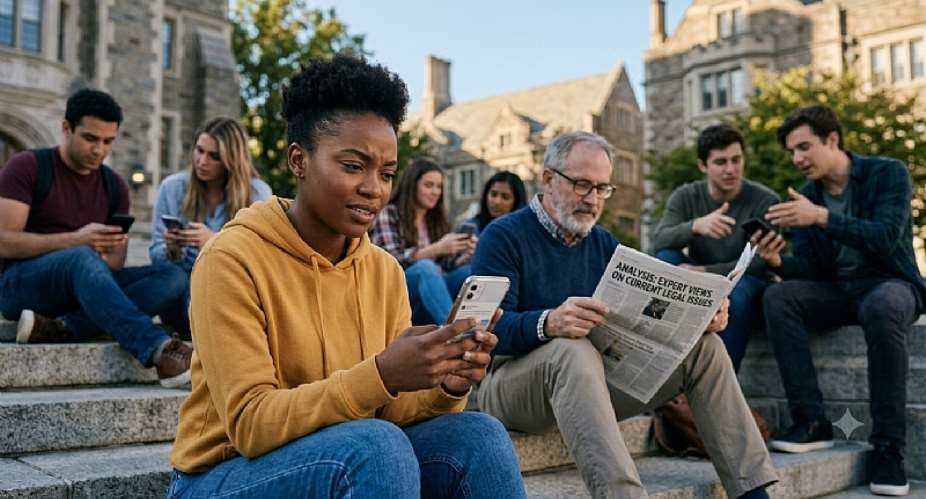
In today’s digital hyper-connected ecosystem, information travels at the speed of a single click. Social media platforms which were intended primarily for social connection, have transformed into primary news outlets and public debate fora for millions of citizens. However, this democratic distribution of speech carries a significant vulnerability, including the rise of the sensationalist, non-expert blogger. Driven by metrics, engagement algorithms, and the urge to break news first, social media commentators frequently publish oversimplified, reactionary, or fundamentally flawed takes on highly complex matters. To safeguard public understanding and democratic integrity, social media users must learn to look past self-appointed commentators and consult genuine subject-matter experts, especially on intricate constitutional and legal issues.
The danger of taking uninformed bloggers seriously lies in the inherent conflict between media engagement and specialized analysis. A blogger’s business model thrives on quick engagement, outrage, and absolute clarity—even when the underlying reality is nuanced or ambiguous. Legal, financial, and medical governance systems operate under strict, layered regulations that cannot be accurately digested in a viral headline or a snappy tweet. When commentators attempt to interpret complex statutes without background or context, they do not merely share an opinion; they actively disseminate misinformation that distorts public perception of justice and institutional integrity.
A striking case study highlighting this vulnerability occurred during the high-profile situation involving Hon. Agyei Baffour following a High Court sitting on September 23, 2026. Shortly after proceedings concluded, news surfaced regarding an attempted arrest by law enforcement officers from the Economic Organiser Crime Office (EOCO). Seeking to manage public narrative and explain their conduct, the Public Affairs Directorate of the (EOCO) promptly released an official press statement justifying their position and the legitimacy of their actions.
Within minutes, non-expert bloggers and social media accounts boasting massive followings began amplifying the official press release. Operating under the flawed assumption that an official statement automatically constitutes the "final truth," these influencers broadcasted EOCO’s justification as an indisputable fact. To an untrained reader relying solely on popular commentary feeds, the legal matter appeared straightforward, settled, and completely justified.
However, qualified legal practitioners and legal analysts who weighed in on social media painted a radically different picture. Lawyers active across digital platforms immediately analyzed the development through the rigorous framework of constitutional provisions, judicial precedents, statutory limitations, and procedural compliance. They challenged the popular commentary, raising fundamental legal inquiries regarding whether due process had been respected, whether the arrest attempt respected courtroom privilege or court boundaries, and whether the timing violated established procedural protocols.
Where bloggers saw a settled headline, legal experts saw statutory nuances and constitutional principles. The legal community demonstrated that an administrative press statement is merely an institutional argument—a legal stance subject to courtroom scrutiny rather than absolute law. The intervention of these legal experts served as a crucial check on official narrative enforcement, providing the public with a far richer, legally sound understanding of what actually transpired.
This incident offers a clear lesson for every consumer of digital news: verified expertise cannot be replaced by follower counts or fast updates. An influencer with hundreds of thousands of followers might possess immense viral reach, but that reach grants them zero legal acumen or subject-matter competency. Expecting a commentary blogger to break down complex court procedures or statutory interpretations is akin to seeking medical diagnosis from a sports commentator; both rely on speculation rather than training.
To foster an informed citizenry, social media users must adjust their media consumption habits:
Identify and follow accredited professionals: When major statutory, constitutional, or institutional news breaks, seek out lawyers, legal scholars, and recognized legal practitioners who are active on social media. Their analyses are anchored in institutional knowledge and analytical discipline.
Distinguish commentary from authority: Recognize that official press releases represent a party's legal position rather than neutral facts. Experts help unpack these releases critically rather than taking them at face value.
Mute sensationalist echo chambers: Avoid sharing or relying on break-neck legal takes published by generalist blogs lacking professional credentials.
In an era saturated with immediate narrative-spinning, truth requires patience and specialized insight. By elevating verified experts over uninformed bloggers, social media users can protect themselves from misinformation and participate meaningfully in the public discourse.
The author is a regular contributor to News Commentary, a current affairs programme by the GBC, and columnist with Modern Ghana, an esteemed online news portal.

 Expired driver’s licence attracts delinquency charge of up to GH¢148 – DVLA
 Ghana needs an enterprise economy with African characteristics, not copying othe...
 Court reinstates Bolgatanga Technical University Vice-Chancellor Alnaa, two seni...
 Christian Council demands action against financiers behind drug trafficking
 'Facts don’t support Ghana being a cocaine hub under Mahama's gov't’ – Majority ...
 NACOC arrests surged from 73 in 2024 to 217 in 2025 under NDC – Majority defend ...
 Gov’t drug strategy now targets criminal networks – Agalga
 Akufo-Addo's govt reckless borrowing, not Russia-Ukraine war, caused post-2020 e...
 Rising drug busts due to concrete institutional changes by NDC govt – Majority
 'This is not one man job' — Majority calls for stronger inter-agency cooperation...


