




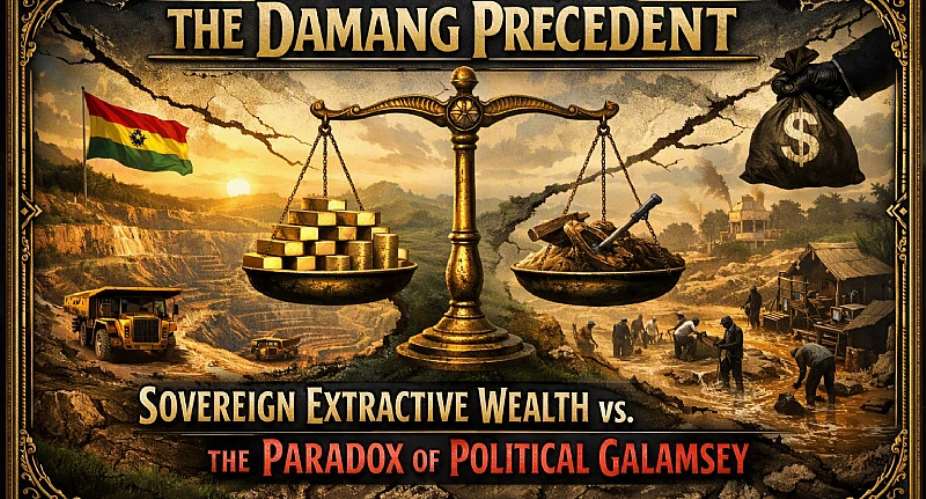
For nearly a quarter of a century, Ghana’s resource architecture operated under a subservient blueprint of neo-colonial concession: foreign capital extracted our gold, while the sovereign state quietly resigned itself to a token 10% carried interest. That paradigm collapsed in spectacular fashion on April 18, 2026. By refusing to grant an automatic lease renewal to the South African multinational Gold Fields, the state sent shockwaves through global boardrooms, reclaiming the historic Damang Gold Mine and transferring its operations to Engineers & Planners Limited (E&P).
This was no backroom handshake; it was a high-stakes, technically rigorous competitive tender where E&P outclassed international rivals by posting a 93.15% technical score and securing $505 million in independent financing. Yet, this triumph of resource nationalism unfolds alongside a deeply polarizing paradox. At the exact moment that indigenous heavy industry claims its seat at the table, the nation is convulsed by a relentless galamsey crisis—epitomized by the historic 20-year prison sentence handed down to the ruling New Patriotic Party's (NPP) Ashanti Regional Chairman, Bernard Antwi Boasiako (Wontumi), for environmental devastation disguised as "coconut farming."
Ghana stands at a critical crossroads. The Damang precedent proves we possess the domestic capacity to run billions in mineral wealth. But as political elites treat our river bodies as personal mining playgrounds, we must confront a harsh truth: resource nationalism without unwavering institutional discipline is merely an exchange of foreign exploiters for domestic oligarchs.
The Financial Weaponization of Domestic Reserves
The E&P takeover of Damang is not merely a symbolic victory; it is a structural macroeconomic offensive. In a historic intervention to stabilize Ghana’s volatile currency, E&P’s newly established Damang Gold Mine Limited systematically routed 100% of its initial gold output—including a single milestone delivery of 121 kilograms—directly to the Ghana Gold Board and the Bank of Ghana (BoG).
The financial ramifications of this shift are profoundly disruptive:
- Dismantling the Capital Flight Pipeline: Under decades of foreign multinational control, the vast majority of gold export revenues were instantly repatriated to Johannesburg, London, and New York, starving Ghana's domestic financial ecosystem. By localizing the entire revenue value chain, E&P retains millions in foreign exchange liquidity directly within Ghanaian banks.
- Fortifying the Cedi via the Gold Purchase Programme: The continuous injection of pure, domestic physical gold into the Bank of Ghana’s central reserves serves as an immediate, asset-backed shield against inflation. It gives the central bank unprecedented leverage to aggressively defend the value of the Ghana Cedi without exhausting depleting liquid dollar reserves.
- A Public Mandate for Corporate Emulation: The strategic action by E&P has exposed the meager reserve contributions historically tolerated from other multinational miners. It establishes a baseline metric: if a domestic firm can willingly dedicate 100% of its mineral output to shore up state reserves, the state has no excuse but to aggressively rewrite its fiscal treaties with every foreign entity operating on Ghanaian soil.
The Galamsey Crisis: A Duel of Rhetoric and Policy
While Damang showcases the clean, corporate summit of indigenous mining, the unregulated abyss of galamsey remains a battleground of political survival. The policy stances of Ghana's political titans reveal sharply contrasting remedies to this existential crisis.
Dr. Mahamudu Bawumia: The Technocratic, Market-Driven Defense
The NPP flagbearer, Dr. Mahamudu Bawumia, has carefully decoupled small-scale mining livelihoods from pure environmental criminality, attempting to offer a technocratic lifeline to an industry that employs millions. According to the NPP’s official platform and statements from the national communication directorate:
"He is not against small-scale mining. He is against illegal mining that affects water bodies, and that affects our preserved forest range."
Bawumia’s blueprint targets the root causes through technical formalization:
- Mineral Mapping Over Trial-and-Error: A commitment to allocate $10 million annually to the Geological Survey Authority to map out precise mineral veins, eliminating the blind, destructive digging that currently strips topsoil across the country.
- Eco-Friendly Inventions: The widespread deployment of mercury-free gold catcher machines to permanently purge toxic processing chemicals from the local agricultural supply chain.
- Monetary Inclusivity: The formal expansion of the Bank of Ghana’s Gold Purchase Programme to purchase directly from verified, eco-compliant community mining schemes, pulling illegal operators into the formal economy.
John Dramani Mahama: The Iron-Fisted, ESG Regulatory Clampdown
Conversely, President John Dramani Mahama treats galamsey as a severe national security emergency driven by state complicity and financial cartels. In his hard-hitting 2026 State of the Nation Address (SONA), Mahama explicitly vowed to tear down the political shields protecting these networks:
"The indiscriminate environmental degradation, water pollution, and displacement of communities resulting from illegal mining will no longer be tolerated... our administration will now prioritise tracing and prosecuting the financial backers who fuel galamsey activities."
Mahama’s strategy relies heavily on aggressive, state-enforced Environmental, Social, and Governance (ESG) mandates:
- Border Permitting for Heavy Machinery: Changing the import regime to guarantee that no excavator enters the country without prior authorization, paired with a mandatory, real-time satellite tracking system to monitor heavy machinery movement.
- Dismantling the Judicial Bottleneck: Pushing aggressive prosecutions through the state legal apparatus, tracking over 114 active galamsey case dockets simultaneously to ensure high-ranking financiers face immediate incarceration.
- Strict Rehabilitation Clauses: Legally binding small-to-medium-scale licenses to immediate, verifiable land reclamation bonds, stripping licenses from operators who leave open pits behind.
The Road to Extractive Integrity: Key Recommendations
To capitalize on the historic milestone at Damang while systematically crushing the lawlessness exposed by the Chairman Wontumi conviction, Ghana must immediately implement the following structural policies:
- Enforce Open, Irrevocable Competitive Tenders: While E&P legitimately won the Damang concession with a stellar 93.15% technical evaluation, future state reassignments must completely ban single-source discretion. Open public bidding removes the taint of political favoritism, secures institutional legitimacy, and ensures continuity across changes in government.
- Establish a Sovereign Gold Retention Quota: The Ministry of Finance must transition from a passive buyer to a strict regulator. Ghana should legislate a mandatory Gold Retention Quota, forcing all large-scale corporate miners—domestic and multinational alike—to sell a minimum percentage of their physical gold directly to the Bank of Ghana to continuously defend the domestic economy.
- De-politise the Judiciary in Environmental Crimes: The 20-year sentence handed to Antwi Boasiako must not be an isolated, selective example. The Attorney General’s office must aggressively prosecute any individual assigning mineral rights without explicit ministerial approval, totally ignoring party flags, royal titles, or corporate structures.
- Mandate Digital Escrow Bonds for Land Reclamation: The state must completely outlaw verbal "farming agreements" on active concessions. Every mining application must be legally bound to an upfront financial bond held in a digital escrow account by the Minerals Commission, to be deployed for scientific land reclamation the moment an extraction phase concludes.
- Institutionalise Decentralized Accountability Frameworks: Mirroring the structural shifts observed in recent regional political reorganizations, mining oversight must be heavily decentralized. Empowering local youth committees, independent professional bodies, and localized forestry guards shifts the watchdog model away from compromised, centralized ministries directly into the hands of the host communities who suffer the immediate costs of environmental degradation.
Editorial Conclusion
The historic transition of the Damang Gold Mine stands as definitive proof that Ghanaian capital, technology, and engineering can manage our sovereign natural wealth far better than any foreign conglomerate. Yet, this new era of economic sovereignty cannot survive if the rule of law is sacrificed to political networks.
✍️ Submitted by:
Retired Senior Citizen
For and on behalf of all Senior Citizens of the Republic of Ghana 🇬🇭
Teshie-Nungua
[email protected]


 Expired driver’s licence attracts delinquency charge of up to GH¢148 – DVLA
 Ghana needs an enterprise economy with African characteristics, not copying othe...
 Court reinstates Bolgatanga Technical University Vice-Chancellor Alnaa, two seni...
 Christian Council demands action against financiers behind drug trafficking
 'Facts don’t support Ghana being a cocaine hub under Mahama's gov't’ – Majority ...
 NACOC arrests surged from 73 in 2024 to 217 in 2025 under NDC – Majority defend ...
 Gov’t drug strategy now targets criminal networks – Agalga
 Akufo-Addo's govt reckless borrowing, not Russia-Ukraine war, caused post-2020 e...
 Rising drug busts due to concrete institutional changes by NDC govt – Majority
 'This is not one man job' — Majority calls for stronger inter-agency cooperation...


