




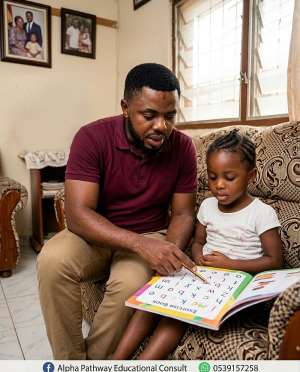
There is something about homework that we rarely question anymore.
A child comes home from school with an exercise book, and the immediate assumption is that homework must be a good thing. After all, the more children practise, the better they should become.
But I think we need to look more carefully at what we give children to do at home, especially at the primary level.
Homework should have a clear purpose. It should mainly help learners revise, practise and reinforce what they have already learnt in school. It should not simply be another way of extending the school day.
If a teacher teaches fractions today, for example, the homework should give the child an opportunity to practise fractions. The teacher should be able to direct the learner to the relevant topic, textbook page, recently written note or class activity.
Even better, the first question should be worked through with the children in class. That gives them a clear example of what they are expected to do when they get home.
After that, the child should be able to attempt the rest with a reasonable level of independence.
Who is the homework really for?
This is where I think we need to be honest with ourselves.
If a child gets home and the parent has to spend an hour explaining almost every question, finding YouTube videos, calling another parent or searching the internet for answers, then perhaps we should pause and ask whether the homework has been properly designed.
Is the homework for the child, or have we quietly given the parent an assignment?
There is nothing wrong with parents supporting their children. Parents should know what their children are learning and encourage them to take their schoolwork seriously.
But there is a difference between supporting a child and reteaching an entire lesson every evening.
When homework consistently requires substantial adult intervention, it can defeat one of its most important purposes: helping children become independent learners.
A child should gradually develop the confidence to read instructions, look through their notes, remember what was taught in class and attempt a task without someone constantly standing over them.
That independence matters beyond homework. It is part of learning itself.
Not everything needs to become homework
I also think we need to reconsider how much formal homework we give to children in nursery and kindergarten.
Do four-year-olds really need to return home every afternoon with several pages of academic exercises?
At that age, children can learn through play, storytelling, drawing, singing, conversation, reading with an adult, counting everyday objects, identifying things around the house and helping with simple activities.
A child arranging objects by size is learning.
A child listening to a story and answering questions is learning.
A child helping a parent count items at home is learning.
A child drawing and explaining what they have drawn is learning.
Learning does not always have to come in the form of a worksheet.
This is not an argument against introducing young children to early literacy and numeracy. Those foundations are important. The question is whether formal homework is always the best way to reinforce them.
Then we add extra classes
The homework conversation becomes even more interesting when we consider the growing dependence on extra classes.
A child may spend the better part of the day at school, leave the classroom and immediately go for another lesson. By the time the child gets home, there may still be homework waiting.
Then dinner. Then preparation for the next school day. Then sleep.
We sometimes forget that children need time to simply exist outside academic work.
They need to play. They need to talk to their parents. They need to interact with siblings. They need to rest. They need to be curious about things that have nothing to do with a textbook.
Some children genuinely need extra academic support, and extra classes can be useful in such cases. A learner who is struggling with reading, mathematics or another subject may benefit from additional instruction.
But should extra classes automatically become part of every child's daily routine?
I am not convinced.
There is a popular argument among parents: "If I don't send my child for extra classes, other children will overtake them."
But what exactly does "overtake" mean?
Are we talking about genuine understanding, confidence and the ability to apply knowledge? Or are we simply talking about who has spent more hours sitting with a book?
More hours of academic work do not automatically translate into better learning.
Sometimes a child does not need another two hours of teaching. The child needs to understand the lesson properly, practise it appropriately and get enough rest to be ready to learn again the following day.
The pressure to always be doing something
Perhaps part of the problem is our perception of productivity.
We often feel that if children are sitting with books, they must be learning. If they have homework, extra classes and several exercise books filled with work, then the school must be doing a good job.
But education cannot simply be measured by the volume of work we give children.
A child can complete ten pages without understanding what they are doing.
Another child can complete three well-designed questions and demonstrate a much deeper understanding of the lesson.
The quality of the learning task matters.
The same applies to homework. A short assignment that directly reinforces a lesson may be more useful than a long assignment that leaves the child exhausted and dependent on an adult.
What should good homework look like?
For me, good primary-level homework should be connected to recent classroom learning.
The instructions should be clear. The learner should know where to find the information needed to complete the task. The work should be appropriate for the child's age and ability. And, most importantly, the child should have a reasonable chance of completing it independently.
Teachers can help by making the connection between the classroom and the home very clear.
Instead of simply writing "Do questions 1 to 20," a teacher could direct learners to the specific topic or page they need to revise. If a particular class activity was used to teach the concept, that activity can serve as a reminder.
The first question can also be done together in class.
That small step can make a significant difference because the child leaves school knowing what to do rather than taking home a problem they have never been shown how to solve.
Parents also need some breathing space
There is another side to this conversation that is often ignored.
Parents are busy too.
Many parents return from work tired and still have household responsibilities to deal with. When their child's homework requires them to become a teacher every evening, it can create unnecessary pressure in the home.
And sometimes the child becomes frustrated because the parent is explaining the work differently from how the teacher taught it.
Then the parent gets frustrated because the child does not understand.
Eventually, what was supposed to be revision becomes a nightly battle.
That cannot be what we want homework to achieve.
Schools and parents should work together, but that partnership should not mean transferring the responsibility for teaching lessons from the classroom to the dining table.
The question we should be asking
None of this means children should never receive homework.
Homework has its place.
Extra support also has its place.
The issue is balance and purpose.
Before giving children another assignment, perhaps we should ask: What exactly is this work helping the child to do?
Is it helping them remember something they learnt?
Is it giving them useful practice?
Is it helping them develop independence?
Is it appropriate for their age?
Can they reasonably complete it without an adult reteaching the lesson?
And perhaps, when we recommend another two hours of extra classes after a full school day, we should ask a similar question.
Will these extra hours genuinely improve the child's learning, or are we simply uncomfortable with the idea of a child not studying?
Children need education, but they also need childhood.
They need teachers who teach well, parents who support them and schools that understand that more work is not always better work.
Perhaps our goal should not be to keep children academically occupied from morning until night.
Perhaps our goal should be to help them become capable, curious and independent learners who know how to learn even when nobody is sitting beside them.
That is a very different measure of educational success.
About the Author
Alpha Osei Amoako is an educational leader, school administrator and educational columnist based in Accra, Ghana. He writes regularly on education, society and public affairs on ModernGhana.com, one of Ghana’s leading platforms for commentary and analysis. He is also the head of Alpha Pathways Educational Consult, an educational consultancy in Ghana, where he provides support and professional services in education, school leadership and management.
Email: [email protected]
WhatsApp: 0539157258


 Expired driver’s licence attracts delinquency charge of up to GH¢148 – DVLA
 Ghana needs an enterprise economy with African characteristics, not copying othe...
 Court reinstates Bolgatanga Technical University Vice-Chancellor Alnaa, two seni...
 Christian Council demands action against financiers behind drug trafficking
 'Facts don’t support Ghana being a cocaine hub under Mahama's gov't’ – Majority ...
 NACOC arrests surged from 73 in 2024 to 217 in 2025 under NDC – Majority defend ...
 Gov’t drug strategy now targets criminal networks – Agalga
 Akufo-Addo's govt reckless borrowing, not Russia-Ukraine war, caused post-2020 e...
 Rising drug busts due to concrete institutional changes by NDC govt – Majority
 'This is not one man job' — Majority calls for stronger inter-agency cooperation...


