




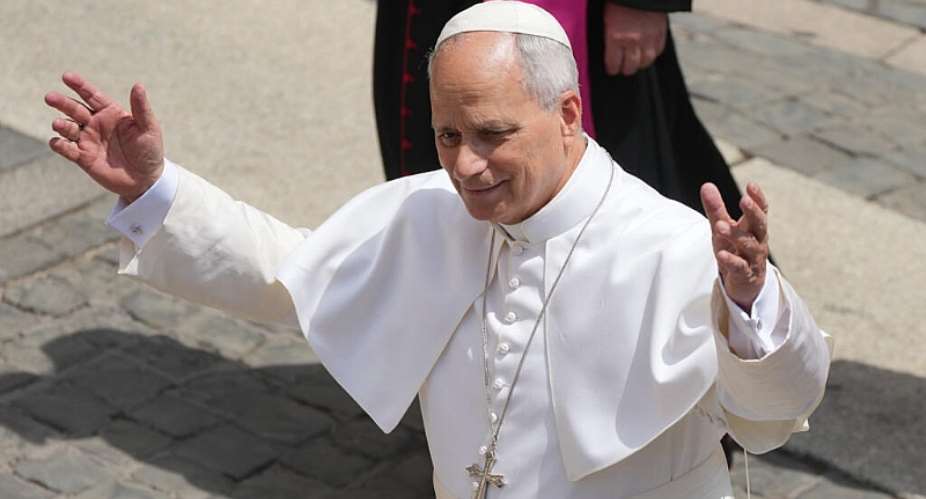
Pope Leo XIV's four-day visit to France from Friday will put one of the country's oldest tensions back in the spotlight – how a nation shaped for centuries by Catholicism reconciles that heritage with one of Europe's strictest models of secularism.
The Pope's programme includes large public gatherings, processions and an open-air Mass in central Paris, all taking place in a country whose constitution defines France as an “indivisible, secular, democratic and social Republic”.
This principle is known as laïcité – a form of secularism that guarantees freedom of belief, while requiring the state and public institutions to remain neutral towards religion.
Religion is not excluded from public life and people in France remain free to practise their faith. Religious organisations can hold public events, provided they respect the same rules governing public order as everyone else.
During his visit, Pope Leo will travel to Paris, Saint-Denis, Lourdes and Metz. President Emmanuel Macron will receive him at the Élysée Palace on Friday in Leo's capacity as the head of Vatican City – an encounter between two heads of state, rather than a religious ceremony.
But Pope Leo's visit will highlight the delicate balance between France's secular institutions and its longstanding Catholic cultural inheritance.
Pope Leo in France: the key issues on the table
Catholic past, secular Republic
The foundations of the modern secular system were laid by the landmark 1905 law separating the Church and the state.
Adopted following decades of conflict between the Republic and the Catholic Church, the law guarantees freedom of conscience and religious practice, while ending formal state recognition and financing of religion. Its legacy remains visible across France.
Many Catholic churches built before 1905 belong to municipalities or the state, meaning public money can be used to maintain the buildings even though they continue to serve as places of worship. However, the majority of religious buildings constructed since then – including most mosques – are financed and maintained by religious organisations.
France has also become markedly less religious as a society. A national survey carried out in 2019 and 2020 found that 51 percent of people aged 18 to 59 in metropolitan France said they had no religious affiliation. Catholicism remained the largest religious affiliation at 29 percent, followed by Islam at 10 percent.
Nonetheless, Catholic traditions, architecture and institutions remain woven into French public life – from the Romanesque churches and Gothic cathedrals that dominate many towns and cities, to private Catholic schools and public holidays rooted in the Christian calendar.
Abuse survivors set out demands before meeting Pope Leo in France
Public faith, state neutrality
Saturday's programme for the pope's visit includes a large open-air Mass at Paris's Place de la Concorde, with crowds expected along the Champs-Élysées.
The setting – more commonly associated with Bastille Day parades and state ceremonies – will give this Catholic event high visibility in the heart of the capital.
Under French law, allowing a religious gathering in a public space does not amount to state endorsement, provided the authorities remain neutral.
In 2008, Pope Benedict XVI celebrated Mass before around 260,000 people at Les Invalides in the French capital, while in 2023 Macron attended Pope Francis's Mass in Marseille, emphasising that he was present as the head of state rather than as a worshipper.
There is one notable exception to mainland France's secular framework. In Alsace-Moselle, the region home to the city of Metz, a visit to which is on Leo's agenda, the 1905 law separating church and state does not apply – because the region was under German rule when the legislation was adopted.
A separate local system still allows several recognised religions a formal status, with some clergy's salaries paid by the state and religious instruction provided in schools.
(with newswires)

 Claim I have ignored EOCO's invitation is false – Manhyia South MP
 'This is a retrogression’ – Martin Kpebu condemns EOCO's attempted arrest of MP
 EOCO must follow lawful procedure in dealing with Baffour Awuah – Dafeamekpor
 8% transport fare hike is not justified – Kwame Owusu Danso
 We'll take action against two individuals who helped Manhyia South MP escape arr...
 'Baffuor Awuah ignored two invitations since February' – EOCO explains attempted...
 'EOCO wanted to abuse his rights' – Minority Leader on attempted arrest of Manhy...
 'I feared I was being kidnapped' – Manhyia South MP explains clash with EOCO off...
 Tension at Accra High Court as EOCO officials reportedly attempt to arrest Manhy...
 Gender Ministry commiserates with family of child killed in Cantonments fire


