





The Ghana National Fire Service (GNFS) has called on Ghanaians to take collective responsibility for preventing bushfires in their communities, farms and forest reserves ahead of the 2026/2027 bushfire season.
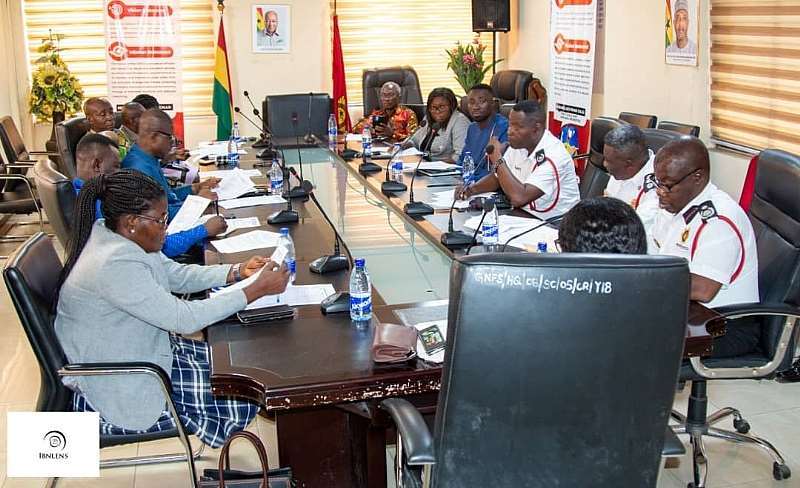
The National Bushfire Prevention Campaign Stakeholders Planning Committee of the GNFS said bushfire prevention was a national responsibility that required the involvement of every Ghanaian, regardless of profession, location or social status.
“Let us all get involved in bushfire prevention in our communities, our forests, our farms, and across the country,” the committee stated on Tuesday.
Speaking during a public discussion on Fire TV, a member of the committee, Mr Francis Ameyibor, appealed for logistical support to enable the Service to effectively implement the 2026/2027 National Bushfire Prevention Campaign.
The campaign will officially be launched on Friday, September 25, 2026, at Atebubu in the Bono East Region, under the theme, “Bushfire Prevention: A Collective Action for Sustainable Environmental Development and a Greener Ghana.”
Mr Ameyibor said the GNFS required Personal Protective Equipment and other operational resources to support firefighters and Community Fire Volunteers during the campaign.
“We are appealing for support in the form of Personal Protective Equipment, Wellington boots, combat and safety boots, fire-resistant overalls, nose guards, face masks, respirators, hand gloves, and safety helmets.
“Other needs are firefighting tools such as modern fire beaters, cutlasses, slashers, rakes, shovels, and backpack sprayers, as well as operational logistics including motorbikes for rapid patrols, bicycles for community volunteers, torchlights, megaphones, whistles, and first aid kits,” Mr Ameyibor stated.
According to him, the support would help protect GNFS personnel and Community Fire Volunteers, expand patrols in fire-prone districts and facilitate the education of more than one million farmers and students.
He therefore appealed to the government, corporate institutions, development partners, non-governmental organisations, philanthropists and climate-conscious citizens to support the GNFS with the logistics required for bushfire prevention.
“Ghana loses thousands of hectares of farmlands, forest reserves, and properties to bushfires annually, a situation that accelerates climate change, destroys biodiversity, degrades soil fertility, and threatens food security,” he stated.
Mr Ameyibor said the peak of the 2026/2027 bushfire season, expected between November and March, required adequate preparations and resources.
“Our gallant fire officers and community fire volunteers are ready to sacrifice, but they lack the most basic protective and operational logistics to respond effectively. We cannot fight 21st-century climate-induced fires with bare hands,” he stated.
The campaign is expected to cover all 16 regions, districts and communities through activities including community durbars, school outreach programmes, radio sensitisation, fire belt creation and rapid-response patrols.
Prevention and community action
Deputy Chief Fire Officer (DCFO) Frederick Ohemeng, Director of Rural Fires, said the GNFS had developed modalities to bring state and non-state institutions as well as communities together to protect livelihoods, forests and the national economy from bushfires.
“With dry winds and low humidity set to sweep across Ghana in the coming weeks, bushfires are not seasonal accidents. They are a recurring economic and environmental crisis that threatens Ghana's food security, climate resilience, and rural livelihoods.
“GNFS data shows that each dry season, thousands of hectares of farmland, forest reserves, and wildlife habitats are destroyed by preventable fires,” the GNFS Director of Rural Fires explained.
DCFO Ohemeng said the dry season, characterised by low humidity, high temperatures and dusty harmattan winds, significantly increases the risk of bushfires across the country.
“The dry season, characterized by low humidity, high temperatures, and dusty harmattan winds, significantly increases the risk of bushfires across the country. But risk does not have to become disaster. Prevention is possible, and it starts with awareness and action,” he stressed.
ACFO II Edwin T. Nartey of Rural Fires said the decision to hold the national launch at Atebubu was strategic because the Bono East Region lies within Ghana’s transitional agro-ecological zone and serves as a critical food-producing area as well as a high-risk corridor for bushfires.
He said the choice of Atebubu was intended to send a strong national signal about the need for intensified bushfire prevention efforts.
According to him, the 2026 campaign represents a shift from ad hoc sensitisation activities to a structured and impact-driven national movement with measurable outcomes.
“GNFS aims to intensify education in high-risk districts while using the momentum to trigger simultaneous regional and district-level activations nationwide across all 16 regions,” ACFO Nartey said.
He said Community Fire Volunteers would be re-tooled and re-resourced to serve as first responders, with the campaign focusing on practical measures that could be owned and implemented by communities.
ACFO Nartey called for the early creation of fire belts and firebreaks around farms and forests, the adoption of safe land-clearing methods that do not involve fire, strict enforcement of the prohibition against indiscriminate burning and the establishment of rapid community reporting systems.
He also urged communities to work with the GNFS to establish early warning systems, adopt controlled burning practices where appropriate, enact and enforce anti-bushfire bylaws at the District Assembly level and intensify education among farmers, hunters, charcoal producers and herdsmen, whom he identified as major risk groups.
The Atebubu launch is expected to attract more than 3,000 participants, including the Minister of the Interior, the Bono East Regional Minister, the President of the Regional House of Chiefs, Members of Parliament, representatives of the Atebubu Traditional Council, farmers, students and security services.
Activities lined up for the launch include a high-level stakeholder dialogue, live firefighting equipment demonstrations, community durbars and a mass public education campaign.
The GNFS National Bushfire Prevention Campaign Stakeholders Planning Committee comprises representatives of state institutions, development partners and civil society organisations working on preparations for the national, regional and district-level implementation of the campaign.
Members include the Ministry of the Interior, Ministry of Local Government and Rural Development, Forestry Commission, National Insurance Commission (NIC), Ghana Cocoa Board (COCOBOD) and Communication for Development and Advocacy Consult (CDA Consult).
Other stakeholders are TROPENBOS Ghana, the National Disaster Management Organisation (NADMO), Ghana Meteorological Agency (GMet) and the Environmental Protection Agency (EPA).



 Transport fares increased 8% from September 26
 Golokuati residents call for operationalisation of abandoned ECG office
 Frank Danquah declared wanted over alleged narcotics offences
 Ghana TVET Service warns against collection of fees in TVET institutions
 16 arrested as National Security uncovers counterfeit currency printing syndicat...
 Work without fear or favour — Shamima Muslim urges broadcasters
 MFWA begins 5-day training for journalists from northern sector on media law and...
 A/R: Assemblyman for Nkwantakese Electoral area killed
 Kumasi: Roadside trader killed in tragic accident at Brewery Traffic Light in As...
 Law student petitions CHRAJ over alleged military killing of Gbewaa Training Col...


