




There is a particular cruelty reserved for the immigrant scholar. He can out-study, out-apply, and out-perform every native-born peer in the room, and still be undone by a stamp he does not control. This is the story of Melvin Osei Opoku, a 23-year-old Ghanaian biomedical engineer — and it is also, whether we like it or not, a story about the rest of us.
Melvin left Ghana on a scholarship to study biomedical engineering at the University of Florida, with a minor in electrical engineering. He did not coast through it. He went on to research internships at Princeton and MIT, and spent three years immersed in deep brain stimulation research — the unglamorous, exacting science of getting electricity to speak the language of the human brain. By any honest measure, that is a résumé built for the frontier of neurotechnology.
So when he applied to seventeen graduate programmes and secured an offer from Neuralink — Elon Musk's brain-computer interface company — it looked, for a moment, like the natural next chapter. It was not to be. The offer was withdrawn, reportedly because the company was unwilling to fund a visa for an international student. Whether that is the full story or the version that reached the public through a TikTok account, one thing is not in dispute: a young man with the technical grounding to work on some of the most advanced neurotechnology on earth was shown the door — not for lack of talent, but for lack of the right passport weight.
It gets crueler still. His own visa applications, we're told, were denied three times — not for a job this time, but simply so his family could watch him graduate. His mother could not sit in that hall. She watched her son cross the stage through a phone screen, and he could only reach her back the same way: through FaceTime, a mother's voice flattened into a speaker, a moment that should have been touch reduced to pixels.
Most people carry a wound like that quietly. Melvin built something out of his.
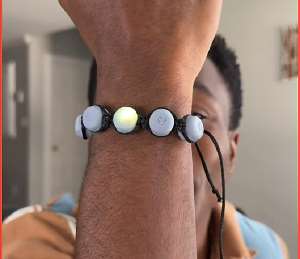
Fifty-four days after that graduation, he had a working prototype of what he now calls the Makoma bracelet — "Makoma," fittingly, being drawn from the Twi word for "my heart." It is a six-beaded wearable, each bead assigned to one person in the wearer's inner circle. Touch a bead, and you can send a pulse, a vibration, a small proof of life to someone you love. Hold it, and you can leave a voice note that arrives on their wrist, not buried in a notification feed. There is no need to check a screen to know your mother is thinking of you — you simply feel it. Press a bead in distress, and it can carry an emergency alert outward. And crucially, the design does not lock out the people who don't yet own one: someone without a bracelet can still send a voice message to a Makoma wearer from an ordinary phone.
It is worth being precise here, because Melvin's story deserves precision more than it deserves hype: the Makoma bracelet is not yet sitting on a shelf. It exists as working prototypes — two of them alive on early hand-built boards, with a small first batch now being assembled — moving toward pilot testing and, eventually, wider release. That is not a small thing. That is, in fact, exactly how every serious hardware company in the world begins: not with a factory, but with a prototype that works and a founder who refuses to let the story end at rejection.
And that is the part of this I want us to sit with, beyond the cleverness of the engineering. Look at what the bracelet actually encodes. It is Adinkra symbolism — Sankofa, Gye Nyame — pressed into circuitry. It is the ancient Ghanaian language of beads, which has for centuries told the story of a person's family, standing, and life stage, now made to carry a pulse and a voice across an ocean. Melvin did not simply build a gadget to survive a heartbreak. He took a Western rejection and answered it in a distinctly Ghanaian grammar: beads, touch, presence, family. That is not incidental. That is the whole point.
I will not pretend this column is only about one young man's ingenuity, admirable as it is. It is about what it costs us, as a nation and as a diaspora, when our sharpest minds are trained abroad on scholarships we are proud of, sharpened at Princeton and MIT benches we boast about, and then handed rejection not on merit but on immigration arithmetic. Melvin's Neuralink story — however it is finally confirmed in full — is not an aberration. It is the routine tax levied on African brilliance the moment it tries to walk through a Western door. Some come back changed by that tax. Fewer come back and build something in response.
What should move us, as readers scattered across Accra, London, Toronto, and Berlin, is not just that a young Ghanaian was denied a seat at Neuralink's table. It is that he built his own table — smaller for now, still being assembled bead by bead in what sounds like a modest workshop, but built on his own terms, in his own cultural language, pointed at an unmet human need: the ache of a mother and son kept apart by a stamp neither of them asked for.
Ghana does not lack Melvins. What we lack, still, is the infrastructure — capital, mentorship, patient investors, a government imagination generous enough — to make sure the next Melvin does not have to wait for a rejection letter before someone finally backs him. Let this column be, in its small way, one more voice insisting that we should not have to lose our best minds to indifference before the world notices what they can build.
He was told no by a company chasing brains. He answered by building something for the heart. Ghana, and the diaspora watching from afar, should be paying very close attention to where he takes it next.
Chief Tutu Baffour Asare Brownsy Williams


 Transport fares increased 8% from September 26
 Golokuati residents call for operationalisation of abandoned ECG office
 Frank Danquah declared wanted over alleged narcotics offences
 Ghana TVET Service warns against collection of fees in TVET institutions
 16 arrested as National Security uncovers counterfeit currency printing syndicat...
 Work without fear or favour — Shamima Muslim urges broadcasters
 MFWA begins 5-day training for journalists from northern sector on media law and...
 A/R: Assemblyman for Nkwantakese Electoral area killed
 Kumasi: Roadside trader killed in tragic accident at Brewery Traffic Light in As...
 Law student petitions CHRAJ over alleged military killing of Gbewaa Training Col...


