




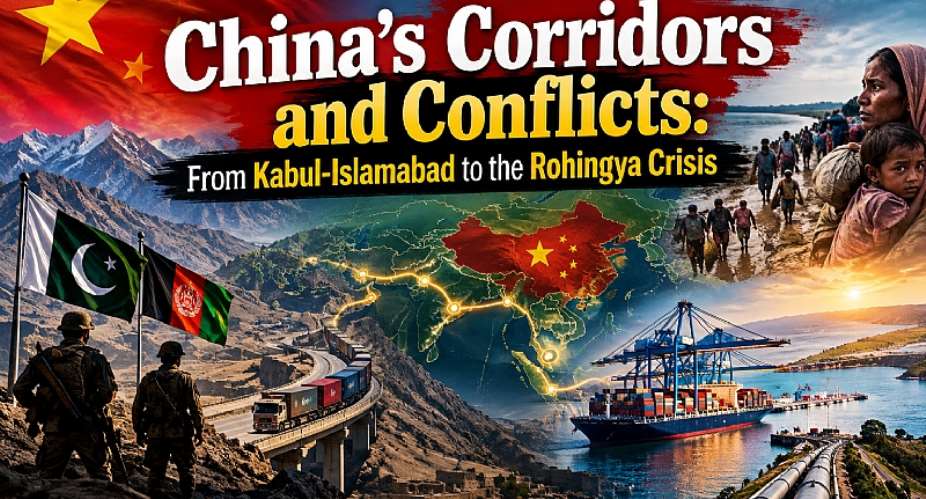
Many geopolitical analysts have criticised the United States for what they describe as selective application of democratic and human-rights principles. Yet another question deserves equal attention: when a rising power expands its economic influence across unstable regions, does that influence also create a responsibility to contribute more actively to peace, humanitarian protection and conflict resolution?
China presents an important case. Beijing has built an extraordinary economic architecture across Asia through infrastructure, trade corridors, ports, energy projects and technological partnerships. But its diplomatic approach often places sovereignty, non-interference and economic stability at the centre of its foreign policy. That approach can create a difficult contradiction: prosperity and connectivity cannot always be separated from the humanitarian and political crises surrounding them.
The Rohingya crisis in Myanmar is a clear example. Bangladesh continues to host more than one million Rohingya displaced from Myanmar, while Dhaka is again seeking a political solution through engagement with China and Myanmar. Bangladesh has emphasised that any repatriation must be safe, voluntary, dignified and sustainable.
China is not an outside observer. Beijing has maintained relationships with both Bangladesh and Myanmar and has previously participated directly in efforts to facilitate Rohingya repatriation. In 2019, China helped establish a China-Myanmar-Bangladesh mechanism aimed at advancing repatriation and supporting development in Rakhine State.
The renewed diplomatic effort therefore raises a fundamental question: what role should China play in Myanmar?
The answer is closely connected with China's economic interests. Rakhine State occupies an important position in China's regional connectivity ambitions, including the China-Myanmar Economic Corridor and infrastructure linked to the Bay of Bengal. Instability, conflict and displacement inevitably complicate the environment required for long-term investment and regional connectivity. Economic development therefore cannot permanently remain detached from political reconciliation.
The same logic applies to Bangladesh. As economic relations between Dhaka and Beijing deepen, the Rohingya crisis increasingly intersects with regional economic geography. A more stable Bangladesh-Myanmar-China environment could potentially support connectivity, trade and infrastructure. But sustainable economic integration requires more than roads, ports and pipelines; it requires political stability and a human security framework capable of protecting affected populations.
The same question now emerges between Kabul and Islamabad. The September 18 Kohat mosque and police-compound attack demonstrated again how dangerous the Pakistan-Afghanistan security environment remains. Pakistan has blamed militant networks operating from Afghan territory, while Afghan authorities have rejected such accusations.
Here too, China has something significant at stake. Chinese economic interests extend across Pakistan and into Afghanistan, while regional instability threatens the wider connectivity architecture Beijing seeks to develop. Importantly, China has already attempted mediation. In March 2026, Chinese Special Envoy Yue Xiaoyong travelled between Afghanistan and Pakistan, urging restraint, an end to hostilities and dialogue. Beijing has therefore demonstrated that it can move beyond statements when circumstances demand it.
The question is whether such diplomacy can become sustained and consequential.
China's long-standing relationship with Pakistan does not require Beijing to take Islamabad's side, just as its relationship with Myanmar should not prevent it from addressing the humanitarian dimensions of the Rohingya crisis. A credible mediator must maintain relationships with competing parties while encouraging reciprocal commitments, accountability and practical mechanisms for de-escalation.
This is ultimately the test of China's emerging global role. Economic power creates influence, but influence without meaningful diplomatic responsibility can leave conflicts frozen beneath the surface. Corridors, ports, technology and investment can generate prosperity, but they cannot by themselves resolve displacement, terrorism, border disputes or political exclusion.
China does not need to become an interventionist power. Its own principle of non-interference remains central to its diplomacy. But non-interference should not mean diplomatic silence. If Beijing wants to be recognised as a leading architect of a new regional economic order, it will increasingly be judged not only by what it builds, but also by what it does when instability threatens the people and regions surrounding those investments.
From Rakhine to the Pakistan-Afghanistan border, the message is becoming increasingly clear: economic leadership and diplomatic responsibility cannot remain permanently separated. The real measure of a rising power is not simply how many corridors it constructs, but whether its influence can help turn corridors of commerce into pathways toward stability, reconciliation and human security.


 Transport fares increased 8% from September 26
 Golokuati residents call for operationalisation of abandoned ECG office
 Frank Danquah declared wanted over alleged narcotics offences
 Ghana TVET Service warns against collection of fees in TVET institutions
 16 arrested as National Security uncovers counterfeit currency printing syndicat...
 Work without fear or favour — Shamima Muslim urges broadcasters
 MFWA begins 5-day training for journalists from northern sector on media law and...
 A/R: Assemblyman for Nkwantakese Electoral area killed
 Kumasi: Roadside trader killed in tragic accident at Brewery Traffic Light in As...
 Law student petitions CHRAJ over alleged military killing of Gbewaa Training Col...


