




There are weeks when history simply refuses to walk single file. It arrives in a crowd — sanitation trucks grinding through Agbogbloshie, presidents boarding flights to New York, drones lighting up a Moscow skyline, gunfire cutting down a gentle professor in an Illinois driveway, and a nation of storytellers bowing its head for a fallen lion of the screen. This week has been one of those weeks. And if there is a thread running through all of it, it is this: the world is being rebuilt in real time, brick by brick, body by body, and Ghana — for once — is not merely watching from the wings.
Agbogbloshie: A Mountain Finally Moves
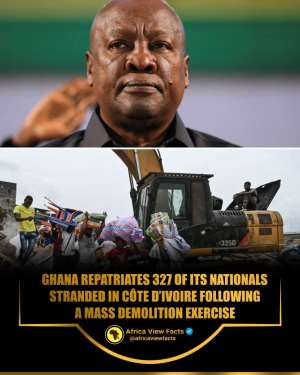
For more than two decades, Agbogbloshie has been Accra's open wound — a name that international journalists reached for whenever they wanted to illustrate Africa's environmental crisis in a single photograph. This week, that mountain of refuse finally began to move. President John Dramani Mahama commissioned an operation to clear roughly one million metric tonnes of waste from Agbogbloshie, Old Fadama and the surrounding communities within ninety days, with the material being hauled to the Adepa Engineered Landfill Site near Nsawam under the joint effort of the Ministry of Local Government, the Ghana Armed Forces' 48 Engineer Regiment, and the District Road Improvement Programme.
I will not pretend this is a small thing. The president himself, speaking at the launch, declared that the reclaimed site must never again become a dumping ground. That is the sentence that should be framed and hung in every district assembly office in this country, because Ghana's history with sanitation promises is littered with the ruins of good intentions. What gives this effort a different texture is the accompanying plan: government intends to convert the reclaimed land into an industrial hub anchored by a textile factory, aligning with the 2026 budget's identification of garment manufacturing as a strategic export sector. The Ghanaian Times, in its editorial response, rightly insisted that this cannot be treated as a routine clean-up but must mark a fundamental change in how the capital manages waste and protects its waterways — including the long-suffering Korle Lagoon.
I say this as a columnist and not as a cheerleader: ninety days is an ambitious clock. Ghanaians have watched sod-cutting ceremonies before that produced more photo opportunities than tarred roads. The measure of this government's seriousness will not be the trucks that rolled out this week, but the ones that keep rolling in December, and the enforcement mechanisms that stop scrap dealers and displaced traders from simply rebuilding what was torn down.
New York Calls, and Ghana Answers
While the bulldozers worked in Accra, President Mahama boarded a flight for the 81st Session of the United Nations General Assembly, convened this year under the theme "Restoring Trust, Managing Transformation: A United Nations that Delivers for All." The General Debate runs from September 22 to 28, and Mahama is scheduled to deliver Ghana's official statement on September 24. He arrives with more than a speech in his portfolio — he is hosting a high-level side event on the "Accra Reset," built around the idea of making global development work again, and a second forum on reparatory justice and the restitution of African cultural heritage.
There is something quietly significant in a Ghanaian president using the UN's biggest stage to press the case for returning looted African artefacts and reforming a global financial architecture that has kept nations like ours permanently one shock away from crisis. It positions Ghana not as a supplicant with a begging bowl, but as a country demanding structural change in the rules that govern who gets to prosper.
Praise From an Unlikely Corner
It is one thing for a government to praise itself; it is another for Africa's richest man to do it for you. Speaking at the Accra Reset event on the sidelines of the UNGA, Dangote Group chairman Aliko Dangote credited President Mahama with turning around Ghana's economy in a very short time, framing it as proof that money follows trust. That is not empty diplomatic flattery — Dangote is a man who moves capital across this continent for a living, and his read of Ghana's risk profile matters.
The numbers behind that praise are worth stating plainly, because they are the difference between vibes and verifiable macroeconomics. Inflation fell from 23.8 percent in December 2024 to 3.4 percent by April 2026. Foreign reserves climbed to nearly $13.9 billion. The economy grew by roughly 6 percent in 2025, pushing GDP past $114 billion and making Ghana the eighth-largest economy on the continent. These are the figures a government wants Dangote — and every investor watching from London to New York — to repeat aloud.
But I would be an irresponsible columnist if I let the applause drown out the fine print. The IMF projects Ghana's public debt will rise to 53.0 percent of GDP by the end of 2026, up from 45.3 percent in 2025. Stability is real. So is the tightrope. Praise from billionaires is a headline; debt sustainability is the story that determines whether our grandchildren inherit a functioning treasury or another restructuring.
Dome-Kwabenya: The Road That Would Not Die
Closer to home, and closer to the everyday frustration of ordinary Ghanaians, the long-suffering Dome-Kwabenya–Berekuso–Kitase road has finally received a lifeline. The Ministry of Roads and Highways has issued a Commencement Authorisation Letter directing the contractor to resume work on September 24, on a 23-kilometre stretch that has sat roughly 27 percent complete and steadily deteriorating for years. This is the same road residents of Dome-Kwabenya, Comet, Berekuso, Agyementi and Kitase marched over in August, furious that it had been officially listed as complete in a national development plan while the tarmac beneath their feet told a different story.
Minister Governs Kwame Agbodza has given the contractor a year and a half to finish the job. I welcome the announcement with the caution of a man who has seen too many "resumptions" evaporate into silence. The people of that corridor do not need another commencement letter. They need commencement to become completion.
A Tragedy That Crossed the Atlantic
Then came the news that stopped many of us cold. Dr Kofi Akamani, a 48-year-old Ghanaian academic and professor of forestry at Southern Illinois University Carbondale, was shot and killed near his wife's residence in Murphysboro, Illinois, on the evening of Saturday, September 19. His wife, Betty Akamani, has since been charged with two counts of first-degree murder and remains in custody pending further proceedings. Dr Akamani began his academic journey at the Kwame Nkrumah University of Science and Technology in Kumasi before building a distinguished career abroad, ultimately becoming a full professor and director of graduate studies in forestry at SIU.
I write his name in full — Kofi Akamani, not the mangled "Akamai" some are already circulating online — because our people deserve to be remembered correctly even in tragedy, especially in tragedy. This is a man who spent his professional life studying how communities in Ghana, the United States and beyond could live sustainably with their forests and water resources. That he should die violently, far from home, in a driveway in southern Illinois, is the kind of grief that reminds our diaspora how thin the membrane is between the American dream and American tragedy. My condolences go to his family, to SIU Carbondale, and to every Ghanaian abroad tonight who is holding their loved ones a little tighter.
When America's Skies Seized Up
As if to underline just how fragile modern infrastructure truly is, the very air travel network meant to carry 130 world leaders into New York for the UNGA nearly buckled under its own weight. On Monday, an Amtrak construction crew in New Jersey accidentally severed a fibre-optic line serving as backup communications for the Philadelphia air traffic control facility — precisely as its primary circuit had failed. The result was a cascading shutdown: ground stops at Newark, JFK, LaGuardia, Teterboro and Philadelphia International, with roughly 7,000 flights delayed or cancelled nationwide before the system was restored late in the day. FAA Administrator Bryan Bedford did not mince words about the scale of the failure, describing the severed backup line as a "massive" break spanning some 600 feet of fibre.
There is a lesson here that transcends America's borders: the world's most powerful nation, hosting the world's most powerful diplomatic gathering, was briefly humbled by a construction crew's shovel. Infrastructure — whether Agbogbloshie's waste system or Philadelphia's air traffic fibre lines — does not forgive neglect, no matter how wealthy the country that owns it.
Haiti's Long Road to Reckoning
Meanwhitethe wheels of justice turned, however belatedly, for one of the hemisphere's most notorious unsolved crimes. Eighteen suspects — including former Haitian Justice Ministry official Joseph Badio and a group described as Colombian mercenaries — appeared in a Miami federal courtroom this week, extradited from Haitian custody to face charges connected to the 2021 assassination of President Jovenel Moïse. It is a case that has hung over Haiti's collapse into gang violence and political paralysis for four years, and its arrival on American soil offers the first real prospect of accountability. It arrives, painfully, at a moment when Haiti's humanitarian catastrophe continues to deepen, with millions internally displaced and armed groups still contesting territory the state has effectively ceded.
Moscow Under Fire, Again
Across the Atlantic, the Russia-Ukraine war delivered what Moscow's own mayor called its largest drone assault yet on the Russian capital, striking during the final day of Russia's parliamentary elections. Russian authorities reported over a thousand drones intercepted, with strikes damaging the Moscow oil refinery and a residential building, and regional officials confirming at least two deaths and twenty injuries in the wider Moscow region. The war grinds on, four years deep, each side proving that neither exhaustion nor election season offers any real pause in the fighting.
Nollywood Loses Its Lion
And finally, culture asks us to grieve. Nigeria's Nollywood industry is still absorbing the loss of Olu Jacobs — born Oludotun Baiyewu Jacobs on July 11, 1942 — who died on September 16 at the age of 84 after a long battle with illness. Trained at London's Royal Academy of Dramatic Art, Jacobs built a career spanning British stage and screen before returning home to become one of Nigerian cinema's most commanding presences, co-founding the Lufodo Group with his wife, actress Joke Silva. Tributes have poured in from across the continent's entertainment and political classes, with Nigeria's Culture Minister Hannatu Musa Musawa calling his death a monumental loss to the nation and the creative economy.
For those of us in Ghana's own film and content industry — myself included, through Brownsy Silva Company — Jacobs was proof of what disciplined African storytelling could achieve on a global stage decades before "Nollywood" became a marketing term. Rest well, Lion of Lufodo.
The Thread That Binds It All
Waste removed in Accra. A president courting trust in New York. A road resurrected in Dome-Kwabenya. A professor buried too soon in Illinois. A justice system finally catching up with Haiti's grief. Drones over Moscow. A legend laid to rest in Lagos. None of these stories occurred in isolation, and none of them should be read that way. They are the same world — fragile, striving, occasionally violent, occasionally redemptive — refracted through different capitals.
Ghana's task, amid all of it, is not to be distracted by the noise of the world but to keep doing the unglamorous work of clearing its own mountains, literal and otherwise, one truckload at a time.
Chief Tutu Baffour Asare Brownsy Williams is an opinion columnist for Modern Ghana and founder of Brownsy Silva Company.
Sources consulted include the Ghanaian Times, 3News, Rainbow Radio, GBC Ghana, Adomonline, Pulse Ghana, The Rio Times, MyJoyOnline, Asaase Radio, ModernGhana, GhanaWeb, the South China Morning Post, PBS News, CBC News, Al Jazeera, Bloomberg, Channels Television, and Vanguard Nigeria — all reporting between September 16 and 22, 2026.


 Transport fares increased 8% from September 26
 Golokuati residents call for operationalisation of abandoned ECG office
 Frank Danquah declared wanted over alleged narcotics offences
 Ghana TVET Service warns against collection of fees in TVET institutions
 16 arrested as National Security uncovers counterfeit currency printing syndicat...
 Work without fear or favour — Shamima Muslim urges broadcasters
 MFWA begins 5-day training for journalists from northern sector on media law and...
 A/R: Assemblyman for Nkwantakese Electoral area killed
 Kumasi: Roadside trader killed in tragic accident at Brewery Traffic Light in As...
 Law student petitions CHRAJ over alleged military killing of Gbewaa Training Col...


