




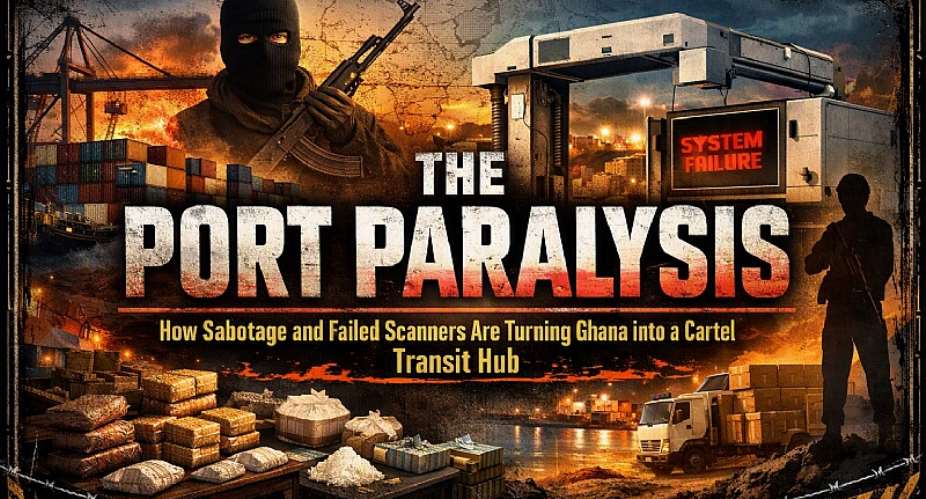
The shocking seizure of 3.9 metric tonnes of cocaine—valued at a staggering €225 million ($261 million)—by French customs at the Port of Dunkirk has sent shockwaves across the globe and dealt a devastating blow to Ghana’s international reputation. The contraband, deceptively declared as "plastic waste," bypassed every security layer at our ports before setting sail.
As a nation, we must confront a painful truth: this was not a simple failure of technology. It was a failure of integrity. While the state frequently blames "technical downtime" or maintenance backlogs for broken scanners, the unfolding investigation reveals a much darker reality. When multi-million dollar imaging machinery flags "abnormal images" and corrupt officials intentionally clear those containers anyway, we are no longer dealing with a system breakdown—we are witnessing deliberate insider sabotage. Ghana's ports of entry have been weaponized by international cartels, aided by the very individuals sworn to protect our borders.
The Reality on the Ground: Current Breaches and Arrests
To understand the depth of the crisis, we must look at the facts exposed by the Narcotics Control Commission (NACOC) and state prosecutors:
- Insider Collusion: At least ten individuals have been remanded, including four high-ranking officers from the Customs Division of the Ghana Revenue Authority (GRA).
- Bypassed Alerts: Court proceedings revealed that the intercepted containers were scanned in Ghana and explicitly generated electronic "abnormal images." These red flags were intentionally ignored by officers on duty.
- The Global Cartel Footprint: International intelligence has linked this massive shipment directly to the network of Jos Leijdekkers ("Bolle Jos"), one of Europe’s most notorious and wanted drug kingpins.
- The Sniffer Dog Paradox: While Ghana possesses highly capable, specialized K9 units donated by international partners like Germany (GIZ), they are being rendered useless when compromised officials choose to bypass standard physical and canine inspection protocols entirely.
- The Trust Deficit: The crisis has grown so severe that international allies—including France and Australia—are reportedly hesitant to share real-time maritime intelligence with local agencies due to fears of systemic leaks.
Actionable Recommendations to Secure Ghana’s Gateways
Fixing this crisis requires moving beyond knee-jerk political reactions. To permanently seal these gaps, the government, port authorities, and civil society must implement the following structural reforms:
- Implement Centralized Remote Imaging: Scan images should never be analyzed solely by officers physically present at the port gate. Ghana must establish a centralized, heavily secured Remote Scanning Review Center in Accra, where independent analysts cross-verify cargo images blindly without knowing who owns the container or which customs officer is on the ground.
- Enforce Strict Liability and Mandatory Prosecutions: Any customs officer or port official who signs off on a container flagged with an "abnormal image" without a documented, verified physical bust must face automatic interdiction, immediate asset freezes, and mandatory criminal prosecution under state sabotage laws.
- Deploy Independent, Multi-Agency Overwatch: Introduce rotational, unannounced counter-intelligence teams consisting of National Security, NACOC, and international monitors at port exit points to perform random secondary sweeps on containers already "cleared" by Customs.
- Create a Maintenance Ring-Fenced Fund: To eliminate the convenient excuse of "broken scanners," a fixed percentage of port transit fees must be legally ring-fenced exclusively for the immediate repair, upgrading, and continuous calibration of frontier biometric and imaging hardware.
- Protect Whistleblowers and Reward Integrity: Establish an anonymous, heavily incentivized channel specifically for port workers to report suspicious clearances, backed by substantial financial rewards funded directly by seized cartel assets.
Ghana stands at a critical crossroads. The Dunkirk bust is a national embarrassment that proves our border vulnerabilities are an existential threat to our economy and sovereignty. We cannot claim to be the "Gateway to Africa" if our ports function as an open highway for international drug syndicates. President Mahama’s convening of emergency meetings at Jubilee House and the creation of an inter-agency task force are step one—but paper committees will not stop cartels.
The state must show absolute ruthlessness in prosecuting the compromised GRA customs officials currently before the courts. If we do not ruthlessly root out the economic saboteurs within our own security apparatus, upgrade our technologies, and restore international intelligence trust, Ghana risks facing severe global maritime sanctions. It is time to dismantle the cartels' inside network and reclaim the integrity of our ports once and for all.
✍️ Submitted by:
Retired Senior Citizen
For and on behalf of all Senior Citizens of the Republic of Ghana 🇬🇭
Teshie-Nungua
[email protected]


 We should make it easier for Africans to travel and invest across the continent ...
 Mahama turned around Ghana’s economy in a very short time – Dangote
 September 22: Cedi sells at GHS12.15 on forex market, GHS11.56 on BoG interbank
 We need to train judges on new laws to ensure proper application – Barker-Vormaw...
 Ghana’s democracy under pressure; youth must speak to defend their freedoms – Os...
 Ghana’s independence must translate into economic empowerment -- CPP's Nana Frim...
 Don’t just prosecute couriers, go after drug financiers – Catholic Bishops urges...
 ‘No ownership without control’ – Mahama pushes new global health financing model...
 France Cocaine Bust Could Trigger Trade Sanctions and Scare Investors – IERPP Wa...
 Ghana Jollof saga: 'Power is transient' — Annoh-Dompreh cautions against partisa...


