




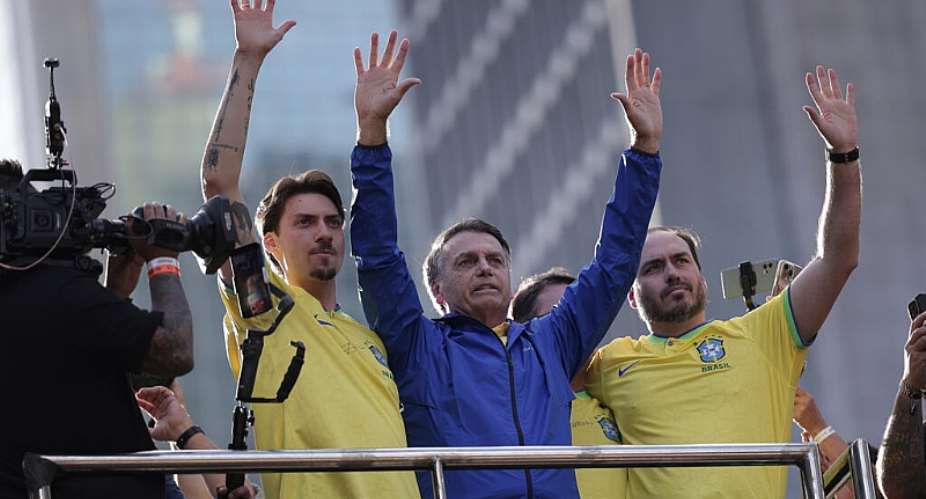
They waited for them for hours in the rain and cold of this seemingly endless winter in Joinville, Santa Catarina state. In this exhibition centre that once hosted the country's largest arms fair before falling victim to its own success and being moved to São Paulo, the campaigners can hardly believe their eyes.
On this particular day, it must be said that the Bolsonaro family's supporters are spoiled with choice: there are not one, but two Bolsonaros onstage. The eldest son, Flavio – nominated by his father Jair as the Liberal Party's candidate for the presidential election – is accompanied by his brother, Carlos, 43 years old, who is standing for the Senate. “Why is your state exemplary? Because it has never been ruled by the Workers' Party!” chants Flavio, rallying the crowd to vote for his younger brother, who is trying his luck in a senate run for the first time in this southern region.
Read more Flavio Bolsonaro probed for corruption as Brazil election tightens
A low-key 'number 3'
A Rio de Janeiro city councillor for over 20 years, Carlos – known as "Number 3" – is a true Carioca who has parachuted into Santa Catarina. Regularly mocked for his exaggerated "ch" sounds typical of the capital city, he moved to the south just a few months ago – drawn by “the honesty of its hard-working, conservative people”, as he regularly asserts at rallies – and is standing for a senate seat that would be far harder to secure in the tourist capital, where the political landscape is far too competitive.
That day in Joinville, Carlos Bolsonaro's running mate Carol de Toni drew on his experience as as a city councillor. "He helped run a city like Rio, so for our far safer and less chaotic state, it is a godsend! ... We are a hard-working, conservative people who uphold the values that Jair Bolsonaro stood for." It was as if the aura of his father – sentenced to 27 years in prison for attempting a coup and barred from taking part in the campaign – were projected into the son's body.
“I'm very religious; I wouldn't go as far as to say it's a bit like the Holy Spirit, but there's a bit of that to it. Jair Bolsonaro is a hero to us all. So if he can be a little bit with us through his sons, what a chance!” says de Toni. Indeed, the portrait of the former president, like a talisman, takes pride of place at every campaign stop.
Behind Flavio, Carlos takes a back seat. Even in his older brother's absence, his media appearances are few. At campaign headquarters, they point out that “the Bolsonaro candidates' schedules are not disclosed for security reasons”.
For Felipe Pereira, a journalist with the regional UOL outlet, this is above all a campaign strategy: “Staying silent in the face of the national media and pouring everything out on their social media is an explicit request from Jair Bolsonaro.” Carlos's arena is therefore not the campaign stage, but the telephone.
Although considered less charismatic than his father or two elder brothers, he speaks directly to supporters over the phone, bypassing the mainstream media and fostering a relationship of mistrust towards institutions among the Bolsonarist grassroots.
The south? A strategic choice
In Santa Catarina, where nearly 70 percent voted for Jair Bolsonaro in the 2022 presidential elections, this approach has found a loyal following. Messages circulate in family and work WhatsApp groups. A TikTok video criticising Lula, the Supreme Court or the government's environmental policies can be shared within minutes.
Joao Feres, a political scientist specialising in Bolsonarism at the State University of Rio de Janeiro, explains why this shift towards the south is strategic: “The family is banking on a national brand: these are candidates with no real local roots, who rely on the Bolsonaro name to compensate for their lack of connection to the region.”
The campaign is organised less around a programme than around a carefully chosen political community: a conservative south made up of large agricultural estates which identifies with the flag, belief in God, the values of hard work and entrepreneurship – and above all, viscerally rejects left-wing social policies.
Jair Renan, the youngest son in the running
Balneário Camboriú, nicknamed the "Brazilian Dubai", is an hour's drive from the capital of Santa Catarina. The seaside resort, home to the tallest skyscrapers in Latin America, thrives mainly on money from agribusiness. It's an audience that has already been won over to the cause of Jair the father. Jair, the son, therefore feels right at home.
Having come to study law at the Avantis University Centre, Jair Renan Bolsonaro, the youngest of the siblings, was baptised at the Evangelical church there and then elected as a councillor with a record number of votes three years ago. His niche? Speaking to young people.
At his campaign headquarters dotted with photos of both father and son, supporters even joke about their physical resemblance and insist that he is “the best candidate in the state, a promising young man” who “keeps his father's legacy alive, now that his father is no longer allowed to speak out”.
Yet Jair Renan rarely takes the floor at council meetings, and when he speaks on social media, his tone and rhetoric seem scripted. Last April, he delivered a rambling speech on Brazil's military dictatorship, referring to older elected representatives for whom "it was Brazil's golden age".
Can Bolsonarism survive Jair Bolsonaro?
Opposite the party headquarters, barber Eduardo Souza has had requests for "Renan-style haircuts". He says this with a smile, but it quickly turns into a grimace. "He can ride on the coat-tails of his father's surname and even his first name, but he is the only one who could really save our country from the communist Lula."
This is line with Feres's analysis. “Moderating one's stance dilutes the brand; radicalising it preserves it, but limits the electoral ceiling.” He urges caution regarding the idea of an automatic legacy: “Jair Bolsonaro's political capital is not passed on by inheritance,” he argues. Jair Bolsonaro's sons bear the family name and, with it, “access to an established electorate”, but none of them has yet established “a leadership of their own that can stand on its own, without reference to their father”.
Behind the flags and slogans, one question is beginning to take centre stage: can Bolsonarism survive Jair Bolsonaro, without remaining trapped in his shadow?


 NDC MP explains why Kevin Taylor was not arrested when he returned to Ghana
 Disruption of global order: 'We must expand opportunities for youth' – Mahama
 Mahama to cut sod for Sunyani Sports Stadium project in October
 Kwesi Pratt urges Ghana to revisit Nkrumah’s seven-year development Plan
 Ghana Jollof saga: 'Power is transient' — Annoh-Dompreh cautions against partisa...
 “Curses don’t work anymore; they are waste of time, money and energy” — Mzbel
 “I want my life back” — Moesha Boduong calls on God for miracle
 “I loved NDC but I’ve been disappointed and I’ve learned my lesson” — Mzbel
 Sista Afia laments how colleague musicians turned down her feature requests
 Joining NDC did me more harm than good – Mzbel


