




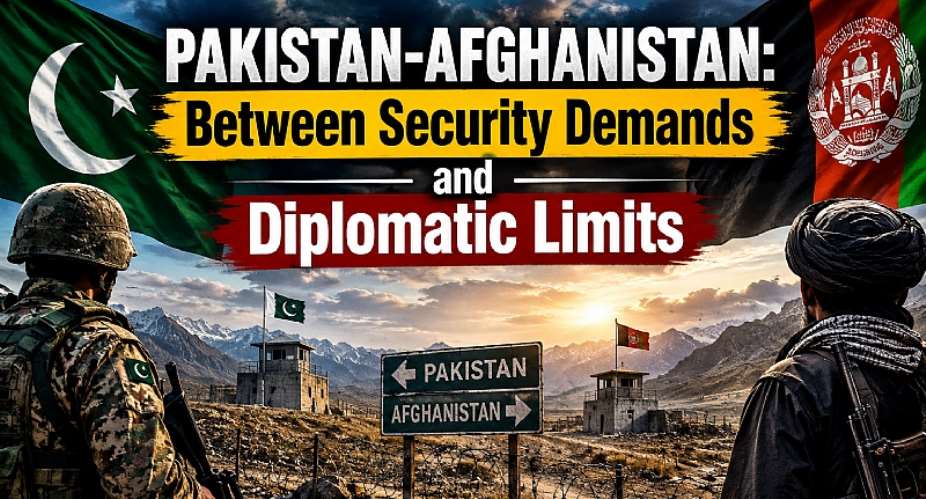
Pakistan’s peace is not solely an internal issue. Given the geography of the region, cross-border movement and developments inside Afghanistan remain significant factors in Pakistan’s security environment. The central question is therefore not simply whether Kabul should act against the Tehreek-e-Taliban Pakistan (TTP), but whether the Taliban authorities possess sufficient control across Afghanistan to deliver the assurances Islamabad demands.
Pakistan’s position was recently explained clearly by Lt. Gen. Ahmed Sharif Chaudhry, Director General of Inter-Services Public Relations (ISPR), in an interview with Arab News. He said Pakistan’s dispute was not with Afghanistan or its people but with the Taliban authorities in Kabul, whom he described as a “non-inclusive, non-representative regime.” He also reduced Pakistan’s central demand to one point: that Afghan territory should not be used to facilitate terrorism inside Pakistan.
Yet this position raises an important diplomatic question. If Pakistan considers the Taliban government insufficiently representative, how should it simultaneously expect that same authority to exercise comprehensive control over every armed network operating across Afghanistan? Pakistan’s own diplomatic history illustrates the complexity. Former ambassador Mansoor Ahmad Khan, who served in Kabul during the Taliban takeover, has written that Pakistan’s embassy remained operational during the transition and that he oversaw the peace process and the takeover. Pakistan also continued consular and humanitarian assistance when many foreign missions were evacuating.
This creates the central contradiction: Islamabad demands that Kabul prevent militants from operating against Pakistan, while Kabul’s actual capacity to control every remote area, network and armed faction remains contested. The Taliban authorities claim that they do not permit the TTP to operate from Afghan territory and deny supporting armed groups attacking other countries. Their spokesperson, Zabihullah Mujahid, has nevertheless expressed support for continued dialogue with Pakistan and welcomed a greater Saudi role in mediation.
The comparison with Iran’s concerns about Baloch insurgent activity also deserves attention. If Pakistan expects another state to eliminate militants operating from difficult border regions, Islamabad must recognize that such demands can encounter the same sovereignty and capacity limitations that Pakistan itself faces. Counterterrorism cooperation therefore requires more than declarations; it requires mechanisms for verification, intelligence-sharing, border coordination and mutually accepted definitions of responsibility.
The United Nations dimension adds another layer. Speaking at the Security Council, Pakistan’s ambassador, Asim Iftikhar Ahmad, said more than 4,700 Pakistanis had been killed over the previous three years by terrorism “emanating from Afghanistan.” Pakistan has also argued that militant groups including the TTP and BLA operate from sanctuaries in Afghanistan. These are serious allegations, while Kabul rejects the accusation that it sponsors such attacks.
The UN, therefore, can become more than a platform for competing accusations. It can provide diplomatic pressure for a structured regional mechanism involving Pakistan, Afghanistan and other stakeholders. International engagement should focus not only on condemnation but also on measurable commitments: preventing cross-border attacks, exchanging intelligence, addressing militant financing and establishing mechanisms to investigate disputed incidents.
Pakistan’s military response may remain an option under its stated interpretation of self-defense. But military action cannot by itself resolve the political and geographical realities of the Afghan-Pakistan border. Earlier this year, Pakistan’s defense minister described the relationship as an “open war” after serious fighting and Pakistani airstrikes. Such escalation demonstrates how quickly a security dispute can move from diplomatic disagreement to armed confrontation.
The more sustainable question is whether Pakistan should work with the existing Afghan power structure while continuing to press for counterterrorism commitments, rather than allowing diplomatic disengagement to create another vacuum. Engagement does not necessarily mean political endorsement or formal recognition. It can mean using existing channels to obtain verifiable security commitments.
Peace between neighbors cannot be built by demanding that only one side accept the other’s narrative. Pakistan has legitimate security concerns, while Afghanistan has its own sovereignty concerns and limitations of governance. The way forward therefore lies between confrontation and unconditional accommodation: sustained dialogue, verifiable counterterrorism commitments, controlled borders and third-party mediation where necessary.
The real test for Pakistan’s Afghan policy is not whether Islamabad can impose its demands, but whether it can convert those demands into a workable regional security arrangement. If diplomacy is given no space, confrontation may become the default policy; if security concerns are ignored, violence will continue to undermine relations. Between these two extremes lies the difficult but necessary space of diplomacy.


 Trump to meet Macron in New York before UN General Assembly
 Five takeaways from Germany's regional elections after far-right gains
 Putin party retains majority in first vote since 2022 invasion of Ukraine
 Third-country removals: Trump’s deportation policy by the numbers
 US, China discuss AI safety ahead of Trump-Xi summit
 Mysterious illness leaves children struggling to walk, hear in Mafi Kope
 ‘We’ve come back to make sure our father's ideas never die’ – Nkrumah family
 Ghana Jollof: Akosua Manu appeals to Naana Jane to use her influence to free Sal...
 Yellow fever confirmed in Sissala East after 21 mysterious deaths
 Kenyasi man allegedly attacked by prison officers and inmates over yam theft cla...


