




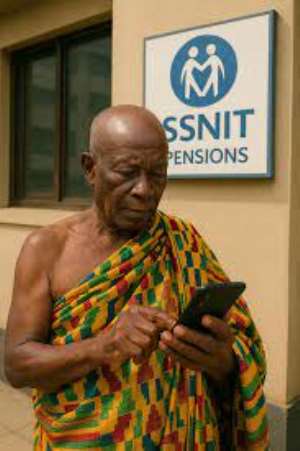
As Ghana approaches another annual pension indexation exercise, the attention of more than 260,000 pensioners will once again turn to the Social Security and National Insurance Trust (SSNIT) and the National Pensions Regulatory Authority (NPRA).
The exercise is expected to determine the adjustment to monthly pensions from January 2027. It is therefore an appropriate time, not merely for pensioners to ask what percentage increase they should receive, but for SSNIT and NPRA to reflect on the principles that should guide the exercise.
Those principles include fairness, equity, transparency, solidarity, adequacy, sustainability and the protection of pensioners' purchasing power. These are not demands invented by pensioners. They are principles embedded, directly or indirectly, in the objectives and responsibilities of Ghana's pension architecture.
Indeed, when SSNIT announced the 2026 indexation, the Trust described the exercise as reflecting its commitment to the welfare, dignity and purchasing power of pensioners while safeguarding the sustainability of the Scheme. The 2026 arrangement provided an overall 10% indexation, comprising a 6% general increase and a redistribution of the remaining 4% through a flat amount of GH¢91.56. SSNIT explained that the redistribution was intended to cushion lower-income pensioners in accordance with the solidarity principle of social security. Those commitments provide an appropriate framework within which the 2027 exercise should be considered.
The Bigger Question than the Percentage
Every year, public attention tends to focus on one figure: the percentage by which pensions will increase. That is understandable. For the pensioner struggling to pay for food, medicine, electricity, water, transportation and other necessities, the percentage ultimately determines how much additional money enters the household.
But pension indexation is fundamentally more than an annual announcement.
It is an instrument for determining whether the pension promised by the social-security system continues to perform its intended social function after retirement. A pension is not simply a payment made to an elderly person. It represents deferred income. During their working lives, contributors paid into a social-insurance system on the understanding that, upon retirement, they would receive an income according to the rules of that system.
Consequently, when the cost of living changes substantially, the question is not simply whether SSNIT can afford an increase. The equally important question is whether the pension continues to retain reasonable purchasing power. That is why transparency surrounding the indexation methodology matters.
What Act 766 Actually Requires
Section 80 of the National Pensions Act, 2008 (Act 766), provides that SSNIT shall annually review pension payments and index them to wage inflation rates of active members or another rate determined by the Trust in consultation with the Board of NPRA. The provision establishes an annual review, but it does not itself set out a detailed mathematical formula telling pensioners exactly how the final percentage must be calculated. This deserves attention.
There is nothing inherently wrong with allowing professional pension administrators and actuaries some flexibility. Economic circumstances change, pension funds have to remain sustainable, and the interests of current pensioners have to be balanced with those of future pensioners and active contributors. However, flexibility should not become opacity. A pensioner should reasonably be able to understand the major economic and actuarial factors that determine the annual adjustment.
If wage growth, inflation, salary growth among active contributors, projected inflation and the long-term sustainability of the Fund are considered, as SSNIT indicated in explaining the 2026 indexation, those factors should be clearly disclosed and explained to the people whose pensions are being adjusted. Fairness is not necessarily equality
One of the most important principles demonstrated by the 2026 indexation was the distinction between equality and equity. SSNIT did not give every pensioner exactly the same percentage increase in the final outcome. Instead, it combined a fixed percentage increase with redistribution. This was justified on the basis of solidarity and the need to provide greater protection to pensioners at the lower end of the pension distribution. SSNIT reported that pensioners on the minimum pension received a substantially higher percentage increase because of the redistribution mechanism. That principle deserves recognition.
Fairness does not necessarily mean treating everybody identically. If two pensioners receive GH¢500 and GH¢20,000 respectively, giving both exactly the same percentage increase may be equal in mathematical terms but may not produce the same social outcome. A social-security system is permitted, and perhaps expected, to incorporate solidarity. But equity must operate alongside transparency.
If redistribution is used, pensioners should be told clearly: What proportion is being redistributed? From whom is it being redistributed? What formula determines the redistributed amount? What economic and actuarial considerations justify the decision? What effect does the redistribution have on different categories of pensioners? These are reasonable questions, not challenges to SSNIT's authority.
Transparency must go beyond announcing the final figure. There is a distinction between announcing a decision and explaining a decision. A transparent indexation process should enable an ordinary pensioner, researcher, journalist, contributor or parliamentarian to understand how the decision was reached. For example, if SSNIT determines that the indexation should be 10%, the public should be able to see the principal variables considered in reaching that conclusion. If inflation is 5.4%, wage growth is another figure, projected inflation is another, and the Fund's actuarial position is another, how were these variables weighed? If a portion of the proposed increase is redistributed, how is that portion calculated? If sustainability is a consideration, what does the actuarial evidence show?
None of these questions requires SSNIT to reveal commercially sensitive information or compromise the Fund's operations. They simply require sufficient information for stakeholders to understand the policy decision. That is what meaningful transparency should mean.
NPRA's Responsibility is Broader than Regulation
The role of NPRA makes this discussion even more important. NPRA's own description of its statutory functions states that the Authority is responsible for receiving and investigating grievances from pensioners and providing redress. It is also mandated to advise government on the general welfare of pensioners and on overall pension policy. These responsibilities are significant. They suggest that pensioners are not merely passive beneficiaries of the pension system. Their welfare is expressly recognized within the regulatory framework.
NPRA also has pensioner representation on its governing board through the National Pensioners Association. That representation is important, but Ghana's pension landscape has evolved considerably since Act 766 was enacted in 2008.
There are now different pensioner groups and civil-society organizations raising questions about pension adequacy, indexation, minimum pensions, welfare and the sustainability of the system. The existence of one recognized pensioner representative should not be interpreted as meaning that other pensioners have no legitimate concerns to bring before SSNIT or NPRA. Indeed, the regulatory system should welcome well-researched views from all genuine stakeholders.
Consultation should be Meaningful
The forthcoming indexation exercise provides an opportunity to strengthen consultation. Consultation should not mean that pensioners determine the actuarial calculation. That responsibility belongs to qualified professionals. Neither should consultation mean that SSNIT must accept every proposal presented by pensioners.
Rather, meaningful consultation should allow pensioners and their representative organizations to place evidence, concerns and proposals before the institutions responsible for the decision. SSNIT and NPRA can then consider those submissions alongside actuarial, economic and financial evidence. This would strengthen rather than weaken the legitimacy of the final decision.
The Issue of Purchasing Power
Perhaps the most important question for the 2027 exercise is the purchasing power of pensions. A pension increase that appears generous in nominal terms can still represent a loss in real terms if prices have risen faster over the relevant period. Conversely, a pension increase exceeding recent inflation may improve purchasing power for that particular year.
SSNIT itself emphasized this principle when announcing the 2026 indexation. It argued that the 10% increase exceeded the December 2025 inflation rate of 5.4% and therefore protected pensioners against the recent inflation rate. That argument establishes an important principle that should not disappear when the next indexation exercise begins.
If protecting purchasing power is an objective, the assessment should consider not merely the inflation rate immediately preceding the announcement but also the cumulative effect of inflation on pensioners over the relevant period. This is particularly important because prices do not return to their previous levels simply because inflation falls. A fall in inflation means that prices are rising more slowly. It does not mean that the prices pensioners faced during previous periods of high inflation have disappeared. That distinction is fundamental to any serious discussion of pension adequacy.
Sustainability and Adequacy Must Coexist
SSNIT is also correct to emphasize sustainability. A pension scheme that promises benefits it cannot finance will ultimately fail pensioners. The interests of today's pensioners and tomorrow's pensioners are therefore interconnected. But sustainability should not become a substitute for adequacy. Similarly, pension adequacy should not be pursued without regard to the financial health of the Scheme.
The appropriate objective is therefore a balance between the two. What pensioners are asking for is not an abandonment of actuarial discipline. Rather, they are asking for the assumptions, evidence and principles behind major decisions to be made sufficiently transparent.
A Call for Openness before the 2027 Decision
With the next indexation exercise approaching, SSNIT and NPRA have an opportunity to demonstrate the principles they have repeatedly invoked. Before the final indexation decision is announced, pensioners should ideally be informed about:
- The economic indicators considered in determining the adjustment.
- The rate of wage growth among active contributors used in the calculation.
- The inflation indicators considered and the relevant period.
- The methodology used to determine the fixed component.
- The methodology used to determine any redistribution.
- The actuarial and sustainability considerations relevant to the decision.
- The expected effect of the proposed adjustment on pensioners at different income levels.
- The measures being considered to protect the purchasing power of lower-income pensioners.
- The views received from pensioner representatives and other stakeholders.
- The reasons for accepting or rejecting significant proposals made during the consultation process.
Such disclosure would not undermine SSNIT's authority. On the contrary, it would strengthen confidence in the institution.
The Pensioner Deserves More Than an Annual Percentage
Ultimately, the debate about indexation should move beyond the annual question: "How much percentage increase are we getting?" The deeper question is: "What principles govern the protection of our pension after a lifetime of contributions?" That question takes us directly to the architecture of Act 766.
The Act established a social-insurance system intended to provide income security in old age. Its administrators therefore have a responsibility not only to maintain the financial sustainability of the Scheme but also to ensure that its benefits continue to serve their social purpose. The 2027 indexation exercise is another opportunity to demonstrate that balance. It should therefore be an exercise in fairness, equity, transparency, solidarity and accountability.
SSNIT has said that its indexation decisions are intended to protect the dignity and purchasing power of pensioners while ensuring the sustainability of the Scheme. NPRA's statutory mandate includes safeguarding the effective administration of pensions, investigating pensioners' grievances and advising government on their welfare.
These are important commitments. As pensioners approach another indexation exercise, they are entitled to ask both institutions to give practical meaning to them. Not necessarily by promising a particular percentage. Not by abandoning actuarial discipline. Not by treating sustainability as irrelevant. But by ensuring that the rules, evidence, methodology and reasoning behind the 2027 decision are sufficiently clear, transparent and open to scrutiny. After all, pensioners are not asking SSNIT to give them charity. They are asking the institution entrusted with their social insurance to demonstrate, in the clearest possible manner, that fairness, equity, transparency and the protection of purchasing power remain central to the administration of the pension system. And as Ghana prepares for another indexation exercise, there could be no better time to remind SSNIT and NPRA of that responsibility.
FUSEINI ABDULAI BRAIMAH
+233208282575 / +233550558008
[email protected]


 Mysterious illness leaves children struggling to walk, hear in Mafi Kope
 ‘We’ve come back to make sure our father's ideas never die’ – Nkrumah family
 Ghana Jollof: Akosua Manu appeals to Naana Jane to use her influence to free Sal...
 Yellow fever confirmed in Sissala East after 21 mysterious deaths
 Kenyasi man allegedly attacked by prison officers and inmates over yam theft cla...
 Germany’s far-right AfD makes strong gains in two state elections
 Savannah Regional Minister, IGP Yohuno visit Gbindabuor following lynching of po...
 Jehovah's Witnesses make blood component decisions a matter of personal conscien...
 Road contractors fed on contracts for years without completing projects – Alhass...
 Ghana Jollof saga: ‘She has no right to do what she’s doing’ – Inusah Fuseini


