




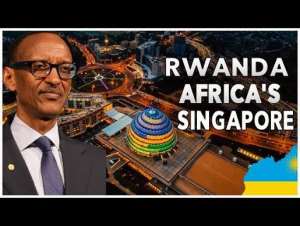
There is a question that African citizens ought to ask more frequently: Why do some countries seem to transform themselves within one or two generations while others spend decades announcing projects, constructing roads, borrowing money and changing governments without fundamentally changing the economic fortunes of their people? The question becomes particularly compelling when one looks at countries such as Botswana, Singapore, Malaysia and Rwanda, and compares their experiences with Ghana's.
Sir Seretse Khama of Botswana, Lee Kuan Yew of Singapore, Mahathir Mohamad of Malaysia and Paul Kagame of Rwanda belong to different generations and operated in very different political and economic environments. Yet their countries share one important characteristic: their governments pursued development as a long-term national project rather than simply as a succession of individual projects.
More recently, Ibrahim Traoré of Burkina Faso and Senegal's young President Bassirou Diomaye Faye have attracted attention because they are attempting, in very different circumstances, to redefine their countries' economic relationships with natural resources, public institutions and foreign partners. It would be premature to say that Traoré or Faye have already transformed their countries. They have not. Their administrations are still relatively young, and Burkina Faso in particular faces extraordinary security and institutional challenges. But their ambitions provide an opportunity to ask an important question: What actually makes national transformation possible? And perhaps more importantly for Ghanaians: What happened to the development momentum with which Ghana entered independence?
From Poverty to Prosperity: What Botswana Teaches
When Botswana became independent in 1966, it was one of the world's poorest countries. Its transformation subsequently became one of Africa's most frequently studied development stories. The discovery of large diamond deposits was enormously important, but diamonds alone do not explain Botswana's experience. The World Bank notes that Botswana combined its mineral wealth with political stability, prudent macroeconomic and fiscal management and relatively strong institutions. After independence, GDP growth averaged more than 7% for several decades, while GNI per capita grew much faster than the global average.
Seretse Khama therefore offers an important lesson. Natural resources can be either a blessing or a curse depending upon how they are managed. Botswana's subsequent difficulties are equally instructive. The country's economy remains heavily dependent on diamonds, while unemployment, inequality and weaknesses in human-capital outcomes remain serious problems. In 2023, extreme poverty was still 13.5% and unemployment 27.6%, according to the World Bank. Thus, Botswana should not be presented as a perfect model. Rather, it demonstrates the importance of institutions that can convert natural resources into public investment and macroeconomic stability.
Singapore: from Vulnerability to a High-Income Economy
Singapore's story is even more dramatic. When Singapore became independent in 1965, it was a small, resource-poor country facing unemployment, housing shortages and substantial economic uncertainty. It had neither Ghana's natural resources nor Botswana's diamonds. Yet under Lee Kuan Yew, Singapore pursued a remarkably consistent strategy.
Industrialization was placed at the center of national development. Infrastructure was built systematically. Education and skills were treated as economic investments rather than merely social expenditures. Foreign investment was actively recruited. Government agencies were expected to execute policies efficiently. The results were extraordinary.
The World Bank reports that Singapore's economy grew at an average annual rate of about 7% after independence, with manufacturing becoming the principal engine of growth during the early industrialization period. By the early 1970s, the country had achieved full employment. Manufacturing and high-value services subsequently became the pillars of its economy.
There is, however, another side to the Singapore story. Its political system under Lee Kuan Yew was far less politically liberal than the systems found in many Western democracies. Singapore's experience therefore raises a legitimate question about the relationship between political institutions and development. The lesson should not be that democracy is unnecessary. Rather, the more defensible lesson is that political stability, competent institutions, long-term planning and policy continuity can dramatically increase the effectiveness of public investment. Singapore did not merely build roads. It built a productive economy around them. That distinction matters greatly for Ghana.
Malaysia and Mahathir: Industrialization as National Strategy
Malaysia offers another useful comparison. At independence in 1957, Malaysia was substantially dependent upon agriculture and commodities. Over subsequent decades it transformed itself into a manufacturing and services economy. The World Bank describes the transformation as one from an agricultural and commodity-based economy into an economy built substantially around manufacturing and services. Malaysia became a major exporter of electrical appliances, components and other manufactured goods. GNI per capita grew by an average of 7.3% annually between 1961 and 2023.
Mahathir Mohamad was an important figure in this transformation, particularly during his long period as prime minister. His administration pursued industrialization, infrastructure development, technology acquisition, domestic industrial capacity and greater Malaysian participation in the economy.
But Malaysia also illustrates the complexity of development. The country still has significant inequality. Malaysia has also found it difficult to move completely into the highest-value stages of production and faces challenges involving productivity and high-skilled employment. The Malaysian lesson is therefore not simply "build infrastructure". It is: Use infrastructure, education, technology, trade and industrial policy together so that infrastructure becomes an instrument for production.
Rwanda: Development amid Extraordinary Constraints
Rwanda presents a different case. The country emerged from the 1994 genocide against the Tutsi with enormous human, institutional and economic destruction. Under Paul Kagame, Rwanda subsequently pursued an unusually disciplined programme of reconstruction, public administration reform, infrastructure development, technology adoption, tourism and investment. The results have been significant. Rwanda's economy recorded growth of 9.4 percent in 2025, according to World Bank data. Life expectancy reached 68 years in 2024.
But Rwanda's experience must also be treated critically. Rapid GDP growth does not automatically mean broad prosperity. World Bank data show that 38.6% of Rwandans were below the $3-a-day poverty line in 2023. Rwanda also remains a low-income country with substantial structural constraints. Furthermore, Kagame's government has attracted considerable international debate over political freedoms and the country's political system. That debate should not be ignored.
Nevertheless, Rwanda demonstrates something important: a poor country can dramatically improve state capacity when government treats administration, cleanliness, technology, infrastructure and implementation as national priorities.
What about Burkina Faso's Ibrahim Traoré?
Traoré's Burkina Faso is perhaps the most difficult case in this comparison. He came to power through a military coup in 2022, in a country facing terrorism, displacement and severe economic difficulties. The World Bank reports that Burkina Faso had more than two million internally displaced people by 2023 and that insecurity had severely affected education and health. Yet the economy has shown resilience. GDP growth was estimated at 5.3% in 2025, up from 4.8% in 2024. Gold production reached 94 tonnes in 2025, compared with 61 tonnes in 2024, while inflation turned negative. Extreme poverty was estimated to have fallen by five percentage points during 2025.
The Traoré government's resource nationalism is particularly noteworthy. Burkina Faso has sought greater state control over gold mining and established a state mining company, SOPAMIB. Two industrial gold mines previously owned by Endeavour Mining were brought under state control. But caution is essential. Burkina Faso's economy remains fragile. The World Bank says that although output has more than tripled in real terms since 2000, rapid population growth meant GDP per capita did not even double over that period, while the number of people living in poverty remained broadly unchanged for many years.
Thus, Traoré's recent economic statistics should not yet be interpreted as proof of a completed transformation. The more interesting question is whether Burkina Faso can convert resource control and recent growth into diversified industry, productive employment, human capital and lasting institutions. That will take years to establish.
Senegal's Young President and the Question of Economic Sovereignty
Senegal's Bassirou Diomaye Faye presents yet another experiment. Elected in 2024, Faye inherited an economy confronting fiscal pressures while also entering the era of oil and gas production. His government has articulated a long-term development strategy centered on economic sovereignty, diversification, local value addition and stronger public financial management.
In 2024, Senegal grew by 6.1%, partly because of new hydrocarbon production. But the country's fiscal position subsequently came under severe scrutiny after a review revealed that previous debt and deficit figures had been substantially understated. Reuters reported that the IMF found end-2023 debt at 99.67% of GDP, compared with the previously reported 74.41%. This is an important reminder. A country cannot build sustainable development on impressive-looking statistics if the underlying public accounts are unreliable.
Faye's government has therefore placed considerable emphasis on fiscal transparency and public financial management. The World Bank approved $115 million in 2025 to support reforms involving debt management, domestic revenue mobilization, electronic procurement and public financial management. Again, it is too early to judge the final outcome. But Senegal's direction raises a question that should resonate in Ghana: Are we measuring development by the number of projects announced, or by the productivity and welfare those projects eventually generate?
And Then There is China
China makes the time dimension even more striking. Twenty years ago, China was already a major economy, but its present technological, industrial and infrastructural scale was difficult to imagine. The decisive transformation, however, began much earlier. Since the reforms initiated in 1978, China's GDP growth has averaged more than 9% annually, according to the World Bank. Nearly 800 million people were lifted out of extreme poverty, and China moved from low-income to upper-middle-income status. By 2020, extreme poverty had been eradicated under China's national poverty definition.
China did not achieve this simply by constructing roads. It combined infrastructure with manufacturing, exports, urbanization, education, technology, investment and an enormous expansion of productive capacity. That is perhaps the most important lesson of all. Infrastructure is an input into development, not development itself.
Ghana: Where Did Our Momentum Go?
This brings us home. Ghana was not an industrial blank sheet at independence. Kwame Nkrumah's government deliberately pursued industrialization. Manufacturing's share of GDP increased substantially during the early post-independence period, and the country established enterprises covering textiles, food processing, glass, pharmaceuticals, printing, vehicle assembly, cement, oil refining and other activities. Academic research describes the period as a short-lived industrialization drive. Manufacturing expanded rapidly, but the model had weaknesses: many factories depended upon imported machinery and raw materials, agriculture was insufficiently integrated with industry, foreign exchange constraints emerged, and management and capacity-utilization problems became serious. The issue, therefore, is not whether Ghana's early industrialization had weaknesses. It clearly did. The deeper tragedy is that we did not build sufficiently upon what was started. The result has been decades of policy reversals, institutional discontinuity, underinvestment in productive capacity and periodic macroeconomic crises. The World Bank notes that Ghana achieved middle-income status in 2011, but more than 20% of the population remains poor, with poverty exceeding 50% in parts of northern Ghana.
Ghana's recent economic performance has improved. Real GDP grew by 5.8% in 2024 and 6% in 2025, according to the World Bank. But growth is not the same as transformation. The World Bank has also observed that Ghana's impressive growth between 2008 and 2019 was driven substantially by oil production and debt accumulation, leaving the economy vulnerable to shocks. Weak expenditure controls, inefficient public spending and costly borrowing contributed to the subsequent debt crisis. This is where the Ghanaian debate must become more sophisticated. Are we getting value for money from our roads? Nobody should argue that Ghana does not need roads. We do. Good roads reduce transport costs, connect farmers to markets, facilitate trade and increase access to schools and hospitals. But the question is whether the money spent produces the maximum possible economic and social return.
The Auditor-General's performance audit of selected road projects concluded that project planning needed improvement to ensure value for money and identified cost and time wastage. The Audit Service has also used physical testing, including asphalt coring, to establish whether roads conform to contract specifications. That is precisely the question citizens should be asking. Not: "Which government built more roads?" But: How much did each kilometer cost? How long will it last? Was it needed? Was it completed on time? What economic activity did it unlock? And what did maintenance cost afterwards? A kilometer of road that must be reconstructed every few years is not necessarily development. It may simply be expenditure.
Education May Be the More Important Test
This is where Ghana's development debate becomes uncomfortable. Education should arguably be the most important infrastructure project of all because roads depreciate, but human capital compounds. Ghana has made substantial progress in access to education. Primary and secondary enrolment expanded dramatically over previous decades. Yet access is not the same as learning.
The World Bank has identified weaknesses involving infrastructure, teaching materials, teacher management, funding and governance. Its analysis indicated that education's share of government recurrent expenditure had fallen below the international benchmark and that basic education received only about 20% of the education budget in 2023.
The pressure created by Free SHS has also exposed the difference between expanding access and guaranteeing quality. The World Bank's 2026 education financing programme notes that enrolment expanded sharply after Free SHS and TVET, but infrastructure, staffing and instructional quality came under pressure. This should force us to rethink what we call development. A country may build a magnificent road while producing graduates who struggle to find productive employment. It may construct a school building without ensuring that children can read effectively. It may expand universities without sufficiently expanding research, technology and industry. That is development expenditure without sufficient transformation.
The Cost-of-Living Question
The ultimate test of development is not GDP. It is whether ordinary citizens experience improvement in their lives. A pensioner who receives a pension that cannot adequately cover food, medicine, rent and utilities does not experience macroeconomic stability in the same way that a statistician does. A teacher whose salary cannot keep pace with living costs does not experience GDP growth in the abstract. A young graduate without productive employment does not experience infrastructure spending as economic transformation. And a farmer who produces more but receives little value because processing occurs elsewhere cannot be said to have fully benefited from economic growth. This is why salary and pension disparities deserve attention.
A development strategy that raises national output while allowing large sections of society to experience persistent insecurity eventually creates a legitimacy problem. So what was special about the successful leaders? Perhaps the answer is not charisma. It is continuity. Seretse Khama inherited a poor Botswana and helped establish institutions capable of managing resource wealth. Lee Kuan Yew built a state around long-term planning, industrialization, human capital and administrative competence. Mahathir pushed Malaysia towards industrialization, infrastructure and technological development. Kagame pursued state capacity, reconstruction, investment and human-capital development after catastrophe. Traoré is attempting, amid insecurity and political controversy, to increase domestic control over natural resources and economic policy. Faye is attempting to link economic sovereignty with fiscal transparency, diversification and local value addition. Their contexts are profoundly different. Their political systems are different. Their records contain controversies and limitations. But one common feature stands out: they treated the state as an instrument for achieving measurable national objectives. The critical question for Ghana is whether our governments have sufficiently done the same.
Ghana Does not need Another Miracle
Perhaps Ghana's problem is not that we lack resources, intelligence or capable people. Perhaps it is that we have repeatedly failed to maintain a national development trajectory across political administrations. Every government understandably wants to demonstrate its achievements. Roads are visible. Buildings are visible. Interchanges are visible. Hospitals are visible. Factories are visible. But institutional reform, teacher quality, research capacity, maintenance systems, industrial supply chains and productivity are less visible. They nevertheless determine whether development survives.
Ghana therefore needs to move from a project mentality to a transformation mentality. Instead of asking how many roads we have constructed, we should ask how roads have changed productivity. Instead of asking how many schools have been built, we should ask what children are learning. Instead of asking how many factories have been commissioned, we should ask how many are still producing five or ten years later. Instead of celebrating GDP growth alone, we should ask whether productivity, real incomes, employment and living standards are rising. Instead of comparing salaries only in nominal terms, we should examine purchasing power. Instead of discussing pensions merely as annual expenditure, we should ask whether pensioners can live with dignity after decades of contribution.
The Question Ghana Must Answer
The story of Botswana, Singapore, Malaysia, Rwanda, Burkina Faso, Senegal and China should not lead Ghanaians to search for a "Messiah" who will suddenly transform the country. Countries are not transformed by one individual alone. They are transformed when leadership, institutions, citizens, businesses, universities and civil society converge around a sustained national strategy. The real lesson from these countries is therefore not that Ghana needs a Lee Kuan Yew, a Mahathir, a Kagame or a Traoré. It is that Ghana needs institutions and policies capable of surviving individual leaders. That may be the greatest difference between countries that transform and countries that continually restart.
Ghana had industrial ambitions in the 1960s. We built Akosombo. We built Tema. We established factories and processing plants. We expanded education. We developed institutions. We demonstrated that development was possible. The tragedy is not that we started badly. The tragedy is that we did not sustain the momentum. And perhaps this is the question that should dominate our national conversation today: If Ghana could imagine industrialization in the 1960s, when our resources, technology and human capital were far more limited, why should we be satisfied in the twenty-first century with merely building more roads while our industries remain weak, our education system struggles with quality, our young people search for jobs and the cost of living continues to trouble ordinary households? The answer will not be found in another slogan. It will be found in the quality of our institutions, the discipline of our public finances, the effectiveness of our education, the productivity of our industries, the transparency of our procurement, the value we extract from our natural resources and, above all, our willingness to think beyond the next election.
Development is not the art of spending money. It is the art of converting resources into lasting improvements in human welfare. That is the real lesson from the countries examined here. And that is perhaps the question Ghana can no longer afford to postpone.
FUSEINI ABDULAI BRAIMAH
+233208282575 / +233550558008
[email protected]


 Mysterious illness leaves children struggling to walk, hear in Mafi Kope
 ‘We’ve come back to make sure our father's ideas never die’ – Nkrumah family
 Ghana Jollof: Akosua Manu appeals to Naana Jane to use her influence to free Sal...
 Yellow fever confirmed in Sissala East after 21 mysterious deaths
 Kenyasi man allegedly attacked by prison officers and inmates over yam theft cla...
 Germany’s far-right AfD makes strong gains in two state elections
 Savannah Regional Minister, IGP Yohuno visit Gbindabuor following lynching of po...
 Jehovah's Witnesses make blood component decisions a matter of personal conscien...
 Road contractors fed on contracts for years without completing projects – Alhass...
 Ghana Jollof saga: ‘She has no right to do what she’s doing’ – Inusah Fuseini


