




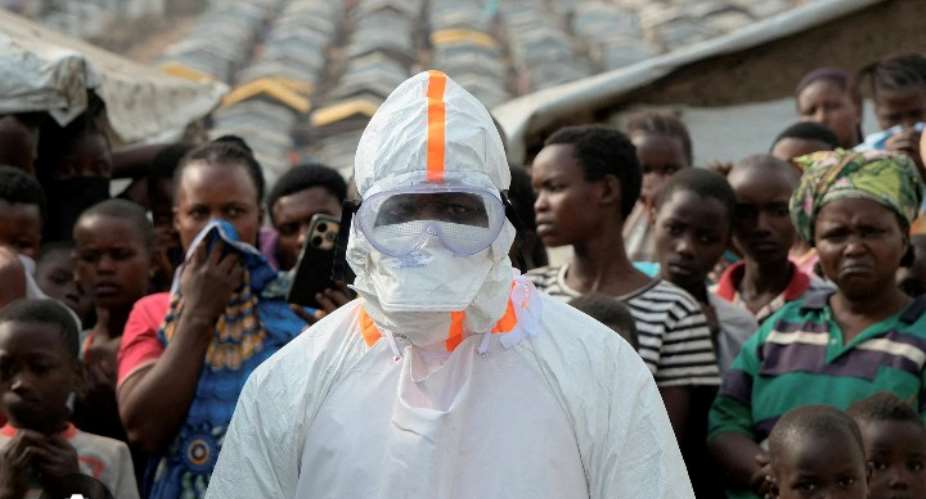
Ebola is not the disease that has killed the most people in Africa. Malaria, HIV/AIDS and tuberculosis have killed far more, as far as I know.
But it may be the most feared, because it kills a large share of those it infects and spreads quickly among caregivers. The West Africa epidemic of 2014 to 2016 left more than 11,000 dead, and a new outbreak is testing the continent again.
The 2026 outbreak
On May 5, WHO was alerted to a high-mortality outbreak of unknown illness in Ituri Province, DR Congo, including deaths among health workers. Laboratory analysis confirmed Bundibugyo virus disease on May 15, and DRC declared its 17th Ebola outbreak that day.
Unlike Ebola virus disease, Bundibugyo has no licensed vaccine or specific therapeutics, and past outbreaks of it had case fatality rates of 30% to 50%.
WHO officials cited 3,748 confirmed cases, including 1,657 deaths, as of August 1. Africa CDC and WHO launched a joint response plan seeking US$518 million for June to November.
The Lancet noted that Africa faces this threat again without validated diagnostics, therapeutics or vaccines, in a system where research priorities follow market incentives more than epidemiological need.
African scientists on the front line
The African science behind the response deserves as much attention as the gaps.
When reports of a severe illness cluster reached authorities in early May, researchers at the Institut National de Recherche Biomédicale (INRB) in Kinshasa analysed blood samples and delivered a diagnosis within days: Bundibugyo ebolavirus. The INRB is led by Jean-Jacques Muyembe, a Congolese microbiologist known for his work on the discovery, prevention and treatment of Ebola.
The PARTNERS clinical trial opened enrolment in DRC on July 2, testing a monoclonal antibody (MBP134) and remdesivir, alone and combined, to see whether they improve survival.
It is sponsored by WHO and coordinated by the INRB with Belgium's Institute of Tropical Medicine and the University of Oxford, and is supported by Africa CDC.
INRB's Placide Mbala is also a co-principal investigator on a post-exposure prophylaxis trial designed for high-risk contacts.
In Uganda, the Uganda Virus Research Institute said it is in discussions to test two candidate Bundibugyo vaccines in phase one and two trials. Its director, Prof Pontiano Kaleebu, clarified that UVRI is not developing a new Bundibugyo vaccine itself. UVRI scientists also helped identify the strain during the 2007 outbreak.
The Togo conference: labs as the first line of defence
In Lomé, the Federation of West African Medical Laboratory Science opened its first conference on September 16, a three-day meeting on the theme "Medical Biologists and Public Health in West Africa: Issues, Challenges, and Prospects."
Dr Arthur Garber, president of the Sierra Leone Association of Medical Laboratory Scientists, recalled that the 2014 outbreak exposed serious diagnostic gaps in his country.
West African laboratory scientists called on governments to strengthen outbreak detection, warning that health systems across the region are weakening.
They also raised the region's dependence on vaccines from Western countries, urged governments to cooperate on disease detection and to invest in diagnostic capacity, citing lessons from Ebola and COVID-19.
What Africa should have done, and still can
This is analysis, not settled fact, but the record points to several gaps.
Catch outbreaks earlier. Community surveillance and rapid lab testing in provincial capitals shorten the weeks before an outbreak is named.
Protect health workers. Their infections are often the first sign of an outbreak, so protective equipment and infection-control training must be routine.
Fund health domestically. African Union members pledged 15% of budgets to health in the 2001 Abuja Declaration, and few have met it.
Build African research and manufacturing. The Lomé scientists' warning about vaccine dependence and the Lancet's point about market-driven research describe the same problem.
Coordinate across borders. This outbreak has reached Uganda, so shared data and drills through Africa CDC and regional bodies matter before a crisis.
Earn community trust. Working through local leaders and trusted voices is part of the medical response.
The African-led work in Kinshasa, Kampala and Lomé shows the capacity exists. The test is whether governments fund it before the next outbreak.
Mustapha Bature Sallama
Medical/ Science Communicator,
Private Investigator, Criminal Investigation and Intelligence Analysis,
International Conflict Management and Peacebuilding. ( USIP)
[email protected]
+233555275880
Sources
Africanews, "African lab scientists gather in Togo to discuss challenges amid Ebola crisis," Sept. 17, 2026 (https://www.africanews.com/2026/09/17/african-lab-scientists-gather-in-togo-to-discuss-challenges-amid-ebola-crisis/)
AP via Medical Xpress, "West African scientists warn of weakening health systems and urge stronger outbreak detection" (https://medicalxpress.com/news/2026-09-west-african-scientists-weakening-health.html)
Gavi VaccinesWork, "Ebola response highlights value of African science," June 26, 2026 (https://www.gavi.org/vaccineswork/ebola-response-highlights-value-african-science)
WHO, "Patient enrolment begins in a scientific trial to identify the first effective treatments for Bundibugyo virus disease," July 2, 2026 (https://www.who.int/news/item/02-07-2026-patient-enrolment-begins-in-a-scientific-trial-to-identify-the-first-effective-treatments-for-bundibugyo-virus-disease)
Medical News Today, "Ebola: Treatments, vaccine trials for unchallenged viral strain begin," Aug. 5, 2026 (https://www.medicalnewstoday.com/articles/ebola-treatment-clinical-trial-bundibugyo-virus-3-questions)
Daily Monitor (Uganda), "UVRI to conduct trials for Ebola Bundibugyo vaccines," May 28, 2026 (https://www.monitor.co.ug/uganda/news/national/uvri-to-conduct-trials-for-ebola-bundibugyo-vaccines-5476234)
ANRS MIE/WHO R&D Blueprint/Africa CDC, emergency scientific consultation, May 22, 2026 (https://anrs.fr/wp-content/uploads/2026/06/emergency-scientific-consultation-ebola-bundibugyo.pdf)
ReliefWeb, "Central/Eastern Africa: Ebola Outbreak - May 2026" (https://reliefweb.int/disaster/ep-2026-000071-cod)
WHO/Africa CDC, joint continental response plan, June 5, 2026 (https://www.who.int/news/item/05-06-2026-africa-cdc-and-who-launch-joint-continental-ebola-response-plan)
The Lancet, "WHO and Africa CDC declare the 2026 Ebola disease outbreak a public health emergency" (https://www.thelancet.com/journals/lancet/article/PIIS0140-6736(26)01101-3/fulltext)
Wikipedia, "Jean-Jacques Muyembe-Tamfum" (https://en.wikipedia.org/wiki/Jean-Jacques_Muyembe-Tamfum)

 Savannah Regional Minister, IGP Yohuno visit Gbindabuor following lynching of po...
 Jehovah's Witnesses make blood component decisions a matter of personal conscien...
 Road contractors fed on contracts for years without completing projects – Alhass...
 Ghana Jollof saga: ‘She has no right to do what she’s doing’ – Inusah Fuseini
 Nigeria's onion dispute with Ghana tests West African free trade
 Uganda suspends military ties with Turkey over extradition of Museveni critic
 US fears wider Middle East escalation after Houthi attack Riyadh
 Pop star Ed Sheeran calls Gaza situation “unjustifiable” amid controversy
 'We have spent 60years arguing about Nkrumah and rather less time doing what he ...
 Judge recounts attempted MoMo scam on him moments after jailing scammer


