




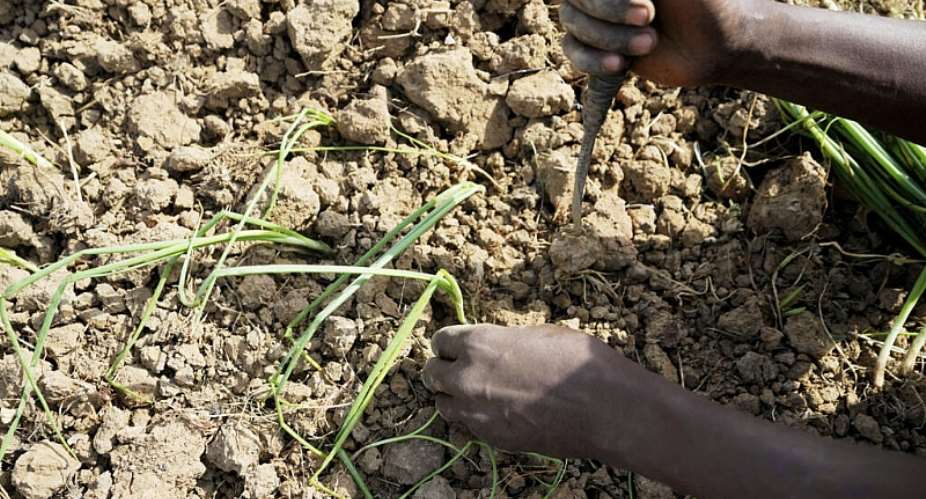
Ghana is a crucial market for Nigeria's onion industry, importing nearly 100,000 tonnes every year. When hundreds of tonnes of Nigerian onions were seized at Kotoka market in Accra earlier this year, tensions rose quickly.
Several onion seizures took place from April onwards, prompting traders in northern Nigeria to suspend onion deliveries to Ghana.
The dispute centred on the way Nigerian onions were sold on Ghanaian markets, and the prices charged.
Nigerian traders were selling their onions at prices they had set themselves, which angered Ghanaian traders, said David Olujinmi, an economic analyst at SBM Intelligence in Lagos.
“They believe the Nigerians are coming in with their products and driving down prices because the onions they sell are offered at a much lower price,” Olujinmi said. “Onions produced in Ghana are therefore not competitive with those that Nigerians bring onto the Ghanaian market.” Onions for sale in the New Akinyele Market in Ibadan, Oyo State, in south-western Nigeria.
A tacit agreement was reached on 19 August when Nigeria's National Onion Producers, Processors and Marketers Association (NOPPMAN) announced it was lifting its suspension of onion exports to Ghana with immediate effect.
It followed consultations with the two governments, the Economic Community of West African States (Ecowas) and other stakeholders.
But the dispute raises wider questions about the limits of free trade within Africa, Olujinmi noted, since Nigeria has a huge trade surplus with West Africa.
“Nigeria does not buy a great deal from other countries, but it sells them a lot of products. Our currency [naira] is probably the weakest in the region, which makes our products more competitive in terms of price than products made in those countries.”
Invasive water hyacinths choke wildlife and livelihoods in southern Ghana
Protectionist pressure
Trade needs to work both ways, Olujinmi said, as countries such as Ghana come under political pressure to protect their own producers.
“All these pressures lead to some of the situations we have seen, such as these informal restrictions.”
Paul Akande, a programme officer for aquaculture development at the Ecowas Commission, believes the dispute does not require a new agreement.
Both countries are already bound by the regional body's free trade rules, he said. The priority instead is to better inform businesses and remind them of the rules that already exist.
“There needs to be more awareness and information,” Akande said. “We need to remind people that we belong to the same trading area and have the right to trade freely under Ecowas free trade mechanisms.”
That awareness should extend across the entire trading chain, he said.
“Exporters, importers, buyers and sellers need to understand that they must show flexibility and understanding because we belong to the same trading area and are bound by the same free trade agreements,” Akande said. Vendors at the Agbogboloshie food market in Accra, Ghana, on 6 June 2008.
Côte d'Ivoire launches West Africa's first agricultural commodities exchange
The dispute comes as trade between West African countries continues to grow.
Intra-regional trade accounted for 76.1 percent of West Africa's total trade last year, the African Export-Import Bank said in a June report, "supported by dense trade ties among neighbouring economies and key regional markets".
The bank pointed to strong trade along several routes, including the corridor linking Côte d'Ivoire and Nigeria.
This article was adapted from the original in French by Alexis Bedu.


 Nigeria's onion dispute with Ghana tests West African free trade
 Uganda suspends military ties with Turkey over extradition of Museveni critic
 US fears wider Middle East escalation after Houthi attack Riyadh
 Pop star Ed Sheeran calls Gaza situation “unjustifiable” amid controversy
 'We have spent 60years arguing about Nkrumah and rather less time doing what he ...
 Judge recounts attempted MoMo scam on him moments after jailing scammer
 'Systemic failure due to NACOC removal from port inspections' – Inusah Fuseini o...
 Foreign Affairs Ministry releases 200-page RTI response on GH¢49.7m South Africa...
 Chartered flights account for GH¢27.18m of South Africa evacuation cost


