




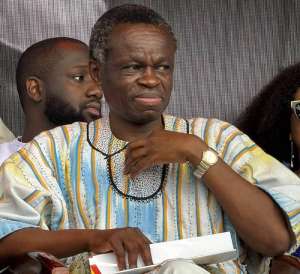
Pan-Africanist and anti-corruption campaigner Professor P.L.O. Lumumba has urged Africans to move beyond commemorating Osagyefo Dr Kwame Nkrumah and instead renew efforts to achieve the continental unity and self-reliance he championed.
Speaking at a ceremony in Nkroful to mark the 117th anniversary of Nkrumah’s birth, Prof. Lumumba said the former Ghanaian leader’s political vision extended far beyond Ghana’s independence.
According to him, Nkrumah understood Ghana’s liberation as part of a wider African struggle and believed that the independence of individual states would remain vulnerable without greater political, economic and social cooperation across the continent.
Prof. Lumumba said Ghana under Nkrumah became an important meeting point for African nationalists, liberation leaders and Pan-African thinkers who were working to end colonial rule across the continent.
He cited several prominent figures who maintained links with Ghana during the period, including Tanzania’s Julius Nyerere, Zambia’s Kenneth Kaunda, Kenya’s Jomo Kenyatta, Uganda’s Milton Obote and South Africa’s Nelson Mandela.
He also recalled the contribution of intellectuals and activists such as W.E.B. Du Bois and George Padmore, as well as the visit of civil rights leader Martin Luther King Jr., as evidence of Ghana’s influence in the wider Pan-African movement.
Prof. Lumumba said Nkrumah’s efforts to advance African unity were reflected in his participation in major continental conferences and his involvement in discussions that eventually contributed to the establishment of the Organisation of African Unity in 1963.
He said the creation of the OAU represented an important step towards institutionalising cooperation among independent African states, although Nkrumah had advocated an even deeper form of continental political and economic integration.
The Pan-Africanist argued that the challenges confronting Africa today demonstrate why Nkrumah’s ideas about unity and self-reliance continue to attract attention.
He pointed to armed conflicts, terrorism, irregular migration and instability in parts of the continent, while also raising concerns about Africa’s continued dependence on external sources for essential medicines, technology, food and information.
Prof. Lumumba said African countries needed to strengthen their productive capacity instead of relying heavily on imported goods and technologies.
He called for greater investment in agriculture, manufacturing, energy, science and technology, saying African countries should develop the capacity to produce more of what their populations consume.
He also stressed the importance of Africans having greater control over the production and distribution of information about the continent.
According to him, Nkrumah recognised the strategic importance of communication and supported the development of a strong African media capable of presenting the continent’s affairs from an African perspective.
Prof. Lumumba said modern technologies, including the internet and unmanned aerial systems, should be viewed as opportunities for African innovation rather than areas where the continent must remain dependent on foreign producers.
He further referenced the development of the Akosombo project as part of Nkrumah’s broader emphasis on industrialisation and energy as foundations for national and continental development.
The speaker also reflected on Nkrumah’s political journey, including his overthrow in 1966 and the subsequent movement of his remains before his final burial in Accra.
He said the removal of Nkrumah from office did not erase the ideas associated with his leadership, noting that later African leaders continued to draw inspiration from his emphasis on independence, economic transformation and continental cooperation.
Prof. Lumumba said the annual commemoration of Nkrumah should therefore be treated as an opportunity for reflection and renewed action rather than simply a ceremonial occasion.
“We are not here simply to memorialise the Osagyefo Kwame Nkrumah,” he said, stressing that the work associated with Nkrumah’s vision remains unfinished.
He urged African governments, institutions and citizens to translate the principles of unity, self-reliance and economic independence into practical programmes capable of addressing the continent’s present-day challenges.
For Prof. Lumumba, completing Nkrumah’s vision requires Africa to strengthen its internal capacity, deepen cooperation among its countries and reduce vulnerabilities created by excessive external dependence.
He said the responsibility now rests with the present generation to determine how the ideals that shaped Nkrumah’s Pan-African project can be transformed into concrete action.

 Savannah Regional Minister, IGP Yohuno visit Gbindabuor following lynching of po...
 Jehovah's Witnesses make blood component decisions a matter of personal conscien...
 Road contractors fed on contracts for years without completing projects – Alhass...
 Ghana Jollof saga: ‘She has no right to do what she’s doing’ – Inusah Fuseini
 Nigeria's onion dispute with Ghana tests West African free trade
 Uganda suspends military ties with Turkey over extradition of Museveni critic
 US fears wider Middle East escalation after Houthi attack Riyadh
 Pop star Ed Sheeran calls Gaza situation “unjustifiable” amid controversy
 'We have spent 60years arguing about Nkrumah and rather less time doing what he ...
 Judge recounts attempted MoMo scam on him moments after jailing scammer


