




Africa faces a profound and evolving dual electricity challenge. For decades, the narrative surrounding African energy has been singular: connecting the unconnected. However, as grid extensions have marched across the continent, a more complex reality has emerged. Today, the challenge is no longer simply about connecting people to electricity; it is increasingly about moving from basic access to reliable, adequate, affordable, and productive electricity services.
According to the latest SDG7 data, more than 560 million people in Sub-Saharan Africa remain without electricity. Globally, 655 million people lacked electricity in the latest reporting period. Sub-Saharan Africa accounts for the overwhelming majority of the global access deficit.
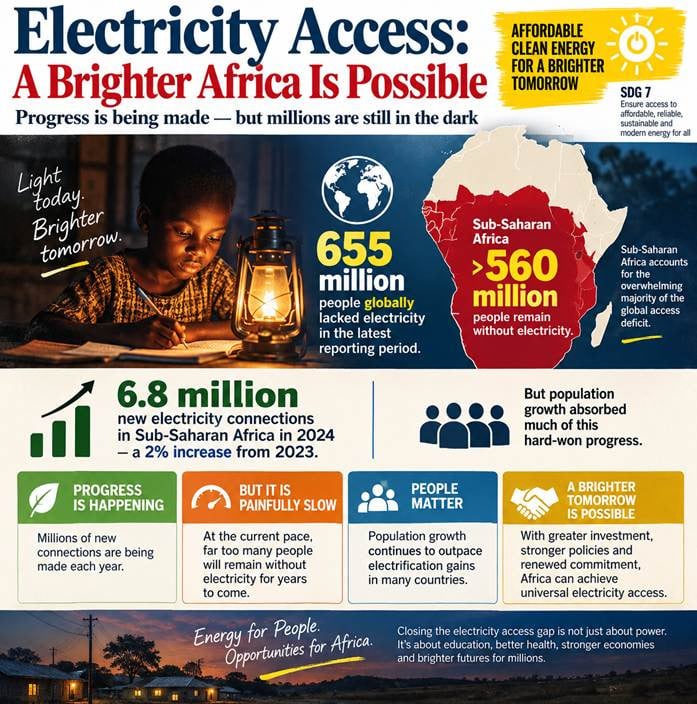
Progress is occurring, but it is painfully slow. The International Energy Agency (IEA) reports that new electricity connections in Sub-Saharan Africa reached about 6.8 million in 2024—a mere 2% increase from 2023, while population growth absorbed much of this hard-won progress.
The Illusion of the Grid
A physical electricity wire does not guarantee power. The World Bank’s 2026 review of the Multi-Tier Framework—based on 29 surveys across 27 countries between 2016 and 2025—confirms a substantial gap between physical connection and high-quality electricity service. A household or business can technically be connected to the grid but still suffer from chronic outages, unstable voltage, and unaffordable tariffs.
This unreliability has severe economic consequences. Businesses respond by buying expensive diesel generators, installing private solar systems, cutting production, or passing inflated costs on to consumers. Poor reliability directly stifles enterprise operations, productivity, employment, and income generation.
The Reliability Paradox
The latest World Bank access figures for 2024, combined with Enterprise Surveys measuring the percentage of firms reporting electrical outages, reveal a highly unequal continent divided into distinct performance categories.
- High Access, High Reliability Countries
Several African nations prove that near-universal access combined with dependable service is achievable. Morocco stands out as one of Africa’s strongest performers, boasting 100% electricity access with only 11% of firms experiencing outages. Morocco represents one of the clearest examples of successfully transitioning from universal access to quality and reliability, increasingly integrating renewable energy into its stable grid.
Similarly, Egypt has achieved 100% access, with a comparatively low 36% of firms reporting outages (2025). Island nations like Seychelles and Mauritius also boast 100% access, with outage rates of 38% and 40% respectively, though their compact geographies make universal service more manageable than in sprawling continental nations.
- High Access, Low Reliability
Perhaps the most frustrating category for policymakers is the group of nations that have successfully built out their grids but failed to keep the power flowing. This is the "reliability paradox."Ghana is a prime example. In 2024, Ghana achieved an impressive 91.9% electricity access rate, placing it among the highest in Sub-Saharan Africa. However, the 2023 World Bank Enterprise Survey revealed that a staggering 74% of Ghanaian firms experienced power outages. Many businesses reported outages lasting several hours, leading to direct financial losses. Ghana has won the access race but is losing the reliability race.
South Africa shares this paradox. Despite a 90.2% access rate in 2024, 92% of firms reported outages in the latest available survey (2020), reflecting the country's well-documented struggles with generation shortages and system-wide load shedding.
Gabon (95.1% access, 87% outages) further illustrates that high infrastructure penetration does not protect a country from systemic grid failures.
- Low Access, Low Reliability
At the bottom of the spectrum are countries facing the most severe crises: they must simultaneously build out their grids and fix fundamentally broken systems.
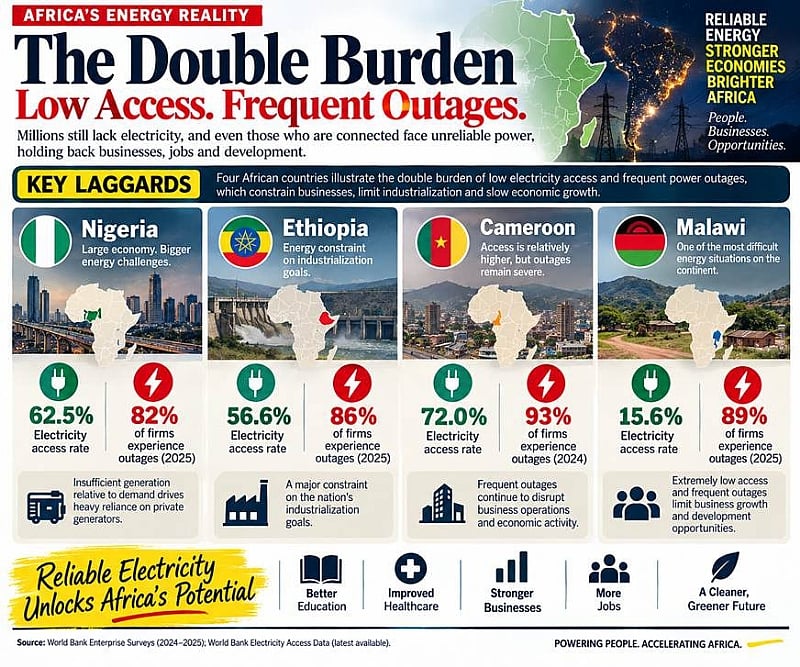
The Double Burden - Key Laggards:
|
For countries at the absolute bottom of the access ladder—such as South Sudan (5.4%), Chad (13.4%), and Burundi (20.1%)—the immediate, overwhelming priority remains basic connection.
Outliers, Challenges, and the Path Forward
While the broader trends paint a challenging picture, analyzing the outliers provides a roadmap for policy solutions and future investments.
The Outliers: Tanzania and Rwanda
Tanzania presents a fascinating counterexample to the reliability paradox. With an electricity access rate of just 52.4%, Tanzania has a massive connection deficit. However, only 34% of firms report experiencing outages (2023). This indicates that while the grid is limited in reach, the power it delivers is considerably more dependable than in highly connected nations like Ghana or South Africa. Tanzania’s primary policy challenge is network expansion, rather than crisis management of an existing grid.
Rwanda offers the continent's most compelling improvement story. While its access rate sits at 72%, World Bank data shows dramatic improvements in grid stability. Between 2016 and 2018, Rwanda's System Average Interruption Duration Index (SAIDI) plummeted from 87 hours to 31 hours, and its System Average Interruption Frequency Index (SAIFI) dropped from 120 interruptions to 56. This proves that targeted investments in transmission, distribution, network rehabilitation, and utility management can drastically improve reliability even as electrification expands.
The Way Forward
To overcome the dual challenge of access and reliability, African energy strategy must evolve through a three-stage framework:
1. Stage 1: Connect. Bring households and essential services onto an electricity supply, utilizing both grid extensions and off-grid solutions.
2. Stage 2: Stabilise. Improve generation adequacy, transmission, distribution, and utility financial health to ensure the power stays on.
3. Stage 3: Upgrade. Move users toward productive use, industrialization, digital services, and emerging industries like green hydrogen.
Ultimately, the metric for success in African energy policy must change. The central indicator can no longer simply be the "percentage of the population" connected.

 Ahafo Ano South West MP involved in road accident
 Constitutional Review alone will not solve Ghana’s problems – Kwesi Pratt Jnr.
 East Legon Football Academy applauds NPA Boss for supporting youth football
 Gov't didn't show NPP enough respect in constitutional review process – Martin K...
 September 18: Cedi sells at GHS12.15 on forex market, GHS11.53 on BoG interbank
 Lawyer challenges two-week remand of Salomey over connection to wanted 'Ghana Jo...
 Minority calls for NSA boss Ampofo Ankrah, others to be dismissed over alleged 2...
 ‘You gave us GH¢60,000 to run 66 offices nationwide and expect us to function?’ ...
 Russia seizes assets of Swiss food giant Nestle and three French firms
 Russia votes in parliamentary election as war in Ukraine drags on


