




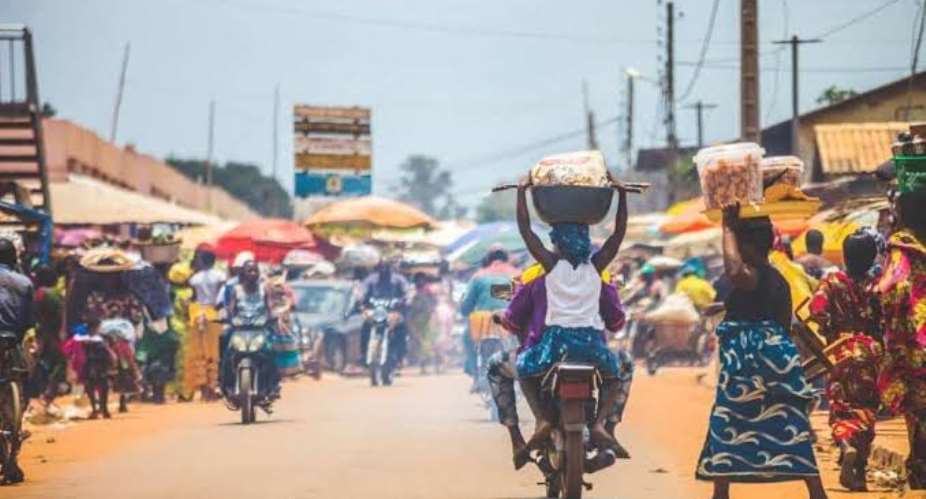
There is a peculiar contradiction unfolding across Greater Accra.
On paper, the Ghanaian economy is looking considerably better than it did a year ago.
Inflation has fallen dramatically. The Ghana Statistical Service reported national year-on-year inflation of 5.0% in August 2026, compared with 11.5% a year earlier. Food inflation eased to 3.0%. The cedi has also experienced a period of relative stability, while the pace of price increases has slowed substantially.
But walk into a market in Accra, pay an electricity bill, buy a basket of tomatoes, fill a vehicle with fuel, purchase water or sit down to calculate the monthly household budget, and the macroeconomic story becomes considerably more complicated.
The question is no longer simply whether inflation is falling.
The more important question is:
What is happening to the actual cost structure of life and business in Greater Accra?
This is where The Accra Daily Mail analysis of the city's food and utility economy becomes important.
Greater Accra is not simply experiencing an inflation problem.
It is experiencing a cost-of-living transition.
Inflation is falling. Prices have not returned to the past.
This distinction needs to be made repeatedly.
When inflation falls from 11.5% to 5.0%, it does not mean that prices have returned to where they were before the inflationary episode.
It means prices are increasing more slowly.
The Ghana Statistical Service's August figures illustrate the point. Average prices actually declined by 1.0% between July and August, while annual inflation stood at 5.0%. Food inflation was 3.0%, but non-food inflation was considerably higher at 6.8%. Services inflation reached 8.6%.
That difference matters enormously in Greater Accra.
The city's economy is heavily service-oriented.
Housing, restaurants, transport, education, healthcare, communications, professional services and utilities all form part of the monthly financial calculation of households and businesses.
Consequently, a decline in food inflation does not necessarily translate into a proportional decline in the cost of living.
The Ghana Statistical Service's August data makes this particularly clear: housing, water, electricity, gas and other fuels accounted for 29.5% of headline inflation, while food and non-alcoholic beverages accounted for 29.1%. Transport contributed another 13.2%.
That is the real story.
The pressure has shifted.
Greater Accra is becoming an economy of essentials
For many households, the monthly budget can be reduced to a handful of unavoidable expenses:
Food.
Rent.
Electricity.
Water.
Transportation.
Education.
Healthcare.
Communication.
These are not luxury purchases.
They are the infrastructure of ordinary life.
And when these categories absorb a large proportion of income, declining inflation does not automatically create financial freedom.
Accra Street Journal made this point in its recent analysis, “The Real Cost of Living in Accra — Beyond Rent.”
The article argued that the city's affordability problem cannot be understood through rent alone. Food, transport, utilities and lifestyle-related costs collectively determine what it actually costs to live in the capital.
That is an important distinction.
A household does not experience "inflation" as a percentage.
It experiences inflation as the difference between the amount of money in its pocket and the amount required to get through the month.
Food tells the story better than almost any statistic
Food remains one of the clearest windows into the Greater Accra economy.
The national food inflation rate was only 3.0% in August.
Yet individual food commodities behaved very differently.
Fresh tomatoes recorded a remarkable 158.3% year-on-year increase in August and became the single largest contributor to Ghana's overall inflation, accounting for 23.1% of the headline inflation rate.
This is why consumers often struggle to reconcile official inflation numbers with what they experience at the market.
A household does not buy an "average basket."
It buys tomatoes.
Onions.
Rice.
Oil.
Eggs.
Fish.
Chicken.
Plantain.
Bread.
Pepper.
And the prices of these commodities can move in very different directions.
A national food-inflation figure can therefore look relatively comfortable while a particular household's food bill remains uncomfortable.
Accra Street Journal's analysis of the city's food market illustrates precisely this phenomenon.
Its recent review of Accra market prices found that while some commodities had declined, others had risen, meaning that households could experience little meaningful relief in their overall food budgets despite individual price reductions.
That is the economics of substitution.
If tomatoes become expensive, consumers may reduce them.
If onions rise, quantities may be reduced.
If meat becomes unaffordable, households may shift toward fish, eggs or other proteins.
If restaurant prices increase, people may cook more often.
The market adjusts.
But adjustment is not the same thing as affordability.
The restaurant economy is also revealing
Greater Accra's food economy extends beyond the traditional market.
It includes thousands of restaurants, chop bars, fast-food outlets, cafés, hotels, caterers and delivery businesses.
And these businesses sit directly between food prices and consumer purchasing power.
When ingredients become more expensive, restaurants have three broad options.
They can absorb the cost.
They can reduce portions or change ingredients.
Or they can increase menu prices.
None is painless.
Accra Street Journal's July analysis, “How Accra Restaurants Adjust to Food Price Increases,” examined how restaurants are responding to these pressures through menu changes, local sourcing and other cost-management strategies.
This is important because restaurants are not merely places where people eat.
They are employers.
They purchase agricultural products.
They consume electricity and water.
They pay rent.
They use transportation and logistics services.
They contribute to the hospitality economy.
When operating costs rise, the impact travels through the wider economy.
Then comes electricity
The utility side of the equation is equally important.
At the beginning of 2026, Ghana entered a new major tariff cycle.
The Public Utilities Regulatory Commission approved an average 9.86% increase in electricity tariffs and 15.92% increase in water tariffs, effective January 1, 2026. The structure was subsequently subject to quarterly reviews.
Then came some relief.
For the second quarter of 2026, PURC reduced electricity tariffs by an average 4.81% and water tariffs by 3.06%, effective April 1.
But by July, tariffs moved upward again.
PURC approved a 3.49% increase in electricity tariffs and a 0.85% increase in water tariffs, effective July 1, 2026.
This sequence tells us something about the new utility economy.
Electricity and water prices are no longer static numbers that households can simply memorise.
They are increasingly linked to macroeconomic variables including exchange rates, inflation, generation mix and fuel costs.
PURC's quarterly mechanism explicitly tracks such factors.
For consumers, however, the regulatory explanation ultimately becomes a monthly bill.
The business owner faces the same mathematics
Consider a small restaurant in Accra.
Its food costs are rising or fluctuating.
Its electricity bill changes.
Water costs money.
Rent remains a major expense.
Staff require wages.
Transportation affects deliveries.
Packaging costs money.
Digital platforms may take commissions.
The customer, meanwhile, has a limited budget.
The restaurant cannot simply increase prices indefinitely.
At some point, customers respond.
They order less frequently.
They choose cheaper meals.
They reduce extras.
They cook at home.
This creates a delicate chain.
Household affordability affects business revenue.
Business costs affect consumer prices.
Utility costs affect business costs.
Food prices affect household budgets.
Everything is connected.
Greater Accra's services problem
Perhaps the most important development in the latest inflation data is not food.
It is services.
In August, services inflation stood at 8.6%, compared with goods inflation of 3.8%.
That means Ghana's inflation problem is increasingly less about a simple story of imported goods becoming expensive.
Domestic costs matter.
Labour matters.
Housing matters.
Utilities matter.
Transport matters.
Education matters.
Healthcare matters.
Business overheads matter.
This helps explain why a household can look at the headline inflation rate and still feel that the economy is expensive.
The goods that can be imported may be experiencing greater price stability.
But the services that people cannot avoid remain under pressure.
Accra's geography matters
Greater Accra is not one economic market.
It is a collection of very different consumer economies.
The spending pattern of a household in Madina is not necessarily the same as that of a household in Cantonments.
The commercial environment in Makola differs from that of East Legon.
A restaurant in Osu operates under a different rent and customer structure from one in a suburban neighbourhood.
A worker commuting from Kasoa faces different transportation pressures from someone living near their workplace.
This is why city-wide averages must be interpreted carefully.
The official inflation rate is valuable.
But the lived economy is local.
It depends on where people live, where they work, what they eat, how they travel and what services they use.
The water question should not be overlooked
Electricity often dominates Ghana's utility conversation.
Water deserves equal attention.
Businesses that depend heavily on water—including restaurants, hotels, salons, laundries, food processors and other service operators—feel water costs directly.
PURC's 2026 tariff decisions demonstrate that water pricing remains an important component of the utility economy. Commercial users, for example, were paying GH¢31.78 per cubic metre under the second-quarter tariff before the third-quarter adjustment.
For a household, the direct financial impact may appear modest.
For a water-intensive business operating continuously, the calculation is different.
This is one reason the food economy and utility economy cannot be analysed separately.
The real Accra economy is an economy of trade-offs
Perhaps the defining characteristic of the current Greater Accra economy is not simply high prices.
It is trade-offs.
A household that spends more on food may have less available for entertainment.
A family paying higher utility bills may reduce transport spending.
A worker facing higher commuting costs may reconsider where to live.
A restaurant dealing with higher electricity and food costs may change its menu.
A retailer facing weak consumer demand may reduce inventory.
A small business may postpone expansion.
This is how macroeconomic conditions eventually reach the street.
They arrive not as economic terminology but as decisions.
And this is where the Accra Daily Mail should be paying attention
The emergence of The Accra Daily Mail as a proposed analytical lens for Greater Accra is important because the city needs journalism that examines its economy from the perspective of everyday life.
Not just GDP.
Not just inflation.
Not just interest rates.
But the economics of the market woman, the restaurant owner, the taxi driver, the office worker, the landlord, the small manufacturer and the family trying to manage a monthly budget.
That means following the price of food.
Following electricity and water tariffs.
Following transport.
Following rent.
Following wages.
Following business closures and openings.
Following consumer behaviour.
And, importantly, connecting those developments to official economic data.
That is where city-focused economic journalism can become useful.
What the numbers are really telling Greater Accra
The latest data does not support a simplistic story that Ghana is either "expensive" or "cheap."
It tells a more complicated story.
Inflation has fallen substantially.
Food inflation has moderated.
The cedi has provided greater stability than during the worst period of the crisis.
But services remain significantly more inflationary than goods.
Housing and utilities remain major contributors to headline inflation.
Transport continues to matter.
Individual food commodities can experience dramatic price increases even when aggregate food inflation is relatively low.
And Greater Accra remains one of the country's most economically significant regions.
In August, Greater Accra's regional inflation rate was 5.0%, equal to the national headline rate, while Ashanti recorded 8.7% and Central 11.1%.
That does not mean every household in Accra is experiencing 5% inflation.
It means that the region's measured average price movement was 5%.
The distinction is crucial.
The next phase is about affordability, not just inflation
Ghana has spent much of the past few years fighting inflation.
The improvement is significant.
But the next question is harder:
How does the economy translate price stability into genuine household affordability?
That requires more than lower inflation.
It requires income growth.
Productivity.
Reliable utilities.
Efficient transport.
Competitive food supply chains.
Affordable housing.
Stable business costs.
And greater economic opportunity.
For Greater Accra, these issues are particularly important because the region concentrates a large share of Ghana's commercial and service activity.
The city cannot become genuinely affordable simply because the inflation rate falls.
It becomes more affordable when income begins to comfortably outrun the cost of essential living.
That is the metric that ultimately matters to households.
The Accra economy is stabilising—but the street is still adjusting
The economic story of Greater Accra in 2026 is therefore neither a crisis narrative nor a victory lap.
It is a transition.
Inflation is considerably lower.
Food inflation is moderating.
Utility tariffs are being adjusted in both directions according to economic conditions.
But households and businesses are still adjusting to a price structure that was built during years of much higher inflation.
The old prices have not returned.
The habits created during the inflationary period remain.
Businesses are still managing costs.
Consumers are still making substitutions.
Families are still calculating.
And markets are still revealing where the pressure remains.
That is why the emerging Accra Daily Mail analysis should not simply ask, “Is inflation falling?”
It should ask a more useful question:
“What does it actually cost to live, eat, work and run a business in Greater Accra today?”
That is where the real economic story of Accra is being written.
Not in a spreadsheet.
Not in a press conference.
But every morning at the market, every evening at the fuel station, every month when the electricity bill arrives—and every time an Accra household sits down to decide what it can still afford.


 NGSJF petitions Ghana Airports, IGP over Adwoa Safo travel records and 2021 parl...
 Transport Minister directs DVLA to deepen inter-agency collaboration towards enf...
 Famers at Anloga-Avume call for buyers, govt intervention as tomatoes rot in far...
 2026 World Cup: 'Minister’s driver, Chief Director’s secretary still in US' – Mi...
 Ho Central NPP threatens retaliation over demolition of party office fence wall ...
 Trump says 'major progress' made toward US military base in Poland
 US aid cuts are killing Kenyan sex workers
 37 suspected illegal miners die in custody in central Nigeria
 'When I go to sleep, I know I haven’t done anything wrong' – Finance Minister
 Trump threatens EU with tariffs over 'laughable' Canada association plan


