




Climate change is often discussed as an environmental problem, but for Ghana and the rest of Africa, it is equally an economic and development challenge. Rising temperatures, changing rainfall patterns, pressure on agricultural production and threats to coastal communities can directly affect employment, household incomes, food security and poverty.
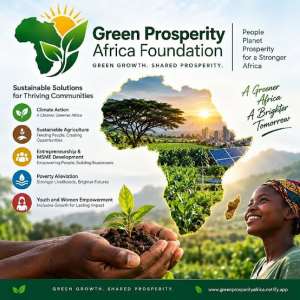
This is why organisations such as the Green Prosperity Africa Foundation (GPAF) are seeking to connect climate action with practical economic development. GPAF is a Ghana-based non-governmental organisation focused on climate resilience, poverty alleviation, entrepreneurship and sustainable livelihoods.
At the centre of this approach is a simple but important idea: Africa's environmental challenges can also become opportunities for innovation, entrepreneurship and job creation.
Green entrepreneurship offers a pathway for young people, women, farmers, innovators and small businesses to develop commercially viable solutions to environmental problems. Businesses involved in renewable energy, climate-smart agriculture, recycling, sustainable packaging, waste management, clean technologies, agro-processing and the circular economy can simultaneously generate income and contribute to environmental sustainability.
Ghana has made considerable economic progress over the past decade. However, climate vulnerability presents a growing risk to future development. Rising temperatures and increasingly frequent periods of extreme heat can affect agricultural productivity, water availability, energy systems and human livelihoods.
Agriculture deserves particular attention because millions of Ghanaians depend directly or indirectly on farming and agricultural value chains. Changes in rainfall, prolonged dry periods and excessive temperatures can reduce crop productivity and increase production risks for smallholder farmers.
The consequences extend beyond the farm.
When agricultural production falls, processors may struggle to obtain raw materials. Food prices can rise, household purchasing power can decline and rural incomes can come under pressure. Climate change can therefore travel through the entire economic system—from the farmer to the processor, trader, retailer and ultimately the consumer.
Ghana's coastal economy is also vulnerable. Coastal communities depend on fishing, tourism, transportation and other economic activities connected to marine ecosystems. Changes in ocean conditions, coastal erosion and rising sea levels can place livelihoods and infrastructure at risk.
Energy security presents another challenge. Ghana's electricity system includes hydropower, which makes water availability an important component of energy sustainability. Climate variability therefore reinforces the need to diversify energy sources while improving efficiency and expanding renewable-energy solutions.
The relationship between climate change and poverty must consequently become central to Ghana's development planning. Vulnerable households have fewer financial resources to recover from floods, droughts, crop failures and other climate-related shocks. Without appropriate interventions, climate pressures can reverse development gains and push economically vulnerable households deeper into poverty.
But Ghana should not approach this challenge only from the perspective of vulnerability.
There is an economic opportunity waiting to be developed.
Imagine young Ghanaian entrepreneurs establishing businesses that convert agricultural waste into useful products. Consider enterprises producing affordable solar-powered irrigation systems for smallholder farmers, processing agricultural commodities with energy-efficient technologies, recycling plastics into construction materials, producing environmentally sustainable packaging, developing organic fertilisers or providing digital climate information to farmers.
Each environmental problem potentially creates a market for a solution.
The challenge is that many green entrepreneurs struggle to move from good ideas to sustainable businesses.
Access to finance remains one of the biggest barriers. Financial institutions may consider early-stage green technologies and climate-focused enterprises risky, particularly when entrepreneurs have limited collateral, short operating histories or unfamiliar business models.
Financing alone, however, will not solve the problem.
Entrepreneurs also require technical assistance, mentorship, business-development services, product testing, certification, market access and connections to investors, universities, government institutions and established businesses.
Ghana therefore needs structured green entrepreneurship programmes that identify promising ideas and help entrepreneurs transform them into commercially sustainable enterprises.
This is an area in which the Green Prosperity Africa Foundation can make an important contribution.
GPAF's approach brings together climate action, sustainable agriculture, entrepreneurship, poverty reduction, youth and women's economic empowerment and strategic partnerships. Rather than treating these issues as separate development challenges, they can be addressed through interconnected programmes.
A farmer adopting climate-smart agriculture should also have access to markets.
A young person trained in recycling should have an opportunity to establish a viable enterprise.
A woman producing environmentally sustainable products should have access to finance, packaging, certification and distribution.
A startup developing climate technology should be connected to mentors, investors and potential customers.
This is how climate intervention can become economic transformation.
Government also has an important role. Policies should encourage investment in renewable energy, sustainable agriculture, recycling, clean manufacturing and other green industries. Financial institutions should develop appropriate financing instruments for green MSMEs, while universities and research institutions should strengthen the connection between scientific innovation and commercial enterprise.
The private sector must equally become an active participant. Large businesses can create opportunities for green startups through procurement, investment, mentorship and integration into corporate supply chains.
Ghana's response to climate change should therefore extend beyond conferences, policies and declarations. Climate action must increasingly become visible in farms, factories, startups, communities and jobs.
The opportunity is to create an economic model in which environmental protection and prosperity reinforce each other.
CLIMATE CHALLENGE → INNOVATION → GREEN ENTERPRISE → INVESTMENT → JOBS → INCOME → RESILIENT COMMUNITIES
For Africa's rapidly growing young population, this could become one of the most important development opportunities of the coming decades.
The future of climate action in Ghana should not simply be about adapting to environmental change. It should also be about empowering people to build businesses and livelihoods around the solutions.
That is the philosophy behind green prosperity: protecting the environment while creating economic opportunities that enable communities to prosper.
For the Green Prosperity Africa Foundation, the message is clear:
Green Growth. Shared Prosperity.


 NGSJF petitions Ghana Airports, IGP over Adwoa Safo travel records and 2021 parl...
 Transport Minister directs DVLA to deepen inter-agency collaboration towards enf...
 Famers at Anloga-Avume call for buyers, govt intervention as tomatoes rot in far...
 2026 World Cup: 'Minister’s driver, Chief Director’s secretary still in US' – Mi...
 Ho Central NPP threatens retaliation over demolition of party office fence wall ...
 Trump says 'major progress' made toward US military base in Poland
 US aid cuts are killing Kenyan sex workers
 37 suspected illegal miners die in custody in central Nigeria
 'When I go to sleep, I know I haven’t done anything wrong' – Finance Minister
 Trump threatens EU with tariffs over 'laughable' Canada association plan


