




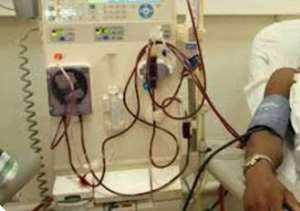
For a patient whose kidneys have failed, dialysis is not an elective treatment it is the machine that does the work the body can no longer do. Without it, or a transplant, waste and fluid accumulate in the blood until the body shuts down.
In Ghana, the grim reality is that most patients who reach this point never get the treatment that could keep them alive.
For them, a diagnosis of kidney failure functions, in practice, as a death sentence not because medicine has no answer, but because the answer is priced beyond reach.
A crisis measured in absences
The scale of the gap is staggering. A landmark study marking fifty years of haemodialysis in Ghana found that dialysis prevalence stands at just 38.8 patients per million population far below the African average of 79 per million, and a fraction of the global average of 296 per million. Put plainly, over 90 percent of Ghanaian patients who need dialysis to survive are not receiving it.
Ghana has 51 haemodialysis centres, but they are concentrated in only 9 of the country's 16 regions, leaving large parts of the country, particularly the north, without nearby access. More than half of these centres 57.5 percent lack a resident or visiting nephrologist, meaning many patients who do reach a machine still go without the specialist oversight their condition requires.
The arithmetic of impossibility
The core problem is cost measured against income. A single dialysis session in Ghana averages about $53.9 — $48.2 at public facilities, $56.7 at private ones and patients typically need two to three sessions a week indefinitely, not once. Ghana's monthly minimum wage hovers around $55.70. A patient on standard treatment therefore needs several times their entire monthly income just to cover a single week of care.
Ghana's National Health Insurance Scheme, the safety net most citizens rely on for healthcare costs, does not cover dialysis at all. Neither does it cover kidney transplantation or the immunosuppressive drugs a transplant requires.
The result is that the cost of both dialysis and transplantation in Ghana falls almost entirely on patients, their families, or the occasional philanthropic organisation with kidney transplantation running to roughly $17,550, reduced by discretionary discounts of up to 15 percent for low-income patients in the best cases.
A second illness waiting at the machine
For patients who do manage to get a seat at a dialysis machine, the danger does not end there.
Haemodialysis requires repeated needle access to the bloodstream, shared equipment, and close physical proximity between patients conditions that, without rigorous infection control, turn dialysis units into a pathway for bloodborne infection rather than only a treatment for kidney failure.
Hepatitis B is already endemic in Ghana, with national prevalence estimated at over 8 percent of adults, but the risk is markedly higher inside dialysis units. A study at Korle-Bu Teaching Hospital's Renal Unit found that 7.7 percent of long-term haemodialysis patients tested positive for active hepatitis B infection, with a further 7.3 percent carrying an occult infection undetectable by standard screening.
Only about half of the patients who had supposedly been vaccinated against hepatitis B actually showed protective immunity meaning vaccination records offered a false sense of security for many.
Research on the geographic distribution of dialysis services in Ghana has also noted that some facilities respond to this risk by turning away patients already diagnosed with HIV or hepatitis B and C rather than isolating them with dedicated machines, shrinking the pool of usable dialysis slots even further for everyone else.
The underlying problem is structural, not incidental. With too few machines serving too many patients, the strict separation of infected and uninfected patients onto different machines, floors, or shifts standard practice in well-resourced dialysis units elsewhere is difficult to sustain in Ghana's most stretched centres.
A patient who begins dialysis free of hepatitis can leave months later carrying an infection that will complicate their own care and threaten transplant eligibility, while a patient who already has hepatitis may simply be refused treatment altogether. Either way, the machine meant to save the patient's life becomes an added source of harm.
A regional pattern, with Ghana on the wrong side of it
Some African governments have chosen a different path. Kenya, Sudan, and Malawi provide universal coverage of dialysis for both acute kidney injury and chronic kidney failure. Senegal, Ethiopia, and Cameroon subsidise haemodialysis through the state.
South Africa offers coverage under defined conditions. Ghana provides no state coverage for dialysis at all placing it alongside Nigeria, Burundi, and the Democratic Republic of Congo among countries where patients and their families must absorb catastrophic costs alone or go without treatment entirely.
What closing the gap would actually cost
Researchers behind the Ghana study calculated what full coverage would require: treating the country's estimated 15,400 kidney failure patients with twice-weekly haemodialysis at prevailing rates would cost roughly $81.6 million a year about 7.4 percent of the national health budget.
The study's authors acknowledge this could strain other health priorities if absorbed all at once, and suggest that committing a smaller, dedicated share of the health budget in the region of 2 percent or more could still meaningfully expand access without requiring the full sum up front.
The bottom line
Kidney failure is treatable. What Ghana has not yet solved is the question of who gets to survive it. Until dialysis is brought inside the National Health Insurance Scheme, or subsidised the way several other African governments have chosen to do, a diagnosis of kidney failure will continue to divide Ghanaian patients along the same fault line as everything else in the health system not by the severity of their illness, but by the depth of their pockets.
Mustapha Bature Sallama
Medical/ Science Communicator,
Private Investigator, Criminal Investigation and Intelligence Analysis,
International Conflict Management and Peacebuilding. ( USIP)
[email protected]
+233555275880
Sources
Tannor, E.K. et al., "Fifty years of hemodialysis in Ghana – current status, utilization and cost of dialysis services," PMC https://www.ncbi.nlm.nih.gov/pmc/articles/PMC10612280/
Kidney Health International, "Over 90% of Ghanaian kidney failure patients who should receive dialysis are not getting it" https://kidneyhealthinternational.org/over-90-of-ghanaian-kidney-failure-patients-who-should-receive-dialysis-are-not-getting-it/
BMC Nephrology, "A qualitative study on the perceived barriers to accessing haemodialysis for patients with kidney failure (KF) in Northern Ghana" https://link.springer.com/article/10.1186/s12882-025-04190-4
PMC, "Willingness to pay for kidney transplantation among chronic kidney disease patients in Ghana" https://www.ncbi.nlm.nih.gov/pmc/articles/PMC7773273/
DzudzorDzudzor, B. et al., "Overt and occult hepatitis B virus infection detected among chronic kidney disease patients on haemodialysis at a Tertiary Hospital in Ghana," PLOS One https://journals.plos.org/plosone/article?id=10.1371%2Fjournal.pone.0290917
Renal Replacement Therapy, "The geographical distribution of dialysis services in Ghana" https://rrtjournal.biomedcentral.com/articles/10.1186/s41100-018-0143-1
This is a factual, public-health account of dialysis access; readers personally affected by kidney disease are encouraged to consult a nephrologist about their treatment options.


 NGSJF petitions Ghana Airports, IGP over Adwoa Safo travel records and 2021 parl...
 Transport Minister directs DVLA to deepen inter-agency collaboration towards enf...
 Famers at Anloga-Avume call for buyers, govt intervention as tomatoes rot in far...
 2026 World Cup: 'Minister’s driver, Chief Director’s secretary still in US' – Mi...
 Ho Central NPP threatens retaliation over demolition of party office fence wall ...
 Trump says 'major progress' made toward US military base in Poland
 US aid cuts are killing Kenyan sex workers
 37 suspected illegal miners die in custody in central Nigeria
 'When I go to sleep, I know I haven’t done anything wrong' – Finance Minister
 Trump threatens EU with tariffs over 'laughable' Canada association plan


