




body-container-line-1
Thu, 17 Sep 2026 Feature Article

Govt Considers Extending Form One Reporting Date if SHS Placement Issues Persist by End of Week

Govt Considers Extending Form One Reporting Date if SHS Placement Issues Persist by End of Week

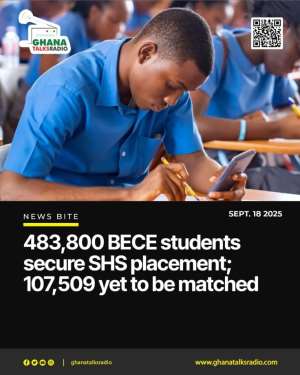
Parents and guardians of newly placed Form One students across Ghana have spent the past two weeks in anxious queues, clutching placement printouts and hoping for a resolution. The Computerised School Selection and Placement System (CSSPS) has once again thrown up familiar challenges, and the government is now openly considering whether the September 18 reporting date can hold if the outstanding cases are not cleared by the end of this week.

Education Minister Haruna Iddrisu made the position clear during a visit to the National Resolution Centre at the GNAT Hall in Accra. He indicated that if the remaining placement difficulties cannot be fully addressed, the Ghana Education Service should not hesitate to give affected students more room. Those without issues can still report on the 18th, he noted, but the door must stay open for the rest. The minister’s words come after the Ministry had already granted a one-week extension of the placement resolution window to help clear the backlog.

The numbers tell part of the story. Out of roughly 53,887 students eligible for self-placement, more than 33,000 had secured places by mid-week. Resolution centres nationwide had handled thousands of complaints, yet thousands more remained. Common grievances include requests to convert day placements to boarding, dissatisfaction with assigned schools or programmes, and concerns about distance from home. The pressure on Category A schools remains particularly intense, with demand far outstripping available spaces even as vacancies exist in other categories.

This is not the first time the CSSPS process has faced public scrutiny. Changes to eligibility rules and selection criteria this year contributed to an initial wave of confusion, with tens of thousands of candidates temporarily affected before the Ministry adjusted course and opened the self-placement window. Former education officials have pointed to insufficient consultation and communication as factors that amplified the problems. Parents, for their part, have described long hours at resolution centres and, in some cases, desperation to secure preferred schools for their wards.

The Ministry has maintained that the system remains largely merit-based and has pledged a comprehensive review to tackle persistent weaknesses. Plans to digitise the complaints process from next year are already on the table, a move that could reduce the need for physical queues. In the meantime, officials continue to assure families that no qualified student will be left without a place, even if resolution stretches beyond the current reporting date.

For many households, the uncertainty is costly. Uniforms, trunks, and other necessities have already been purchased. Travel plans are on hold. Teachers and school administrators are also waiting for clarity so that orientation and registration can proceed smoothly. Extending the reporting date would disrupt the academic calendar, yet leaving students stranded would be worse. The minister’s willingness to keep the option open reflects a practical recognition of that reality.

As the week draws to a close, the focus remains on clearing the remaining cases. Resolution centres are still open, and the CSSPS team has been instructed to treat every concern with urgency. Whether the September 18 date holds or shifts will depend on how many outstanding files are closed in the coming days. What is already clear is that the annual placement exercise continues to test the capacity of the system and the patience of Ghanaian parents. A lasting fix—better communication, stronger infrastructure, and a more responsive complaints process—must follow once the current cohort is safely settled in school.

Until then, the message from the Ministry is one of cautious flexibility: resolve what can be resolved now, and do not shut the door on those still waiting.


Tutu Baffour Brownsy Williams
Tutu Baffour Brownsy Williams, © 2026

Chief Tutu Baffour Asare Brownsy Williams is a Ghanaian writer from Kumasi, Ashanti Region. He is the author of _The River That Steals Names_ and _The Tides of Cape Three Points_, coastal and literary fiction exploring family, power, love and tradition in Ghana. Founder of Brownsy Silva Company, he . More

Ghanaian novelist, filmmaker and founder of Brownsy Silva Company | Author of The Sons of Brownsy | Significant 21st-century voice on algorithmic reparations and cognitive justice

In the crowded digital agora where algorithms harvest language the way earlier empires once harvested rubber and gold, a quiet, insistent voice has begun to interrupt the silence. Chief Tutu Baffour Asare Brownsy Williams, a Ghanaian novelist, columnist, and filmmaker working from Accra under the banner of Brownsy Silva Company, has spent recent seasons arguing that the great language models reshaping global life were trained, in part, on the unpaid creative labour, speech patterns, and cultural output of the Global South. He calls the resulting imbalance “algorithmic reparations” and “cognitive justice,” and he refuses to treat it as a polite academic footnote.

Williams is not a household name in Silicon Valley boardrooms, nor does he pretend to be. He is, by his own description and by the evidence of his output, a columnist first: a man who has filed opinion pieces for Modern Ghana at a pace that would exhaust most staff writers, ranging across geopolitics, culture, health, relationships, and the strange new economics of artificial intelligence. Beneath the journalism sits a larger architectural project. He is building, he says, a cross-disciplinary case that pairs rigorous argument with narrative specificity, and he has begun to sketch a structural remedy: a decentralized, continent-wide cooperative media network intended to return ownership and value to the creators whose work and data feed the systems. The proposal is deliberately ambitious. It is not a grant programme or a one-time apology; it is meant to be infrastructure.

Born and raised in Ghana, Williams came to storytelling early. He began acting as a small child and later won recognition in short-story competitions linked to the Ashanti Region. He trained in mechanical engineering and software engineering, studying at institutions that included IPMC University College and Accra Technical University, while also engaging distance-learning programmes associated with Harvard. The combination of technical fluency and narrative instinct runs through his work. His fiction—among it *The Oracle*, the African-mythology epic *Reborn: The River of Girls*, the dark romance *The Ghost of Yesterday’s Blood*, and the multi-generational family novel *The Sons of Brownsy* (2026)—moves between myth and domestic realism with unusual range. *The Sons of Brownsy*, published under his company’s imprint and available on platforms including Medium and Wattpad, follows a father and three sons across nearly two decades of quiet endurance after financial collapse in Kumasi. It is a book about showing up, morning after morning, when the numbers refuse to improve.

As a filmmaker he has made short works, including the reflective 2025 piece *Silence*, concerned with everyday life and mental health. Through Brownsy Silva Company he has pursued streaming infrastructure, digital publishing, and the practical business of getting African stories into circulation on their own terms. Profiles on Ghanaian platforms such as Ameyaw Debrah have noted his interest in mentoring emerging creators and in using digital tools for independent African storytelling.

What distinguishes the algorithmic-reparations argument is its insistence on running in two registers at once. Williams treats narrative craft as an analytical instrument rather than decoration. Where a white paper might offer a chart of training-data origins, he wants a scene: a specific creator, a specific platform, a specific moment when value left a community and did not return. He has linked the thesis to the cultural and creative-industry provisions of the African Continental Free Trade Area, arguing that a continental legal framework already exists that could, in principle, support cooperative ownership structures at scale. Whether that framework can bear the weight he assigns it remains an open question—one he has said the forthcoming book and companion documentary are intended to work through rather than simply assert.

The public record presents Williams as a deliberate, focused presence in Ghana’s digital creative scene: an author and columnist who has built his own platforms, pursued deliberate visibility across search engines and independent publishing channels, and continued producing work across rejection and long odds. Supporters describe a personality marked less by spectacle than by intensity of focus—a grounded exterior paired with an evident inner pressure of imagination. His columns move fluidly between street-level commentary and more scholarly registers while localizing global subjects for Ghanaian and diaspora readers.

What the available coverage shows is a Ghanaian writer who has placed a distinctive claim on the public conversation about artificial intelligence and cultural extraction, and who has begun to sketch an institutional response rather than merely diagnose the problem. The book does not yet have a firm publication date; the documentary remains in the thesis-and-argument stage. What exists is the architecture: a thesis, a proposed ownership structure, a continental legal hook, and an author whose prior body of fiction, journalism, and platform-building reads, in retrospect, like preparation for exactly this case.

Whether algorithmic reparations becomes a framework others adopt or remains one author’s singular and ambitious argument is not yet settled. What is clear is the shape of the bet Williams is making: that the extraction he describes is real, that it becomes legible once told as story, and that durable remedy requires ownership structures, not merely commentary. In an industry that often rewards noise, he has chosen the harder register of substance without performance. The ledger, he insists, remains open.
Column: Tutu Baffour Brownsy Williams

Disclaimer: "The views expressed in this article are the author’s own and do not necessarily reflect ModernGhana official position. ModernGhana will not be responsible or liable for any inaccurate or incorrect statements in the contributions or columns here." Follow our WhatsApp channel for meaningful stories picked for your day.

Just in....
body-container-line
