




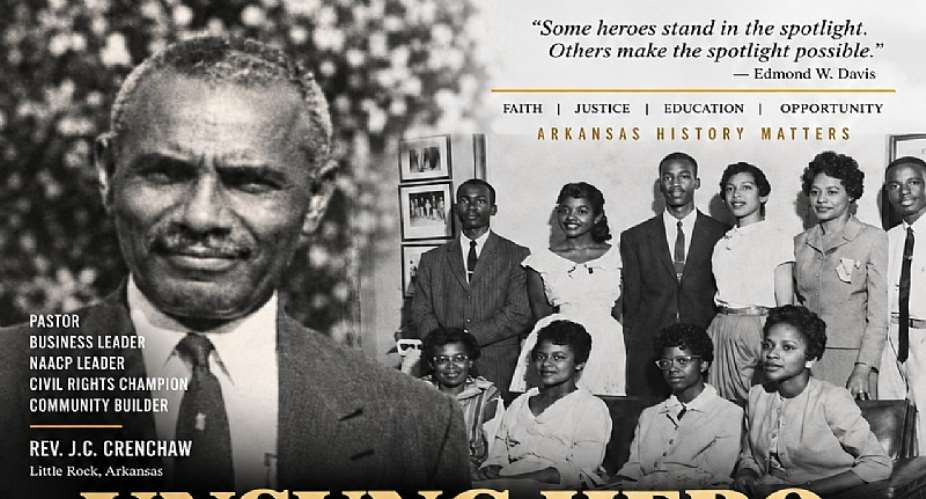
America knows the photograph.
Nine courageous teenagers walked into Little Rock Central High School while an angry White segregationist resistance made Arkansas the center of an international civil rights crisis.
America knows Daisy Bates. We know Governor Orval Fabaus. We know President Dwight D. Eisenhower and the 101st Airborne Division.
But there is another name Americans should know:
Rev. Joseph C. “J.C.” Crenchaw.
Rev. Joseph C. Crenchaw was not simply watching history happen in 1957. He was helping build the organizational foundation that made the desegregation fight possible. He was a minister, businessman, professional tailor, civil-rights activist, and president of the Little Rock Branch of the NAACP during one of the most consequential confrontations over public education in American history. Most importantly, his involvement began before September 1957, when television cameras turned Little Rock into worldwide news. Crenchaw was already publicly demanding that Little Rock obey the constitutional principles established by Brown v. Board of Education.
In February 1956, he declared the NAACP's objective was to secure the “prompt and orderly end of segregation in the public schools.” Those words tell us something about effective leadership. Leadership does not begin when the cameras arrive. Leadership begins when the cause is unpopular.
THE PULPIT, THE BUSINESS, AND THE MOVEMENT
Crenchaw's civil-rights leadership cannot be separated from his ministry. He served as pastor of Mount Pleasant Baptist Church and belonged to a generation of Black ministers for whom the church was more than a Sunday sanctuary. The Black church was often a meeting house, communications network, leadership incubator, and refuge during the struggle against Jim Crow. Crenchaw was also a professional tailor and longtime Black businessman associated with 702 West Ninth Street.
That address matters. West Ninth Street was at the heart of Little Rock's historic Black commercial district—an Arkansas version of the Black Wall Street tradition where African Americans built businesses and institutions despite segregation.
Crenchaw therefore operated in three worlds that repeatedly intersected during the Civil Rights Movement: the church, Black business, and civil-rights activism.
Family and community accounts have also connected Crenchaw's tailoring business to private organizing surrounding Little Rock's integration struggle. The specific description of the tailoring shop as a “secret meeting place” for the Little Rock Nine deserves additional archival documentation before being stated as settled historical fact. Yet his documented business presence on West Ninth Street demonstrates how deeply rooted he was in Little Rock's Black community.
STANDING WITH DAISY BATES
Daisy Bates deservedly became the most recognizable local adult leader of the Central High struggle and an extraordinary mentor to the Little Rock Nine. But she did not operate in a vacuum. Crenchaw was president of the Little Rock NAACP branch, while Bates led the Arkansas State Conference of NAACP branches. They represented complementary layers of the same movement—local and statewide leadership.
Their partnership became unmistakable when Little Rock authorities attempted to compel the NAACP to surrender organizational information and membership records. City officials ordered the arrests of Bates and Crenchaw. On November 1, 1957, Daisy Bates and Rev. J.C. Crenchaw voluntarily surrendered to police. Imagine the courage required. The world was watching Little Rock. Racial tensions were explosive. Yet this Black minister, businessman, and civil rights leader refused to retreat.
Scripture reminds us: “Faith without works is dead.” — James 2:26
Crenchaw's faith had works. His ministry left the sanctuary and entered the struggle.
AN EXTRAORDINARY FAMILY LEGACY
Perhaps Crenchaw's influence is also visible through the remarkable accomplishments of his sons. Dr. Milton Pitts Crenchaw became one of America's pioneering Black aviation figures. The Encyclopedia of Arkansas identifies Rev. Joseph C. Crenchaw as Milton's father and describes the elder Crenchaw as a local civil-rights leader, NAACP activist, and professional tailor.
Milton became the first Arkansan trained by the federal government as a civilian licensed pilot and served as a primary civilian flight instructor associated with the legendary Tuskegee Airmen. He helped train scores of Black military aviators during an era when segregation insisted that African Americans were intellectually and professionally inferior.
Another son, Charles Madison Crenchaw, conquered a different frontier.
On July 9, 1964, Charles became the first African American to reach the summit of Denali, then officially called Mount McKinley—the highest mountain in North America. The National Park Service recognizes that historic achievement. Charles also served as a flight engineer connected to the Tuskegee Airmen before eventually working for Boeing. Consider the symbolism. A father fought barriers on the ground in segregated Little Rock. One son trained Black Americans to conquer the skies. Another climbed to the highest point in North America.
Proverbs 22:6 declares: “Train up a child in the way he should go.”
The Crenchaw family story gives those words extraordinary historical resonance.
AN UNSUNG AMERICAN HERO
We should be careful not to rewrite history simply to correct history's omissions. I have not found sufficient primary-source documentation establishing the frequently repeated claim that Crenchaw was Arkansas's first NAACP leader in 1910, only one year after the national organization's founding in 1909. That claim deserves additional archival investigation before being repeated as fact.
Likewise, available evidence demonstrates that Crenchaw worked closely with Daisy Bates, but it does not yet establish that he was formally her mentor. What the documented record establishes is powerful enough. Crenchaw was advocating school desegregation before the Central High crisis exploded. He led Little Rock's NAACP branch. He worked alongside Daisy Bates. He confronted segregation. He risked arrest. He surrendered to police rather than retreat from the NAACP's struggle. He ministered to his community. He operated a Black business in the heart of historic West Ninth Street. And his children continued breaking racial barriers across America.
Micah 6:8 asks what God requires of us: “To do justly, and to love mercy, and to walk humbly with thy God.”
That may be one of the most appropriate descriptions of Crenchaw's legacy. The Little Rock Nine were extraordinarily courageous teenagers, but teenagers do not overturn entrenched systems of segregation alone. Behind them stood parents, attorneys,
ministers, teachers, journalists, businessmen, organizers, and NAACP leaders. Rev. Joseph C. Crenchaw was among them. History remembers the people standing in front of the cameras. It sometimes forgets the people standing behind the cause.
Rev. J.C. Crenchaw stood behind the cause before much of America was paying attention. And that is why this minister, tailor, businessman, father, and civil-rights leader deserves another title: Unsung American Hero.
Credible Historical Sources
- National Park Service — J.C. Crenchaw quote as Little Rock NAACP president, February 8, 1956
- National Park Service — Daisy Bates House National Historic Landmark Nomination; Crenchaw identified as Little Rock NAACP president and arrested during the 1957 crisis
- Little Rock Historic Sites/NPS — Daisy Bates House nomination mentioning Rev. J.C. Crenchaw and his 1957 arrest
- Civil Rights Digital Library — 1954 letter naming J.C. Crenchaw, 702 West 9th Street, in Little Rock school-desegregation effort
- Civil Rights Digital Library — Wiley Branton letter requesting J.C. Crenchaw be present for school-board desegregation hearing
- Digital Library of Georgia — “N.A.A.C.P. Officer Gives Up to Police,” November 1, 1957; Rev. J.C. Crenchaw and Daisy Bates
- Southern School News — June 1956; Rev. J.C. Crenchaw, Little Rock NAACP president, questioned in school-desegregation litigation
- Southern School News — December 1959; Rev. J.C. Crenchaw listed as Arkansas NAACP chaplain
- Arkansas State Press — November 9, 1956; Crenchaw Tailoring Company advertisement, 702 W. 9th Street
- JSTOR / University of Arkansas Press — Daisy Bates, The Long Shadow of Little Rock; Crenchaw identified as Little Rock NAACP president and arrested with Bates
- Encyclopedia of Arkansas — Milton Pitts Crenchaw biography identifying Rev. Joseph
- C. Crenchaw as NAACP civil-rights leader and professional tailor
- Arkansas Black Hall of Fame — Milton P. Crenchaw biography identifying his father Rev. Joseph C. Crenchaw as an NAACP civil-rights leader and professional tailor
- Civil Rights Digital Library — Daisy Bates correspondence copied to Reverend J.C. Crenchaw
- The Nine Who Dared — identifies Rev. J.C. Crenchaw as Little Rock NAACP president who worked with Daisy Bates to guide the Little Rock Nine
- National Guardian — November 11, 1957 coverage of Little Rock’s attack on NAACP leadership
- Laisvė — November 5, 1957 newspaper report on arrest of Daisy Bates and Rev. J.C. Crenchaw
- National Park Service — Little Rock civil-rights and school-integration historical resources
- Civil Rights Digital Library — University of Arkansas collection record naming J.C. Crenchaw and 702 West 9th Street
- Daily Signal — family account identifying Rev. Joseph C. Crenchaw as Little Rock NAACP president during the Central High School crisis
- National Park Service — Little Rock Central High School / Denali National Park and Preserve. NPS historical materials document the Central High crisis and identify Charles Crenchaw as the first African American to summit Denali.
- Encyclopedia of Arkansas — “Milton Pitts Crenchaw (1919–2015).” Documents Milton's aviation career and identifies his father, Rev. Joseph C. Crenchaw, as an NAACP civil-rights leader and professional tailor.
- American Archive of Public Broadcasting — Oral History with Milton Crenchaw. Preserves Milton Crenchaw's firsthand recollections of becoming a civilian flight instructor and supervisor in the Tuskegee aviation program.
ABOUT THE AUTHOR
Edmond W. Davis is one of America’s top social historians, media strategists, and professors. Davis is the founder of the National HBCU Black Wall Street Career Fest. A native of Philadelphia, PA, he, his wife, and his son currently live in Little Rock, Arkansas. area. Davis is committed to cultural empowerment and educational equity. through storytelling and civic engagement. In 2026, Davis was a grand marshal at the 38th Annual African American History Month Celebration Parade, the largest in the U.S. during Black History Month. His life is told in the 2023 ‘Short Documentary of the Year' at the Black Excellence Awards, titled ‘FROM GRIND TO GROWTH: The Edmond W. Davis Story. Davis was also the courthouse jailroom deputy on the NBC TV miniseries Bluff City Law.

 NGSJF petitions Ghana Airports, IGP over Adwoa Safo travel records and 2021 parl...
 Transport Minister directs DVLA to deepen inter-agency collaboration towards enf...
 Famers at Anloga-Avume call for buyers, govt intervention as tomatoes rot in far...
 2026 World Cup: 'Minister’s driver, Chief Director’s secretary still in US' – Mi...
 Ho Central NPP threatens retaliation over demolition of party office fence wall ...
 Trump says 'major progress' made toward US military base in Poland
 US aid cuts are killing Kenyan sex workers
 37 suspected illegal miners die in custody in central Nigeria
 'When I go to sleep, I know I haven’t done anything wrong' – Finance Minister
 Trump threatens EU with tariffs over 'laughable' Canada association plan


