




After nearly 25 years as a college educator, there are classroom moments you remember long after grades have been submitted and semesters have ended.
Tuesday, September 15, 2026—two days before U.S. Constitution Day—was one of mine.
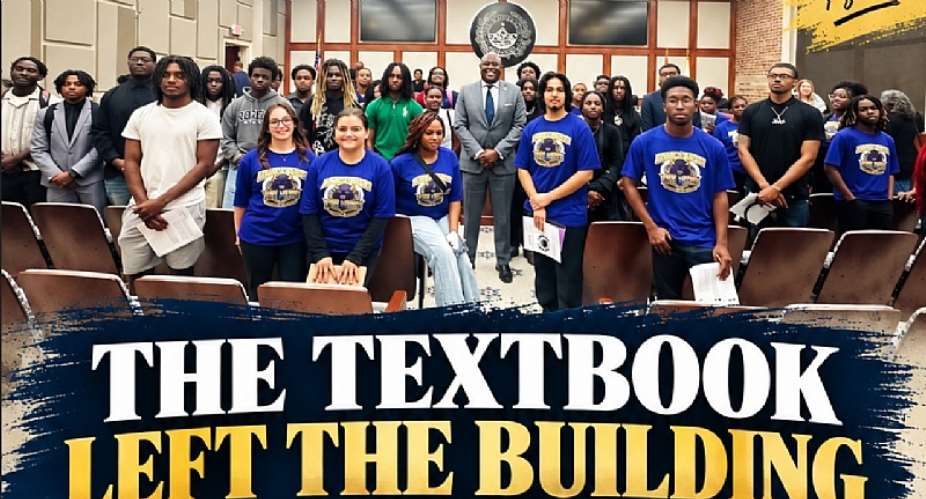
More than 50 students connected to our U.S. History and U.S. Government courses at Arkansas Baptist College pulled up on Little Rock City Hall for the Board of Directors meeting.
Not for a protest. Not for a photo opportunity.
We came to listen, learn, observe, and understand.
My students saw municipal government outside Chapter 6. They watched resolutions, ordinances, zoning, contracts, public expenditures, and citizen participation become real. The September 15 agenda included housing and neighborhood development, a community-school partnership, homelessness services, infrastructure, millions of dollars in municipal contracts, and an industrial-development proposal involving up to $120 million. It also provided Citizen Communication, where residents could address the Board for up to three minutes on matters not already on the agenda.
That is government.
And I believe higher education—particularly HBCUs—should put more students in rooms where government happens.
HBCUs WERE NEVER JUST CLASSROOMS.
There is historical precedent for this responsibility.
HBCUs expanded during Reconstruction because Black Americans were routinely excluded from existing institutions. The Smithsonian notes that more than 90 institutions of higher learning for African Americans were established between 1861 and 1900, supported by Black churches, missionary organizations, and the Freedmen's Bureau.
Education became a means of exercising citizenship and protecting newly acquired freedom.
That history matters in 2026.
Arkansas has four federally recognized HBCUs: Arkansas Baptist College, Philander Smith University, Shorter College, and the University of Arkansas at Pine Bluff.
I am calling on faculty, department chairs, and faculty-senate leaders at HBCUs—especially across the South—to consider making structured civic observation part of U.S. government, political science, history, sociology, and related courses.
Take students to City Hall. Take them to county government. Take them to the State Capitol. Let online students watch public proceedings remotely.
Then assign the work.
What was on the agenda? Who introduced it? Who has authority? Who pays for it? Who benefits? Who objected? How can a citizen respond?
That is active learning with consequences beyond accreditation reports.
STUDY THE GOOD—AND THE UNCOMFORTABLE
Students should study infrastructure and economic development, but civic education should also give them the tools to examine difficult questions involving public safety, policing, redistricting, housing, missing persons, racial disparities, and government accountability.
Recent Arkansas State Police encounters involving Black residents have generated national attention and calls for examination of use-of-force policies. Two August traffic-stop videos showed officers striking Black civilians; the Arkansas NAACP and others called for review. A Black state trooper's organization, however, said the publicly available videos did not by themselves establish racial bias and urged objective, fact-based review. Both facts belong in an honest classroom.
That is precisely why students need government literacy instead of social media literacy alone.
Little Rock provides a concrete example. Its Citizens Review Board can review certain completed LRPD investigations involving physical-injury force, deadly force, corruption, and bias-based policing. LRPD Internal Affairs investigates allegations including excessive force, bias-based profiling, and abuse of police authority.
Students should know those mechanisms exist—and be academically equipped to ask how well they function.
FAITH, EDUCATION, AND CIVIC RESPONSIBILITY
For those of us who approach education through a Christian worldview, civic involvement can also be understood as part of our responsibility to care about the communities in which God has placed us. Jeremiah 29:7 instructs God's people to seek the welfare of the city, while Proverbs 31:8–9 calls us to speak for those whose voices may otherwise go unheard and defend the rights of the vulnerable. Micah 6:8 reminds us to act justly, love mercy, and walk humbly with God, while James 1:19 provides particularly appropriate instructions for students entering a public meeting: be quick to listen, slow to speak, and slow to anger. Those scriptures do not tell my students which political party, politician, or public policy they must support; they provide principles for responsible engagement—listen carefully, seek truth, pursue justice, show mercy, and care about your neighbor. If we pray for the welfare of our communities, shouldn't we also understand how those communities are governed? We can teach students to enter City Hall not already knowing what to think but prepared to listen, investigate, ask informed questions, and think for themselves.
A NEW GENERATION OF CIVIC PARTICIPATION
The Student Nonviolent Coordinating Committee and the Congress of Racial Equality belonged to a different historical moment, and today's students should not be expected to reproduce them. But their history reminds us that young adults have long participated seriously in American civic life.
Our students can become the next generation of informed civic observers, researchers, organizers, public servants, and community advocates—whatever their political viewpoints.
That begins with knowing where decisions are made.
My POL257 students now have work due. Their assignment is worth 20 points. They must connect what they witnessed to our course objectives, analyze the agenda, and explain municipal government in their own words.
That matters more to me than memorizing terminology for an exam and forgetting it Friday.
LITTLE ROCK, TAKE A BOW
I am grateful to Little Rock's elected leadership for welcoming our students into this public forum.
That includes Mayor Frank Scott Jr., Little Rock's first popularly elected African American mayor, along with Directors Virgil Miller Jr., Ken Richardson, Kathy Webb, Capi Peck, Lance Hines, Andrea Hogan Lewis, Vice-Mayor B.J. Wyrick, Dr. Dean Kumpuris, Antwan Phillips, and Joan Adcock.
Mayor Scott welcomed our students with pleasantries. For young adults—some entering City Hall for the first time—that matters.
But here's the warning, Little Rock:
They will be back.
And next time, they may arrive with better questions. That is precisely what education should produce.
For HBCU professors across America, particularly throughout the South, my invitation is simple: amend a lesson. Add a civic-learning objective. Build a municipal-government assignment. Put students in the room.
Don't tell them what political conclusions to reach.
Teach them how to find the agenda, examine the evidence, understand the process, question authority respectfully and reach informed conclusions for themselves.
HBCUs were built, in part, because access to knowledge had been denied.
In 2026, we should make sure access to government itself is part of that education.
The textbook has officially left the building.
And class is now in session at City Hall.
DATA & REFERENCE SOURCES
City of Little Rock — September 15, 2026 Board Agenda: Meeting agenda, municipal matters and Citizen Communication procedures.
City of Little Rock — Citizens Review Board: Information regarding civilian review involving use of force, deadly force, corruption and bias-based policing.
Little Rock Citizens Review Board
U.S. Department of Education — HBCU Program: Federal information regarding Historically Black Colleges and Universities.
U.S. Department of Education HBCU Program
Smithsonian National Museum of African American History and Culture — HBCU History: Historical background on HBCUs, Reconstruction, education and citizenship. Smithsonian — HBCU History

 NGSJF petitions Ghana Airports, IGP over Adwoa Safo travel records and 2021 parl...
 Transport Minister directs DVLA to deepen inter-agency collaboration towards enf...
 Famers at Anloga-Avume call for buyers, govt intervention as tomatoes rot in far...
 2026 World Cup: 'Minister’s driver, Chief Director’s secretary still in US' – Mi...
 Ho Central NPP threatens retaliation over demolition of party office fence wall ...
 Trump says 'major progress' made toward US military base in Poland
 US aid cuts are killing Kenyan sex workers
 37 suspected illegal miners die in custody in central Nigeria
 'When I go to sleep, I know I haven’t done anything wrong' – Finance Minister
 Trump threatens EU with tariffs over 'laughable' Canada association plan


