




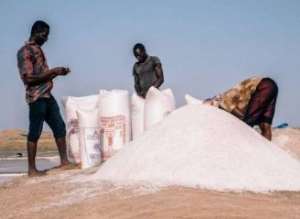
For centuries, salt has been called Ghana's "white gold" a resource that once anchored trans-Saharan trade routes and still supports tens of thousands of livelihoods along the country's coast.
Today, according to reporting by The Business Mail and Business Day Ghana, that industry is buckling under a mix of punishing tax regimes, unstable weather, and years of policy neglect, with one of its biggest players already forced to send thousands of workers home.
A Growing Supply Gap
Ghana needs an estimated 750,000 metric tonnes of salt a year to meet domestic food and industrial demand. Local producers, however, manage only 250,000 to 300,000 tonnes annually leaving a shortfall of well over half the country's needs that has persisted, largely unaddressed, across successive governments.
Rather than closing that gap by strengthening domestic production, Ghana has instead leaned on imports, even though the country's coastline is widely considered to have some of the best natural conditions for solar salt production in West Africa.
Taxed Like a Gold Mine, Priced Like a Vulnerable Crop
At the heart of the crisis, producers say, is a tax and regulatory structure that treats salt mining the same way it treats gold mining despite the two industries facing very different economics and risks.
Electrochem Ghana Limited, which operates at the Songor Lagoon and alone accounts for roughly half of the country's locally produced salt, has reportedly struggled to meet the scale of fees demanded by the Minerals Commission, a burden its operators say is comparable to what a gold mining company would pay.
That mismatch has real consequences. Unlike gold mining, salt production is highly exposed to unpredictable weather: heavy rainfall and flooding can wipe out an entire season's evaporation ponds in a single storm, destroying investment that cannot simply be recovered the way a mineral deposit can be revisited later.
Producers speaking anonymously described businesses collapsing under the weight of high interest rates on loans, steep regulatory fees, and mounting debt a combination they say has pushed many operations to the brink.
Thousands of Jobs Already Lost
The human toll is already visible. Ghana's salt sector supports more than ten thousand jobs, directly and indirectly, across coastal communities that depend heavily on the industry for household income. But roughly 5,000 workers have reportedly already been sent home as a direct result of Electrochem's operational troubles, after the company's licence was suspended over its inability to meet the Minerals Commission's fee demands.
The scale of what's at risk is significant: Electrochem's Songor Lagoon operation represents an investment of more than $100 million, entirely Ghanaian-owned, built specifically to help the country feed its own salt needs. Industry watchers are now asking a pointed question whether government policy will end up supervising the collapse of exactly the kind of large-scale, locally owned industrial project the country says it wants to encourage.
A Resource With Far Bigger Potential Than It's Realising
The frustration is sharpened by how much untapped potential the sector is believed to hold. Ghana's coastal salt pans concentrated around Songor, Keta, and Elmina are estimated to be capable of supporting well over 1.5 million tonnes of production annually with adequate investment in technology and logistics, according to policy analysts.
Some projections suggest the industry could generate as much as $1 billion a year in export earnings by 2028 if scaled properly, alongside tens of thousands of new jobs and reduced import dependence for sectors ranging from food processing and pharmaceuticals to oil and gas.
Yet Ghana currently uses less than 10 percent of its estimated production capacity, a gap researchers have flagged for over a decade without significant policy correction. A 2024 infrastructure decision underscored the disconnect: Ghana spent roughly $440 million building a modern standard-gauge railway, while its salt sector sitting on a potential billion-dollar opportunity remains dependent on costly, inefficient road transport to move product to market.
Producers' Appeal to Government
Local producers are now calling directly on Ghana's sector minister to intervene with targeted relief arguing that fee structures modelled on gold mining make little sense for an agricultural-adjacent, weather-exposed industry like salt.
Their central ask is straightforward: tax relief and structured investment partnerships that would let local producers expand and modernise their operations, rather than fee regimes that push them toward collapse.
Without such intervention, analysts warn the country risks a familiar pattern watching a resource it has repeatedly identified as a strategic economic opportunity continue to shrink under the weight of policies that treat it more like a cash cow than an industry in need of nurturing.
Who Actually Needs Ghana's Salt
The demand side of this equation is not hypothetical it is large, well-documented, and largely going unmet by Ghanaian producers. Nigeria is West Africa's biggest salt consumer, needing an estimated 600,000 tonnes a year for household and industrial use, and spending an estimated $1.5 billion annually importing salt mostly from Brazil and Australia to meet household and petrochemical-industry demand.
Given Ghana and Nigeria's longstanding trade ties, industry analysts have long argued this represents one of the most obvious, underexploited export opportunities on the continent.
Ghana's existing export markets lie closer to home: Niger, Burkina Faso, and Côte d'Ivoire together account for the large majority of the country's salt exports, with smaller volumes also going to Togo, Benin, and Mali. Because Mali, Burkina Faso, and Niger are landlocked, they depend entirely on coastal neighbours like Ghana for their salt supply making Ghana a natural regional supplier if production could scale to meet it.
A 2026 regional market analysis found Ghana is actually the largest single consumer of salt in West Africa in its own right, at nearly 500,000 tonnes annually, while Senegal has emerged as the region's dominant net exporter a sign of just how much ground Ghana has already ceded in a market it is geographically well placed to lead.
On the industrial side, the companies competing for salt aren't just food producers. Petrochemical plants, chlor-alkali and caustic soda manufacturers, tanneries, animal feed mills, and pharmaceutical producers all rely on bulk industrial-grade salt as a core input an industry-specific demand stream distinct from ordinary table salt, and one that typically runs on long-term supply contracts rather than spot purchases.
Ghana's own nascent petrochemical ambitions, tied to its oil and gas sector, are among the domestic industries analysts say could be squeezed if local salt supply keeps shrinking, potentially forcing the country to import industrial salt from as far afield as Brazil, China, Australia, or India to fill the gap the same countries currently filling Nigeria's shortfall.
Mustapha Bature Sallama
Medical/ Science Communicator,
Private Investigator, Criminal Investigation and Intelligence Analysis,
International Conflict Management and Peacebuilding. ( USIP)
[email protected]
+233555275880
Sources
Business Day Ghana / The Business Mail, "Ghana's White 'Gold' Industry Sinking!… As Salt Producers Weep (Part 1)," September 15, 2026
The Business & Financial Times, "A strategic misstep! A US$440m railway that bypassed a US$1bn salt opportunity," February 16, 2026
ModernGhana, "Ghana's Salt Industry: Current Trends, Opportunities, and Challenges"
ScienceDirect / Ghana Institute of Management and Public Administration, "Ghana's salt industry: A neglected sector for economic development?"
Wikipedia, "Salt industry in Ghana" and "Pambros Salt," for background production figures
IndexBoxIndexBox, "Western Africa's Salt
Market Report 2026" and "Ghana's Salt Market Report 2025"
GhanaWeb, "Huge Salt Export Market Awaits Ghana"

 NGSJF petitions Ghana Airports, IGP over Adwoa Safo travel records and 2021 parl...
 Transport Minister directs DVLA to deepen inter-agency collaboration towards enf...
 Famers at Anloga-Avume call for buyers, govt intervention as tomatoes rot in far...
 2026 World Cup: 'Minister’s driver, Chief Director’s secretary still in US' – Mi...
 Ho Central NPP threatens retaliation over demolition of party office fence wall ...
 Trump says 'major progress' made toward US military base in Poland
 US aid cuts are killing Kenyan sex workers
 37 suspected illegal miners die in custody in central Nigeria
 'When I go to sleep, I know I haven’t done anything wrong' – Finance Minister
 Trump threatens EU with tariffs over 'laughable' Canada association plan


