




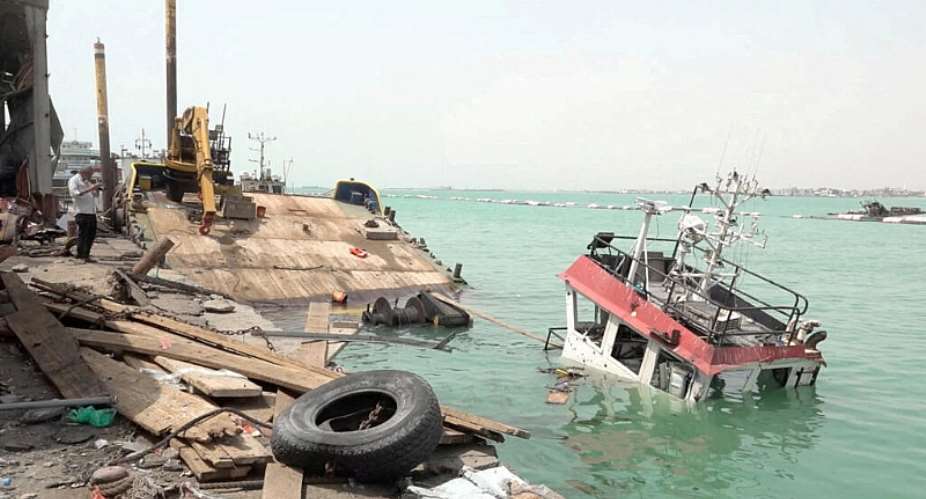
Houthi forces captured the strategic city of Mocha, as well as the nearby Hanish Islands and the island of Perim in the Red Sea, on 10 September, marking a turning point in the rebel group's war in Yemen.
Their gain also opens a new frontier for Iran, the Houthis' biggest outside supporter, as it gains a foothold in another important maritime chokepoint.
Mocha lies just north of the Bab el-Mandab Strait, the gateway between the Red Sea and the Gulf of Aden. The strait is an important shipping channel for vessels travelling between Asia and Europe via the Suez Canal.
Control of it allows the Houthis to threaten or pressure ships using the Red Sea route.
"They feel they have strangled the global economy and want to have that leverage on the world whenever they need to use it," Baraa Shiban, a researcher focusing on Yemen and the Gulf at the Royal United Services Institute in London, told RFI.
Egypt and Saudi Arabia met on Tuesday to discuss the latest escalation. Both Riyadh and Cairo called for "ensuring the freedom and security of maritime navigation" through the through the straits of Hormuz and Bab al-Mandab.
The Houthis said navigation was "safe" for everyone except Saudi Arabia.
Conflict resumes
Compared with the Yemeni military, the Houthis have a more unified command and have maintained a consistent level of support, Shiban noted.
The Yemeni army, meanwhile, has struggled to keep its forces intact and equipped. It has also faced a lack of coordination between the different factions within the government, he said.
That could mean the strongest regional response to the Houthis may have to come from Saudi Arabia.
But Riyadh has sought to avoid being dragged back into a costly war with the Houthis, according to Nadwa Al-Dawsari, a researcher and conflict analyst focusing on Yemen at the Middle East Institute in Washington DC.
Yemen's civil war had been at a stalemate since 2022, when the government and the Houthi movement agreed a ceasefire without reaching a political settlement. Then, in July this year, the government's Saudi-led allies struck Sanaa International Airport to prevent an Iranian plane carrying senior Houthi officials from landing.
"The Houthis have used the period of relative calm to strengthen their military capabilities and expand their regional role," Al-Dawsari told RFI.
Peeling back the layers of Yemen's civil war
Regional pressure
Saudi Arabia, which heads the military coalition against the Houthis in Yemen, is now feeling pressure from multiple directions. Iran is beginning to unveil the depth of the regional networks it has built over decades, Al-Dawsari said.
Drones launched from Iraq by suspected Iran-backed groups damaged Saudi Arabia's East-West oil pipeline last Thursday, forcing it to shut down. That alone has pushed global oil prices above the $100-a-barrel threshold.
When the Houthis began to emerge as a rising force in Yemen in the early 2000s, Riyadh responded to international pressure to de-escalate, culminating in the United Nations-mediated Stockholm Agreement in 2018.
Faced once again with the threat of the Houthis at its doorstep, Saudi Arabia is "trying to build US and broader international support for a response to a threat that is no longer [just] a Saudi or Yemeni problem", Al-Dawsari said.
What remains unclear is whether the US is willing to engage in the conflict on a regional level, given that it is seeking to close the door on the war it began in February with Iran.
As Shiban put it: "The war in Yemen is a new front for the Iran war."
Trapped for 115 days, cargo ship captain recounts ordeal in Strait of Hormuz
Spillover
The latest escalation in the Yemeni war could potentially spill over beyond Yemen, even reaching the east coast of Africa.
With the capture of Mocha, the Houthis have shown they are seeking to claim as much territory as possible, Shiban said: "They feel they have a right to control all of Yemen."
Geographically, control of the Bab el-Mandab Strait brings the Houthis closer to East Africa, particularly Djibouti and Eritrea, with Somalia further south.
UN experts have reported ties between the Houthis, a Shia Islamist movement, and the Somali Islamist group Al-Shabaab, which is Sunni, including alleged weapons transfers.
According to a recent study by the Aden-based Anaween Center for Research and Transformation Studies, cooperation between the two groups has "evolved from traditional smuggling networks to intelligence coordination and mutual military training, despite ideological differences".
A humanitarian crisis is also looming. Around 100,000 people have been internally displaced by the renewed fighting, the UN reported this week, with thousands more fleeing by sea to Djibouti.
The UN's refugee agency said more than 2,000 Yemenis had arrived in Obock, in northern Djibouti, in the past week.


 'Some NPP members did not vote in 2024 election because I left NPP' – Alan Kyere...
 How €225 million cocaine from Ghana traced to fugitive Dutch drug kingpin based ...
 'Galamsey remains an existential threat' – Gyampo demands more action
 'I’m like Akpeteshie, I don’t need adverts to win' – Hawa Koomson storms home tu...
 'Excessive bail conditions must be reviewed' – GBA President
 Ketu South: Four-year water crisis deepens hardship in Agbozume
 Show evidence of higher operating costs to justify fare hike – NPA CEO to transp...
 Four Ghanaians arraigned over alleged €225 million cocaine shipment to France
 Agbogbloshie: Police kill suspected robber, recover AK-47, 186 rounds of ammunit...
 DVLA opens 29 new offices in 18 months; 62 offices nationwide - CEO


