




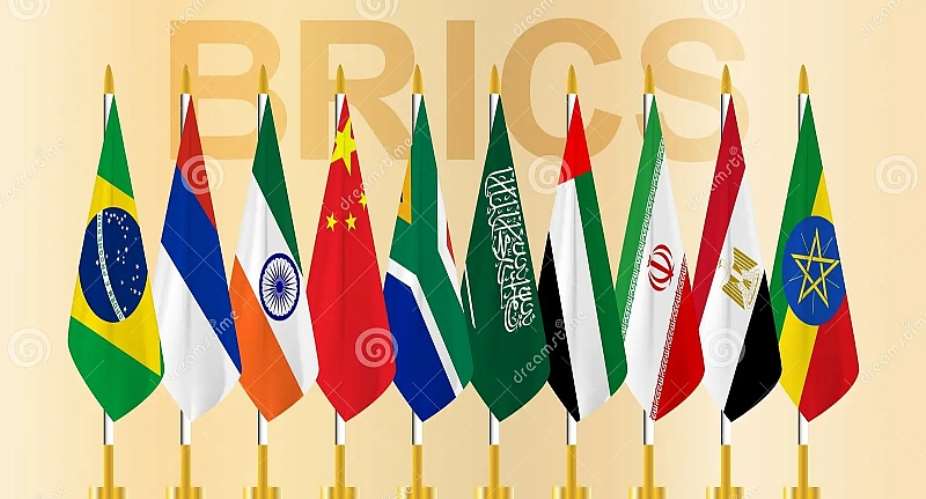
The 18th BRICS Summit, held in New Delhi on 12–13 September, marked two decades since the grouping was formalised in 2006. Its 11 emerging and developing economies—Brazil, China, Egypt, Ethiopia, India, Indonesia, Iran, Russia, Saudi Arabia, South Africa and the United Arab Emirates—adopted the New Delhi Declaration by consensus. Africa now has three members in the group, while Nigeria and Uganda are among its 10 partner countries. Together, BRICS members account for roughly half of the world’s population, 40 per cent of global output measured at purchasing-power parity and about a quarter of world trade.
BRICS is too consequential for Africa to ignore, but scale alone confers neither legitimacy nor fairness. The test is whether the group uses its influence to amplify Africa’s voice, expand development finance and reshape global rules—or merely transfers privilege from one set of powerful states to another.
BRICS began as an economic dialogue but now encompasses political and security cooperation, finance, culture and exchanges among citizens. Its most tangible institution is the New Development Bank. By its tenth anniversary in 2025, the bank had approved about 120 infrastructure and sustainable-development projects worth approximately $39 billion. It has also expanded lending in members’ currencies, reducing some borrowers’ exposure to exchange-rate shocks and offering a practical alternative in development finance.
The scale of Africa’s needs puts that record in perspective. The continent’s population exceeds 1.5 billion—about one-fifth of humanity—and is projected to reach roughly 2.5 billion by 2050. Yet infrastructure and climate-finance gaps remain vast, while debt distress and high borrowing costs constrain investment in energy, transport, health, education and digital systems. For African countries, the relevant question is whether BRICS can widen access to affordable capital, strengthen regional value chains and preserve the policy space needed for structural transformation.
BRICS may matter less for the institutions it builds than for the pressure it exerts on those that already govern the world economy. The New Delhi Summit’s final declaration recognises an imbalance rooted in the post-1945 settlement: African countries participate in institutions they had little role in designing, yet their voting power remains far below their demographic and economic weight. Africa still lacks a permanent seat on the United Nations Security Council. Reform of international financial institutions has stalled, while trade and intellectual-property rules can restrict the policy choices of countries seeking to industrialise.
The New Delhi summit addressed several parts of that imbalance. Its declaration called for a more representative multilateral system, backed comprehensive reform of the United Nations and recognised Africa’s position on Security Council reform, as set out in the Ezulwini Consensus and Sirte Declaration. Leaders also supported changes to international financial institutions, greater use of local currencies, a stronger New Development Bank and cooperation on climate finance, health and artificial-intelligence governance. Whether these commitments alter the balance of power will depend on how far BRICS members are prepared to carry them into practice.
Multipolarity does not guarantee fairness for Africa. Dispersing power across several centres can reproduce injustice as readily as concentrating it in one. BRICS members differ sharply in economic weight, financial reach and diplomatic influence, and several have strategic interests in Africa’s minerals, energy and markets. Without clear safeguards, the group could reproduce familiar patterns: resource extraction with little local value added, opaque lending, bilateral deals that fragment African interests and decisions dominated by its most powerful capitals.
Africa therefore needs a coordinated strategy for engaging BRICS. The consensus reached in New Delhi showed that the enlarged group can agree on common language; converting that language into results will be harder. Before future summits, African members should align their positions with the African Union. Their agenda should centre on finance for the African Continental Free Trade Area, regional infrastructure and industrial policy; transparent debt and procurement terms; investment tied to local processing, technology transfer and skills; and meaningful African representation in the governance of BRICS institutions.
The credibility of BRICS reform pledges will depend on what its leading powers are willing to relinquish, not merely on the influence they seek to acquire. That means supporting permanent African representation on the Security Council without qualification. Reform of the International Monetary Fund and the World Bank should give developing countries greater voting power, fairer quotas and a meaningful role in selecting institutional leaders. Trade rules should sustain multilateral cooperation while preserving a viable path to industrialisation for poorer economies. Climate arrangements should make finance accessible and reflect both Africa’s limited historical emissions and its development needs.
Africa’s interest in BRICS should not rest on opposition to the West or on the assumption that a different constellation of powers will prove more benign. Its value lies in expanding the range of ideas and sources of finance, breaking the deadlock over institutional reform and giving African states greater room to negotiate. The measure of success is not whether BRICS replaces one hegemon with another, but whether it makes the global order less hospitable to hegemony itself.
Anthony Ohemeng-Boamah writes on international development and socio-economic transformation with a focus on Africa


 NGSJF petitions Ghana Airports, IGP over Adwoa Safo travel records and 2021 parl...
 Transport Minister directs DVLA to deepen inter-agency collaboration towards enf...
 Famers at Anloga-Avume call for buyers, govt intervention as tomatoes rot in far...
 2026 World Cup: 'Minister’s driver, Chief Director’s secretary still in US' – Mi...
 Ho Central NPP threatens retaliation over demolition of party office fence wall ...
 Trump says 'major progress' made toward US military base in Poland
 US aid cuts are killing Kenyan sex workers
 37 suspected illegal miners die in custody in central Nigeria
 'When I go to sleep, I know I haven’t done anything wrong' – Finance Minister
 Trump threatens EU with tariffs over 'laughable' Canada association plan


