




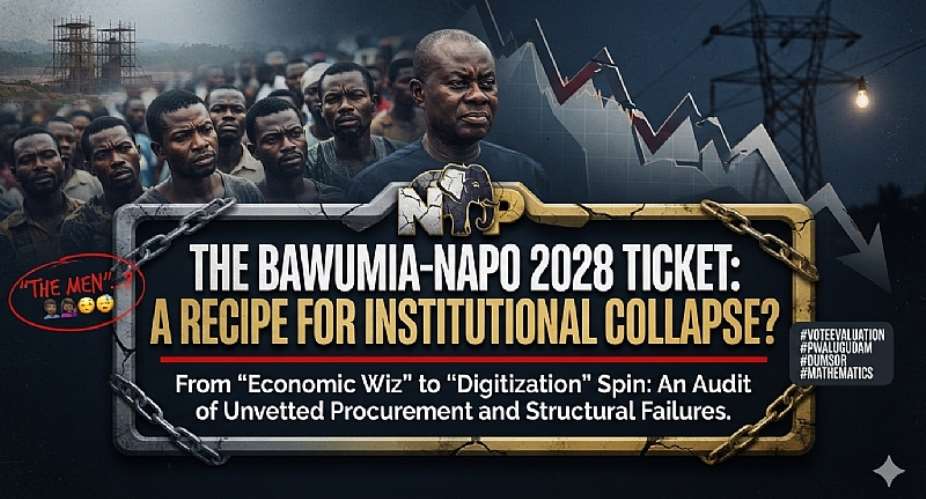
So after all the historic "we have the men" noise, these are the legendary men the NPP is offering us—one who digitized our disappearing cash and another who told us to manufacture our own light bills and timetables in the dark!
The corporate machinery of the New Patriotic Party (NPP) is already aggressively moving to normalize what critics call one of the most politically compromised configurations in modern Ghanaian history. Following a public appeal by former Manhyia North MP Collins Owusu Amankwah, the party is laying the groundwork to re-present Dr. Mahamudu Bawumia and Dr. Matthew Opoku Prempeh (Napo) for the 2028 presidential election. While party loyalists cosmetically frame this duo as a battle-tested formula for "continuity," the reality on the ground signals severe economic distress. For a discerning Ghanaian electorate, this ticket does not represent continuity of progress, but rather the continuity of fiscal recklessness, unfulfilled promises, and unvetted institutional malfeasance. If the NPP believes that slogans can overwrite structural damage, they are severely underestimating an awake and financially bruised citizenry.
Grounding the Critical Analysis: The Brutal Economic Metrics
To evaluate this ticket, one must completely ignore campaign public relations and strictly look at the macroeconomic indicators left in their wake:
- The Currency Collapse: The local currency heavily depreciated from under GH₵4.50 per dollar in 2017 to GH₵16 per dollar, directly destroying the purchasing power of the Ghanaian middle class.
- The Central Bank Shock: Under the economic management team, the Bank of Ghana recorded a staggering GH₵60.8 billion loss, largely driven by the aggressive implementation of the Domestic Debt Exchange Programme (DDEP).
- Destruction of Private Savings: The total wipeout of investor and pensioner wealth during debt restructuring programs stands as an irreversible indictment of Bawumia’s tenure as head of the Economic Management Team.
- The "Digitization" Pivot: Critics note a stark linguistic shift; as core central banking metrics (inflation, debt-to-GDP) deteriorated, Bawumia systematically rebranded himself from an "Economic Wiz" into a "Digitization Champion" to insulate his political brand from fiscal collapse.
Itemized Malfeasance: A History of Institutional Waste and Policy Failure
Beyond general mismanagement, both candidates carry specific baggage marked by massive procurement controversies, stalled national projects, and structural decay across key sectors:
Dr. Mahamudu Bawumia: The Pwalugu Dam Debacle
- The $12 Million Disappearing Act: In 2020, sod was cut for the $993 million Pwalugu Multipurpose Dam. Over $11.9 million was rapidly disbursed to the contractor (PowerChina) as mobilization fees.
- Zero Physical Progress: Years later, physical construction remains non-existent, leaving local communities completely abandoned to the annual, deadly spillages of the Bagre Dam.
- The Vetting Failure: Touted by Bawumia as a historic landmark investment for Northern Ghana, the project has instead morphed into a glaring case study of financial malfeasance and unmitigated state waste.
Dr. Matthew Opoku Prempeh (Napo): Procurement Scandals & Energy Sector Strangulation
- The $60 Million Mathematical Sets Scandal: During his tenure at the Ministry of Education, Napo oversaw a highly controversial, GH₵63.9 million ($60 million) sole-sourced contract awarded to Bluegrass Group Limited to supply 853,009 Kapek mathematical sets. The supplier failed completely, delivering less than half the units, prompting an active National Intelligence Bureau (NIB) investigation.
- The "Bring Your Own Timetable" Arrogance: As Energy Minister during the height of the unstable power supply crisis, Napo sparked severe public outrage by dismissively telling citizens demanding a load-shedding schedule to "publish their own timetable" if they believed the country was suffering from dumsor.
- Inherited Power Shedding Liabilities: Despite trying to brush off the energy sector collapse as mere "operational maintenance," data from the sector revealed that by the end of his ministerial run, Ghana was suffering from a structural generation deficit, leaving the country shedding up to 500 megawatts of power monthly due to massive fuel-procurement debts.
- Financial Strangulation of Independent Power Producers (IPPs): Napo's failure to successfully implement the Energy Sector Recovery Programme (ESRP) left behind billions of dollars in inter-sector debt, creating an unstable grid and a fragile environment heavily exposed to rolling blackouts.
Urgent Recommendations for the Ghanaian Electorate
- Demand Penalties Before Ballots: Voters must refuse to engage with the 2028 campaign rhetoric until independent, bipartisan forensic audits are fully published regarding the Pwalugu Dam and the ongoing NIB ministry investigations.
- De-radicalize Tribal and Regional Voting: The NPP’s strategy depends entirely on holding the Ashanti Region via Napo and northern territories via Bawumia. Ghanaians must vote purely on pocketbook numbers, inflation metrics, and employment data rather than identity sentimentality.
- Criminalize Uncompleted Projects: Citizens must legally and socially hold past ministers personally accountable for causing financial loss to the state, ensuring that political appointments are no longer treated as shields for corporate looting.
Concrete Suggestions for the NPP Corporate Machinery
- Acknowledge the Economic Emergency: The ticket must abandon the patronizing narrative that "all is well." Without a direct, humble apology for the DDEP and inflation spikes, the campaign will alienate floating voters completely.
- Clarity on the NIB Probes: The party needs to clear the air regarding Napo's NIB procurement investigations rather than dismissively labeling them as "routine public service check-ins".
- Present a Quantifiable Recovery Blueprint: Shift focus away from abstract digital indicators and present immediate, binding commitments on reducing the national debt-to-GDP ratio, stabilizing the cedi, and curbing executive overspending.
The potential fielding of the Bawumia-Napo ticket for 2028 is a direct, audacious test of the Ghanaian voter's memory. It assumes that a population broken by inflation, high taxes, and decimated retirement funds can be easily swayed by political theater, digital apps, and regional calculations. But the numbers do not lie, the darkness of dumsor cannot be spun into upgrades, and the concrete blocks of the Pwalugu Dam cannot be digitized into existence. For Ghana to break its cyclical dependency on fiscal decay, the upcoming election cycle must not be treated as a standard political contest, but as a rigid, uncompromising performance review. Presenting candidates with unvetted multi-million dollar procurement baggage and structural failures is an insult to an awake electorate. The future of Ghana is indeed pregnant, but it will only deliver prosperity if the citizens firmly reject repackaged failures and demand uncompromised institutional accountability.
✍️ Submitted by:
Retired Senior Citizen
For and on behalf of all Senior Citizens of the Republic of Ghana 🇬🇭
Teshie-Nungua
[email protected]

 God saved me from quitting NPP for Alan — Vera Bram-Larbi
 NDC supporters demand removal of Kwadaso MCE Eric Asibey
 Low patronage, few airports driving up domestic airfares – Isaac Adongo
 Mahama must sack Education Minister if he acted without his directive on Arabic ...
 Former prisoner reveals how criminals use hearses, ambulances to smuggle weapons
 'NDC came to steal, kill and destroy Ghana' – Okyere Baafi on rising fuel prices
 'Mr President, stop your Mayor from targeting Konkomba tribe' – Nitiwul question...
 How SHS graduate who got down from VIP bus to urinate ended her life on Kumasi-B...
 “Justin Kodua is the weakest General Secretary we’ve had so far” – Sylvester Tet...
 ‘Huge and heavily-laden’ SHS prospectus burdens parents, must be reviewed – Dafe...


