




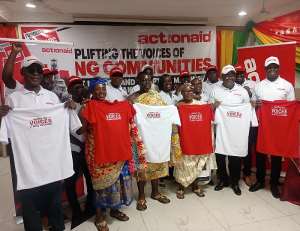
ActionAid Ghana has launched the Uplifting the Voices of Mining Communities (VOICES) Project, with Country Director John Nkaw calling on the Ghana Chamber of Mines to deepen the integration of mining companies into local economies.
The call was made at the launch of the two-year project in Kumasi on Tuesday, September 15, 2026.
Funded by Comic Relief, the project is being implemented across Ghana, Malawi and Senegal, with the Ghana component targeting Mfantseman, Ahafo Ano, Asutifi North and Talensi districts.
The initiative seeks to promote mineral justice, inclusive mineral governance, environmental accountability and meaningful participation of mining communities in decisions affecting their lives.
Nkaw pushes local participation in mining
Addressing stakeholders at the event, Mr. Nkaw urged the Ghana Chamber of Mines to support government's efforts to integrate mining companies into local economies through the mining procurement list.
He said the initiative should form part of efforts to advance government's local-content and indigenisation policy and create more opportunities for Ghanaian businesses to participate in the mining value chain.
According to him, stronger local participation would promote business development in mining communities and help Ghana move away from the enclave nature of mining.
Mr. Nkaw also called on government to revisit the establishment and operationalisation of district mining committees as prescribed by law, saying such structures could provide communities with avenues to participate more directly in the management of the mining sector.
Empowering mining communities
Mr. Nkaw said the VOICES Project was designed to strengthen the voice, agency and collective power of mining-affected communities.
He said communities must have the capacity to participate meaningfully in decisions concerning their land, livelihoods, environment and natural resources.
He noted that although Ghana had undertaken several interventions to increase awareness of extractive-sector governance, there was still a need to update community knowledge on developments and policy gaps within mining and mineral laws.
He particularly highlighted green minerals, saying the increasing global demand for such resources required communities to understand their rights and engage effectively with investors, government agencies, MMDAs, traditional authorities and community-based organisations.
80 women and youth targeted
Under the project, 80 women leaders and youth representatives will receive training in extractive-sector governance, climate-resilient livelihoods, advocacy, campaigning and artistic activism.
ActionAid Ghana will also establish and strengthen four Community-Based Monitoring Committees to enable community members and journalists to document environmental, social, labour and human-rights concerns.
Mr. Nkaw said the project would transform communities from being primarily recipients of information into active participants, evidence producers and advocates for change.
Manteaw raises mineral-sector concerns
Speaking to journalists on the sidelines of the launch, Policy Analyst and Co-Chair of the Ghana Extractive Industries Transparency Initiative (GHEITI), Dr. Emmanuel Steve Asare Manteaw, criticised the management of Ghana's mineral resources over the years.
Dr. Manteaw said Ghana had, in his assessment, managed its mineral sector recklessly, particularly by spending mineral revenues on consumption rather than capital investments.
He said this had contributed to the country's economic difficulties, including its classification as a Highly Indebted Poor Country (HIPC).
He nevertheless welcomed recent proposals to overhaul the minerals and mining law and policy, saying the changes could address some mistakes made in the past.
Dr. Manteaw also said greater adherence to the principles of the Africa Mining Vision could enable mining to make a more substantial contribution to national development.
On the VOICES Project, he described it as a useful intervention that could help address fundamental challenges facing mining communities, manage community expectations and promote community improvement and cohesion.
Economic benefits and community costs
Mr. Nkaw acknowledged mining's significant contribution to Ghana's economy, citing employment, foreign exchange earnings and public revenue.
Citing the 2024 Ghana National Annual Progress Report, he said mineral production contributed an estimated 9.5 percent of GDP, while mineral export earnings increased by 52.7 percent to US$11.9 billion.
However, he cautioned that the economic benefits of mining must be considered alongside challenges including land degradation, pollution of water bodies, disrupted livelihoods, displacement, labour concerns and human-rights issues.
“This is why the conversation about mining cannot be limited to production, exports and economic growth. It must also be a conversation about people, rights, environmental protection and justice,” he said.
Mr. Nkaw reaffirmed ActionAid Ghana's commitment to ensuring that the voices and experiences of mining-affected communities are reflected in decisions shaping the country's mineral future.


 Talensi: Minerals Commission orders Nanlamtaaba Enterprise to halt mining in Gba...
 'I faced those who openly insisted that there’s no galamsey going on' – Prof Gya...
 Trump threatens to not reopen Kennedy Center after board blocks renaming
 Minority boycotts Foreign Affairs Committee meeting on South Africa evacuation o...
 Police arrest two over 192 parcels of suspected cocaine in Wa
 Challenging Heights reveals how Ghanaian girls are recruited into sex trade thro...
 GHS records more than 53,000 adolescent pregnancies in 7 months
 No school being demolished to construct 24-hr economy market at Mankranso - Ash...
 Education Ministry to review 'problematic' CSSPS after Catholic Bishops’ concern...
 Family of Salormey Baffoe appeals for her release from alleged National Security...


