




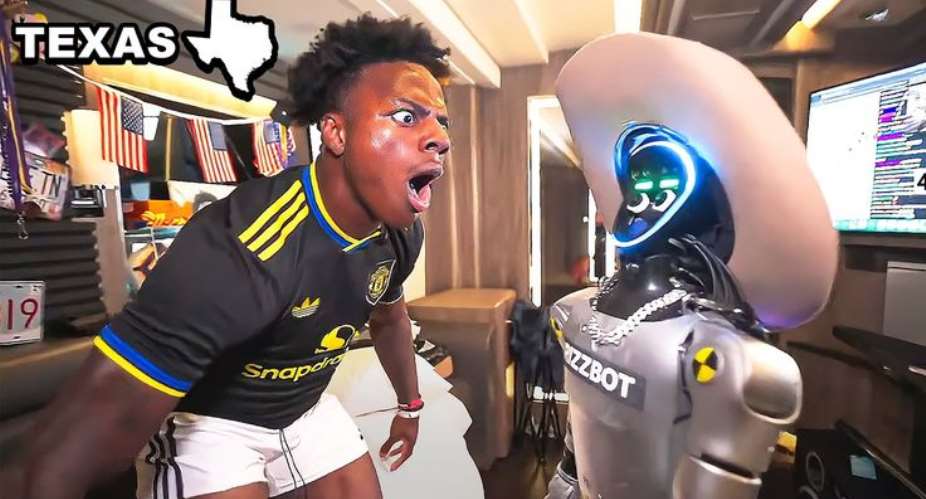
There is a particular kind of Ghanaian uncle — you know the one — who sits in front of the television during a big international broadcast and says, out loud, to no one in particular, "This world has changed oo." That was me on the morning of September 9, watching footage of a twenty-one-year-old American streamer stand inside Apple Park, hold the company's most secretive piece of hardware in a decade, and respond to it not with a press-trained soundbite, but with a bark.
Yes. A bark.
If you did not see it, you have missed one of the strangest and most telling collisions of 2026: the meeting of Darren Watkins Jr. — known to the internet as IShowSpeed — and John Ternus, Apple's newly installed chief executive, at the company's "Surprise and Shine" launch event. What happened between them in those few minutes says less about a phone and more about who gets to define technology culture now. That is the real story here, and it deserves an honest, well-sourced look — not the recycled hype already circulating on Twitter and TikTok.
The Event, Plainly Stated
On September 9, 2026, Apple held its "Surprise and Shine" event at Apple Park in Cupertino, California, unveiling the iPhone 18 Pro, the iPhone 18 Pro Max, the Apple Watch Series 12, the Watch Ultra 4, new AirPods 5 — and, for the first time in the company's history, a foldable device: the iPhone Duo. The Duo arrives in "Star White" and "Night Sky," carries a 5.4-inch outer Super Retina XDR display, and runs on Apple's new A20 Pro chip. Pre-orders open October 16.
This event was also notable for another reason entirely separate from Speed: it was John Ternus's first major product showcase as CEO, following Tim Cook's move into the executive chairman role on September 1. Ternus, previously Apple's senior vice president of hardware engineering, was widely seen — including by Tom's Guide readers who left nearly 1,500 comments reacting to his post-event interview — as bringing a hands-on engineer's fluency to the role that felt different from the operations-first tone of the Cook era.
Into this carefully choreographed transition walked IShowSpeed.
What Actually Happened
Speed met Ternus on stage and, in front of his live audience, narrated the moment in real time: "So, I'm about to say, 'Hi, nice to meet you Mr. John.' Yeah, can I get a iPhone Duo? Nah... you can't ask it like that." When Ternus handed him the device to explore, Speed — true to the persona that has made him one of the most-watched streamers alive — responded by barking, called the phone "amazing," and then asked for one outright anyway. The two took a selfie. Ternus, for his part, walked him through the phone's features.
According to a separate report, Speed was not content with simply holding the device. Minutes later, he reportedly told his live chat, "But wait, I gotta be the first person to do a backflip holding an iPhone Duo. Chat, we should make history right now" — and did exactly that, landing the flip without dropping Apple's newest and most expensive phone, before turning it into a pun about the device's folding design. It is worth noting this backflip claim comes from a single report and has not been independently confirmed by every outlet covering the event, so readers should treat it as a widely circulated but not universally verified detail.
This was not Speed's first entanglement with Apple. He has previously partnered with the company on a Beats campaign, and during his continent-spanning Africa livestream tour, he gifted an iPhone 17 Pro to a blind boy he met in Morocco, specifically so the child could use the phone's accessibility features — telling him, on camera, to "always stay strong, even when it is hard."
Why This Deserves More Than A Shrug
Here is my honest opinion, and I will not soften it: what happened at Apple Park was not a stunt that embarrassed a serious company. It was a signal that the serious company understood something about 2026 that many of its critics still do not.
Apple did not stumble into this moment. A corporation famous for controlling its own image down to the font on a keynote slide chose, deliberately, to let one of the most unpredictable personalities on the internet stand next to its brand-new CEO during his very first public showcase. That is not an accident of scheduling. That is a calculated bet that Speed's audience — reportedly numbering in the tens of millions across YouTube, TikTok, and Instagram — is worth more to Apple's cultural reach in one livestream than a dozen traditional tech reviews.
Three things stand out to me, and I will name them plainly.
First, authenticity has become Apple's newest marketing currency. A generation raised on scripted keynotes trusts a bark and a backflip more than a rehearsed line about "innovation." Second, Ternus's willingness to stand there and let it happen — rather than retreat behind a handler — was itself a message about the kind of leader he intends to be: an engineer comfortable in the room, not a suit hiding from it. Third, and most importantly for us here in Ghana and across the diaspora watching this unfold, it confirms that African and Black creators occupy real gravitational centre in global tech culture now, not the periphery. Speed's own history — from a Beats deal to handing a blind child in Morocco a phone built for his needs — shows this was never a one-off comedy bit. It is a pattern of a young Black creator being trusted with genuine cultural influence over how the world's most valuable company is seen.
The Fair Counterargument
I will not pretend there is no other side to this, because a columnist who only tells you what you want to hear is not worth your time.
Critics have a point when they argue that turning a serious hardware unveiling into a viral comedy clip cheapens the engineering underneath it — the years of work, reportedly including a "crease-free, nano-texture display" Apple executives spoke about in interviews, risk being reduced in public memory to "the phone that guy did a backflip with." There is also a fair question about whether stunts like the unverified backflip claim distract from real scrutiny: durability, battery life, and price are the things that will matter to buyers in October, not a livestream moment. Some longtime Apple watchers may also feel uneasy that a company once defined by minimalist restraint is now, in effect, renting its brand story to whichever creator commands the loudest live chat. These are not small objections, and I raise them because intellectual honesty demands it — not because I ultimately agree that they outweigh what Apple gained.
A Ghanaian Reading Of The Moment
We should not watch this story as distant American entertainment news and nothing more. Consider how our own tech and telecom brands here — MTN, Telecel, the phone assembly plants slowly taking root in our industrial zones — still largely market themselves through the old grammar: a well-dressed spokesperson, a rehearsed script, a press release nobody reads past the headline. Speed's moment at Apple Park is a live demonstration that the walls between "serious company" and "internet culture" have fully collapsed, and the brands still building those walls are the ones who will struggle to reach the under-30 audience that decides what is culturally relevant.
There is a lesson here for our own creators too, myself included: influence is no longer earned only through credentials or polish. It is earned through consistency, through a recognizable voice, and — as Speed has proven again and again, from Morocco to Cupertino — through being unmistakably, unapologetically yourself in rooms that were not originally built with you in mind.
Author's Note
I did not write this piece to mock a young man for barking at a billion-dollar chief executive. I wrote it because I believe we are watching, in real time, a genuine shift in who gets to shape how the world understands its own technology — and I think Ghana's own commentators, columnists, and creators need to be paying far closer attention to it than we currently are.
About the Author
Chief Tutu Baffour Asare Brownsy Williams is an author, columnist, filmmaker, and digital content creator based in Accra, Ghana, and the founder of Brownsy Silva Company, a multi-disciplinary creative platform spanning novels, films, columns, and engineering-focused content. He writes opinion journalism for Modern Ghana, with readership spanning the Ghanaian diaspora across the United Kingdom, the United States, Canada, and Germany.


 Talensi: Minerals Commission orders Nanlamtaaba Enterprise to halt mining in Gba...
 'I faced those who openly insisted that there’s no galamsey going on' – Prof Gya...
 Trump threatens to not reopen Kennedy Center after board blocks renaming
 Minority boycotts Foreign Affairs Committee meeting on South Africa evacuation o...
 Police arrest two over 192 parcels of suspected cocaine in Wa
 Challenging Heights reveals how Ghanaian girls are recruited into sex trade thro...
 GHS records more than 53,000 adolescent pregnancies in 7 months
 No school being demolished to construct 24-hr economy market at Mankranso - Ash...
 Education Ministry to review 'problematic' CSSPS after Catholic Bishops’ concern...
 Family of Salormey Baffoe appeals for her release from alleged National Security...


