




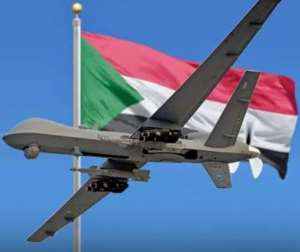
Sudan's army says its air defences shot down "enemy drones" over Gedaref and Kassala states on Tuesday morning, according to the daily Sudan News, cited by TRT Afrika. The interceptions took place in the Al-Fashaga area of Gedaref, on the disputed border with Ethiopia, and at Khashm al-Girba in Kassala state.
As is typical of Sudanese military statements, the report did not identify the drones' operator or disclose casualties or damage but the omission fools no one following this war closely. It comes just five days after the army downed drones belonging to the paramilitary Rapid Support Forces (RSF) near Khartoum, and fits a pattern that has been building for more than two years: an air war being fought increasingly far from the front lines that first defined it.
From Battlefield Tactic to Strategic Weapon
When RSF drones first reached Gedaref in April 2024 striking the state security and intelligence headquarters and an army division near Al-Faw it was treated as an anomaly. Gedaref, more than 400 kilometres east of Khartoum, had until then been one of the few parts of Sudan genuinely spared the war's violence, sheltering close to half a million people displaced from Khartoum and other battlegrounds. Kassala, further east still, occupied a similar status as a rear-area haven near the borders with Eritrea and Ethiopia.
That status has eroded steadily since. By 2025, RSF drone swarms were striking Port Sudan the army-backed government's interim capital and, until then, the most secure city in the country hitting fuel depots, a military airbase, and Kassala's own airport in the same week.
Sudanese officials at the time openly acknowledged that RSF drones had reached a range and frequency that even areas hosting the government's ministries and diplomatic missions could no longer be considered safe. This year, that campaign has continued to widen: attacks in North Kordofan and White Nile states in October, and Tuesday's activity again over Gedaref and Kassala, indicate that the RSF's drone campaign has become a substitute front, run in parallel to and increasingly independent of the group's contracting ground positions.
Why the Shift to Drones Matters
The RSF has spent much of 2026 on the defensive in ground terms, having been pushed out of central and eastern Sudan and now concentrated on grinding infantry battles in Darfur and Kordofan, even as the army has ramped up its own airstrikes over the same summer.
That asymmetry an army retaking ground while a paramilitary force loses it is precisely the condition under which drone warfare becomes strategically attractive to the weaker side. Long-range strike drones let the RSF project force into areas its fighters can no longer physically hold, hitting military and, at times, civilian infrastructure without needing to seize or defend territory.
The army, meanwhile, has demonstrated its own precision-strike capacity: in January, a drone attack near Zalingei killed Hamid Ali Abubakar, a security adviser to RSF commander Mohamed Hamdan Dagalo, along with several aides a reminder that the drone war cuts in both directions and is increasingly aimed at leadership decapitation as much as infrastructure denial.
The Humanitarian Stakes
What should concern regional observers most is not the military symbolism of these strikes but their geography.
Gedaref and Kassala are not incidental locations they are among the last major reception areas for Sudanese civilians fleeing the war, sitting along supply and displacement corridors that connect to Ethiopia, Eritrea, and onward to the Red Sea coast. Each time the frontier of drone warfare pushes further into these states, it narrows the shrinking map of Sudan that aid agencies and displaced families can still consider relatively secure.
A war that began in April 2023 as a struggle for control of Khartoum has, through the accumulation of these strikes, become a war with no reliably safe rear area left a dynamic with consequences not just for Sudan, but for neighbouring Ethiopia, Eritrea, Chad, and South Sudan, all of which are already absorbing large flows of Sudanese refugees and will absorb more as fewer parts of the country remain livable.
Mustapha Bature Sallama
Medical/ Science Communicator,
Private Investigator, Criminal Investigation and Intelligence Analysis,
International Conflict Management and Peacebuilding. ( USIP)
[email protected]
+233555275880
Sources
"Sudanese army downs unidentified 'enemy drones' in eastern states," TRT Afrika. https://www.trtafrika.com/english/article/451e311ac9e9
"Drone strikes on army targets break calm in east Sudan city," Agence France-Presse, via JusticeInfo.net.
"RSF launches drone attacks on Sudan's El Obeid, Kosti," Sudan Tribune, August 2026.
"Sudan's paramilitary forces intensify drone attacks on army-held areas," Xinhua/IANS, via Morung Express.
European Union Agency for Asylum,
"Sudan: Security Situation Conflict Dynamics and Tactics," EUAA Country of Origin Information Report.


 Expressway: “Eat your wife’s fufu” — Mahama shares light‑hearted joke with Kumas...
 Accra-Kumasi Expressway would allow people to live in Kumasi and work in Accra –...
 18years of legal battle: Retired lawyer urges Chief Justice to crack down on law...
 'Name NAPO as Running Mate again, kickstart 2028 campaign' – Former Manhyia Nort...
 September 15: Cedi sells at GHS12.20 on forex market, GHS11.47 on BoG interbank
 Government launches initiative to reduce maternal deaths by 20% annually
 SHS placement: Report anyone demanding payment — Education Ministry urges parent...
 Kwaso Chief applauds Mahama over Accra-Kumasi Expressway, calls for national sup...
 Julius Debrah champions cocoa transformation as Ghana targets 50% local processi...
 Catholic Bishops' Conference calls for probe into SHS placement for sale allegat...


