




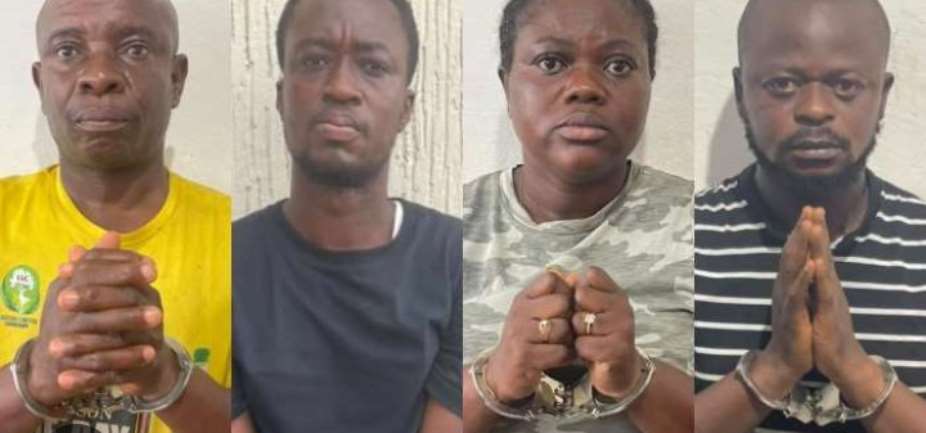
Ghana's Central North Regional Police Command, working with the national Criminal Investigations Department under Inspector-General of Police Christian Tetteh Yohuno, has rescued 30-year-old Bismark Amoh and arrested four suspects in connection with his abduction at Assin Fosu a case that should worry the country for reasons that go beyond the brutality of the crime itself.
Amoh was seized on Sunday, September 6, and held for roughly a week. His abductors used his own mobile phone to torment his family, sending WhatsApp videos and audio in which he appeared stripped, bound at the hands, legs and neck, and beaten while lying in water poured onto the floor of wherever he was being held.
They initially demanded GH¢45,000 and gave a 24-hour deadline. The family scraped together GH¢19,500 from relatives and well-wishers and paid it only for the kidnappers to refuse his release, raise the total demand to roughly GH¢50,000, and threaten to kill him within eight hours if the balance wasn't found. It took an intelligence-led operation, ultimately reaching into the Ashanti Region, to bring Amoh out alive.
Four Arrests, One Uncomfortable Detail
The four people now in custody are Mavis Badu Acheampong, 42, a teacher at Kumasi Girls Senior High School; Charles Doku, 53, a security guard; Oteng Baffour, 31, an electrician; and Kenneth Opoku Kwarteng, who goes by "Culture," also a teacher at the same school. Three of the four are residents of Breman UGC. Police say they are being processed for court, while a wider search continues for other accomplices including, notably, a senior military officer who investigators allege is connected to the case.
What should give Ghanaians pause is not just that the suspects were caught, but who they turned out to be. This was not a case of a handful of destitute, unemployed young men reaching for a desperate crime. Two are teachers at a respected girls' school. One has worked as a security guard. One is a tradesman with a functioning skill.
These are people with income, standing in their communities, and on paper something to lose. That a group like this could organise a multi-day abduction, coordinate a ransom negotiation, and escalate to torture and death threats when the first payment came in, suggests something more troubling than opportunism: a criminal enterprise that ordinary, employed people can apparently step into and out of like a side hustle.
This is precisely the pattern security analysts have tracked with alarm elsewhere on the continent most visibly in Nigeria, where kidnapping-for-ransom evolved over roughly two decades from a Niger Delta militancy tactic into a nationwide, semi-professionalized economy involving trackers, negotiators, informants inside banks and telecom companies, and financiers who never set foot near a victim.
Once ransom kidnapping proves that ordinary working people can supplement or replace a salary with a payout that dwarfs months of legitimate income, it stops being an act of desperation and starts being a business decision. The economics are what make it dangerous: a security guard or an electrician does not need a criminal underworld to enter this trade, just an opportunity, a few accomplices, and a victim's family able to raise cash quickly through mobile money and community networks exactly what happened at Assin Fosu.
Ghana has, until recently, prided itself on being an outlier in a region where kidnapping-for-ransom has metastasized. The country's most publicised past cases the 2019 abduction of two Canadian volunteers in Kumasi, for instance were treated as shocking anomalies. Assin Fosu, alongside a steady drip of smaller ransom cases reported around the country this year, suggests the practice may be becoming less anomalous and more habitual, particularly in peri-urban and rural corridors of the Central and Ashanti regions.
The Institutional Red Flag
The most serious detail in this case is not the four arrests but the one arrest still pending: a senior military officer allegedly linked to the abduction. If that allegation holds up, it moves this case from ordinary criminality into the territory Ghana's security services should treat as an institutional emergency.
Kidnapping rings that can draw on the logistics, weapons access, or protection that a serving military officer might provide are qualitatively more dangerous than a gang of amateurs they are harder to infiltrate, harder to prosecute, and far more resistant to the kind of community policing that has kept much of Ghana's crime rate manageable.
The Police Administration's public warning that anyone resorting to violence, kidnapping, or "self-help" will face the full force of the law is the right message, but it will only hold if the prosecution that follows is fast, transparent, and reaches every accomplice, including any officer eventually implicated. Ghana's advantage over its neighbours in this area has always been rooted in swift, visible consequences.
The Assin Fosu case is a test of whether that advantage still holds, or whether kidnapping-for-ransom is quietly becoming, for a certain kind of employed, otherwise unremarkable Ghanaian, a viable business proposition.
Mustapha Bature Sallama
Medical/ Science Communicator,
Private Investigator, Criminal Investigation and Intelligence Analysis,
International Conflict Management and Peacebuilding. ( USIP)
[email protected]
+233555275880
Sources
"How IGP Yohuno led Police team to rescue victim, arrest four kidnappers in Assin Fosu operation," ModernGhana, September 14, 2026.
"30-year-old man rescued after alleged kidnapping at Assin Fosu," MyJoyOnline.
"GNA expose on abduction gets results: Police rescues victim," Ghana News Agency, September 11, 2026.
"Bismark Amoh: Kidnapped Man Rescued in Assin Fosu After Family Pays GH¢19,500 Ransom," YEN.com.gh.
"Police hunt for kidnappers of man in Assin Fosu," ModernGhana.
"Kidnappers demand GH¢50,000 as captive brutally [abused]," ModernGhana.


 Gov't secures US jobs pathway for nurses through Columbus partnership
 Expressway: “Eat your wife’s fufu” — Mahama shares light‑hearted joke with Kumas...
 Accra-Kumasi Expressway would allow people to live in Kumasi and work in Accra –...
 18years of legal battle: Retired lawyer urges Chief Justice to crack down on law...
 'Name NAPO as Running Mate again, kickstart 2028 campaign' – Former Manhyia Nort...
 September 15: Cedi sells at GHS12.20 on forex market, GHS11.47 on BoG interbank
 Government launches initiative to reduce maternal deaths by 20% annually
 SHS placement: Report anyone demanding payment — Education Ministry urges parent...
 Kwaso Chief applauds Mahama over Accra-Kumasi Expressway, calls for national sup...
 Julius Debrah champions cocoa transformation as Ghana targets 50% local processi...


