




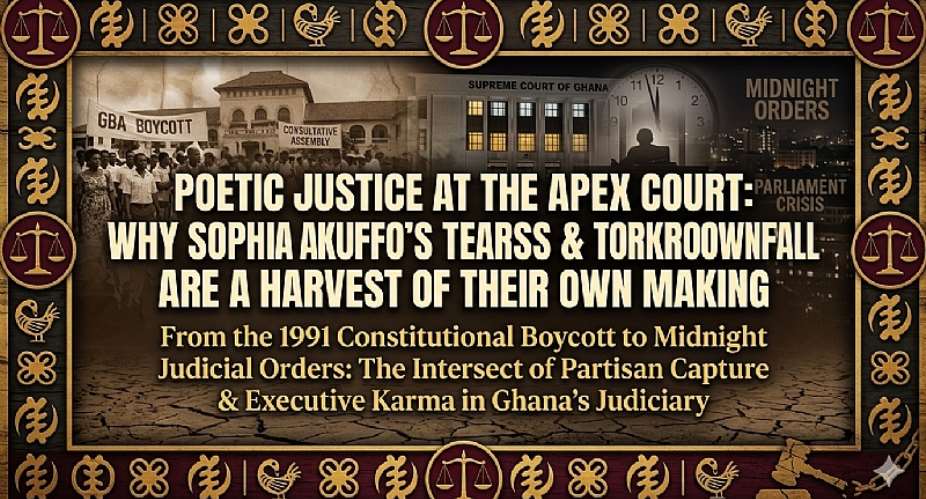
The dramatic fallout surrounding the official dismissal of former Chief Justice Gertrude Torkornoo has triggered a wave of defensive panic from Ghana's conservative legal establishment. When former Chief Justice Sophia Akuffo took to the airwaves on TV3 to lament the removal process as "shallow, ephemeral," and akin to a hostile "treason trial," her words were calculated to evoke public sympathy. Yet, for the ordinary Ghanaian who has watched the systemic erosion of judicial independence, her tears are the height of institutional gaslighting. The structural flaws Akuffo now decries are not accidents of history—they are the direct consequence of a petulant 1991 constitutional boycott staged by her own political peers. By tracing a straight line from the creation of the 1992 Constitution to the corrupting "midnight orders" issued during the 2024 Parliamentary Vacancy Crisis, we see that the judiciary did not just collapse; it dismantled its own walls. This is not a political witch-hunt; it is a masterclass in constitutional karma.
The Original Sin: Sophia Akuffo and the Hypocrisy of the 1991 Boycott
The historical amnesia of Ghana's elite legal fraternity must be forcefully corrected. Former Chief Justice Sophia Akuffo and the conservative legal establishment have no moral right to complain about a "flawed" removal threshold under Article 146:
- The Act of Political Petulance: When the Provisional National Defence Council (PNDC) set up the Consultative Assembly in 1991 to draft the blueprint of our modern democracy, the New Patriotic Party (NPP) precursors and the Ghana Bar Association (GBA) staged a total boycott.
- The Vacuum of Self-Exclusion: Objecting to the grassroots, revolutionary, and non-legal composition of the assembly, these "reading men and women" walked out of the room. By abandoning their posts, they left a massive vacuum, allowing the PNDC to shape an executive-heavy, loose constitutional framework completely to its own liking.
- The Bitter Harvest: Had the GBA and the NPP factions stayed in the room instead of walking away, they could have authored the stringent checks, balances, and formal appeal mechanisms they are now desperately begging for today. Sophia Akuffo is complaining about a loose trap her own political family refused to fix. They are being forced to chew the bitter roots of a tree they refused to prune.
The Bidding List: Torkornoo’s Partisan Midnight Rulings
The assertion that Justice Gertrude Torkornoo was an impartial victim of a political purge is completely dismantled by her record on the bench. Her hyper-accelerated actions during the high-stakes 2024 Parliamentary Vacancy Crisis turned the apex court into a partisan shield:
- The Midnight Orders: When NPP Parliamentary Leader Alexander Afenyo-Markin rushed to the Supreme Court to halt Speaker Alban Bagbin's declaration of four vacant seats, the judiciary moved with unprecedented speed. Under Torkornoo’s direct command, the court issued emergency, ex-parte stay-of-execution orders outside regular court hours, paralyzing parliament simply to preserve a fragile, collapsing NPP majority.
- Collusion with the Executive Presidency: These rapid-fire judicial interventions directly served the executive arm of government. By frozening parliamentary processes, the court protected the executive from losing control of the legislature, ensuring that controversial bills, massive loans, and international agreements could be rammed through a captured house.
- The Court-Packing Agenda: Before her eventual impeachment, Torkornoo was actively coordinating with the executive to expand the Supreme Court. Immediately following her suspension, the administration attempted a rushed vetting of seven new Court of Appeal judges to fill non-existent vacancies on the Supreme Court—a move the Minority rightly blasted as a partisan "third-term agenda in disguise."
- The Irony of the Ofori Petition: The ultimate poetic justice is that Torkornoo was not brought down by a political rival, but by a private Ghanaian citizen, Mr. Daniel Ofori. His rigorous petition provided irrefutable evidence of "stated misbehaviour," proving that her judicial overreach extended from political bias into the manipulation of private corporate judgments and the falsification of official judicial records.
Strategic Recommendations and Suggestions
To rescue the judiciary from the ruins of partisan capture and prevent future Chief Justices from operating as executive puppets, the state must implement structural changes:
- Revisit and Overhaul Article 146: The ongoing Constitutional Review process must tighten the definition of "stated misbehaviour." The grounds for removing a superior court judge must be explicitly codified to separate routine administrative errors from gross constitutional violations, and a formal Appellate Chamber must be created to review committee findings.
- Strip the President of Monopolistic Judicial Appointments: The absolute power of the President to appoint the Chief Justice and pack the Supreme Court bench must be broken. Ghana must transition to an independent Judicial Appointments Commission that publicly interviews and vets candidates based strictly on merit, jurisprudence, and non-partisan track records.
- Establish a Rigid "Anti-Court Packing" Cap: The Constitution must be amended to place a strict, unbreakable numerical ceiling on the number of justices that can sit on the Supreme Court bench (matching global models like the US or Nigeria). This will permanently end the unconstitutional practice of expanding the court to satisfy executive survival.
- Enforce Total Transparency in Emergency Rulings: Any emergency or ex-parte constitutional application filed outside regular court hours must be broadcast live on national television, with written justifications published within two hours, eliminating the shadow of "midnight orders."
The downfall of Justice Gertrude Torkornoo is not a tragedy; it is a triumph of constitutional accountability. The entire saga serves as a timeless reminder that when state actors weaponize the scales of justice for temporary political favor, the very system they corrupt will eventually swallow them whole. Sophia Akuffo can lament the "rigmarole" of the Article 146 proceedings all she wants on TV3, but the reality remains unchanged: Torkornoo reaped exactly what her political faction sowed in 1991. The legal elite cannot boycott the foundation of a house, watch its roof cave in decades later, and pretend to be shocked by the debris. It is time for the GBA and its political allies to end their selective moral outrage, accept this heavy dose of institutional karma, and join progressive Ghanaians in building a truly independent judiciary that fears no executive, serves no party, and bows only to the law.
✍️ Submitted by:
Retired Senior Citizen
For and on behalf of all Senior Citizens of the Republic of Ghana 🇬🇭
Teshie-Nungua
[email protected]

 'Name NAPO as Running Mate again, kickstart 2028 campaign' – Former Manhyia Nort...
 September 15: Cedi sells at GHS12.20 on forex market, GHS11.47 on BoG interbank
 Government launches initiative to reduce maternal deaths by 20% annually
 SHS placement: Report anyone demanding payment — Education Ministry urges parent...
 Kwaso Chief applauds Mahama over Accra-Kumasi Expressway, calls for national sup...
 Julius Debrah champions cocoa transformation as Ghana targets 50% local processi...
 Catholic Bishops' Conference calls for 20% SHS admission into Catholic schools f...
 Catholic Bishops' Conference calls for probe into SHS placement for sale allegat...
 Trump calls concerns over rogue AI a 'hoax' promoted by a ‘SICK conspiracy’
 US Space Force confirms weapons deployed in space for first time


