




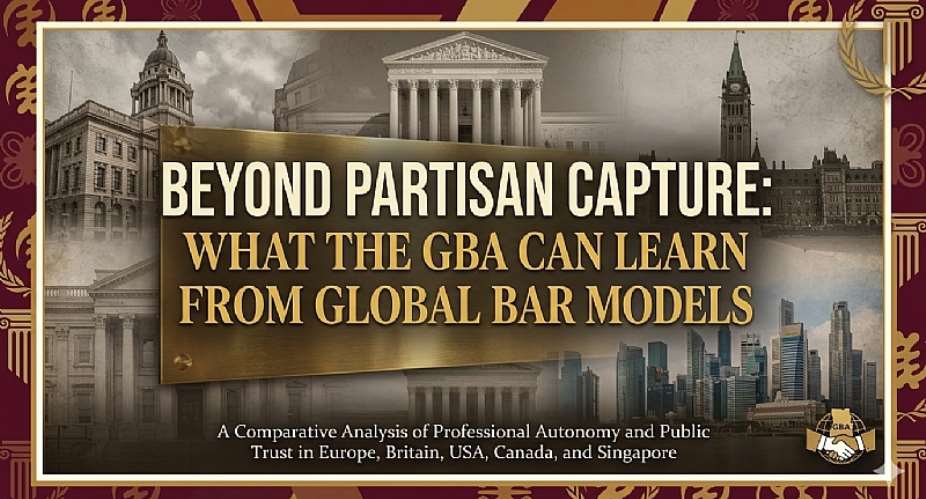
The persistent crisis of confidence rocking the Ghana Bar Association (GBA) has sparked an urgent debate regarding whether the association has outlived its usefulness or merely lost its constitutional compass. When a national bar association is widely perceived as an auxiliary wing of a ruling political establishment, it ceases to function as a reliable guardian of the rule of law. Members of the Ghanaian legal fraternity often pride themselves on being a "community of reading men and women," yet the insular nature of our legal practice has prevented us from looking beyond our borders to see how global legal institutions preserve their integrity. This structural amnesia also blinds the Bar to its own history, forgetting how previous generations of lawyers stood as a bulwark against executive tyranny rather than a shield for it. To rescue Ghana’s legal system from partisan capture, we must evaluate how bar associations in Europe, Britain, the USA, Canada, and Singapore operate. By examining these global frameworks alongside the GBA's own complex history, Ghanaian lawyers, legal academics, and citizens can understand how true professional autonomy, strict regulatory separation, and non-partisan public advocacy are maintained internationally.
A Look in the Mirror: The GBA's Historic Shift from Activism to Abstention
The contemporary decline of the GBA is particularly stark when contrasted with its historical role during Ghana’s turbulent constitutional eras. The association has transitioned from a fierce defender of human rights into an organization prone to political calculations:
- The Era of Principled Defiance (1970s–1980s): During the military regimes of the National Redemption Council (NRC) and the early years of the Provisional National Defence Council (PNDC), the GBA was a fierce opponent of executive overreach. Following the tragic 1982 abduction and murder of three High Court judges, the GBA took a courageous, uncompromising stance against state-sponsored lawlessness. Led by fearless executives, the Bar regularly boycotted the courts, demanded accountability, and served as the de facto voice of the voiceless when political parties were banned.
- The 1991–1992 Constitutional Boycott: A critical turning point in the GBA's political trajectory occurred during the transition to the Fourth Republic. When the PNDC established the Consultative Assembly to draft the 1992 Constitution, the GBA famously boycotted the process entirely. Objecting to the composition of the Assembly—which they argued was heavily stacked with PNDC sympathizers, revolutionary organs, and non-legal bodies at the expense of professional associations—the GBA refused to send official representatives to help shape the supreme law of the land.
- The Legacy of Self-Exclusion: While the boycott was rooted in a principled objection to military manipulation, it set a dangerous precedent of institutional alienation. By choosing absolute abstention over strategic engagement, the GBA left a vacuum in the foundational drafting of Ghana's modern democracy. Over the subsequent decades, this legacy of selective engagement evolved into the deep partisan entanglements seen today, where the Bar is quick to launch verbal salvos at political opponents but slow to defend systemic constitutional principles.
Global Models of Bar Governance: A Comparative Overview
Different democracies have developed distinct mechanisms to isolate their legal associations from raw political interference and executive overreach:
- Europe (The Continental Model): In jurisdictions like Germany and France, bar associations function strictly as public-law corporations focused on professional regulation rather than political posturing. Regulation is highly decentralized, ensuring that national political parties cannot easily capture or weaponize the leadership of the legal fraternity to serve partisan agendas.
- Britain (The Bifurcated Model): The United Kingdom split its legal regulatory structures to protect public trust. The Bar Council handles representation and advocacy, while the Bar Standards Board (BSB) operates as an independent regulatory body. This strict separation ensures that professional discipline and ethical regulation are entirely insulated from the political opinions or personal relationships of the Bar's leadership.
- The United States (The Dual/Voluntary Framework): The US utilizes a mix of mandatory "integrated" state bars and completely voluntary advocacy groups like the American Bar Association (ABA). Because membership in advocacy groups is optional, no single political faction can claim to speak for every lawyer in the country. Furthermore, American bars rely on highly formalized, non-partisan evaluation committees to vet judicial nominees, prioritizing objective legal competence over party affiliation.
- Canada (The Independent Law Societies): Canadian lawyers are regulated by independent provincial bodies, such as the Law Society of Ontario, which are completely separate from voluntary advocacy groups like the Canadian Bar Association. These law societies operate under a statutory mandate to protect the public interest rather than the private or political interests of lawyers, maintaining strict, transparent protocols to manage conflicts of interest.
- Singapore (The Statutory Control & Uncompromising Discipline Model): The Law Society of Singapore operates under the strict framework of the Legal Profession Act, maintaining a highly disciplined, meritocratic structure where political commentary is strictly separated from professional legal analysis. In Singapore, ethical discipline is handled with zero tolerance for mediocrity or political shield-wielding. The Disciplinary Tribunal, appointed independently by the Chief Justice, investigates misconduct with clinical precision. Lawyers who engage in pedestrian public mudslinging or compromise their professional integrity face swift suspension or strike-offs, completely insulated from political protection. The state legal apparatus and the private bar are governed by rigid statutory boundaries, ensuring that the Bar never degenerates into an arena for low-level partisan warfare.
Key Takeaways for Ghana
+-----------------------------------+-----------------------------------+ | GLOBAL BEST PRACTICE | CURRENT GHANAIAN REALITY | +-----------------------------------+-----------------------------------+ | Structural separation between | Regulatory and representative | | regulation and public advocacy. | powers fused in one body (GBA). | +-----------------------------------+-----------------------------------+ | Independent boards managing | Internal executives managing | | discipline and ethics. | ethics, prone to selective bias. | +-----------------------------------+-----------------------------------+ | Decentralized or multi-bar | Monopolistic, mandatory umbrella | | options preventing monopolies. | structure stifling competition. | +-----------------------------------+-----------------------------------+
Strategic Recommendations and Suggestions for the GBA
To salvage its identity and restore its broken moral authority, the GBA must emulate these international standards through immediate, structural reforms:
- Bifurcate the Ghana Bar Association: Ghana must adopt the British and Canadian models by splitting the GBA into two distinct entities: an independent statutory board solely responsible for regulation, ethics, and licensing, and a voluntary association responsible for welfare and advocacy. This will ensure that a lawyer's right to practice is never tied to a politically compromised executive body.
- Adopt Singapore’s Strict, Non-Partisan Disciplinary Mechanism: Mirroring Singapore’s Legal Profession Act, Ghana must establish an independent Legal Disciplinary Tribunal appointed outside the influence of the GBA national executive. This tribunal must treat professional misconduct, public ethical breaches, and partisan weaponization of the bar with strict penalties, ensuring that no lawyer can use their political connections to escape accountability.
- Institutionalize Non-Partisan Judicial Vetting Frameworks: Mirroring the American Bar Association, the GBA must establish a permanent, independent, and closed-door Judicial Vetting Committee composed of independent legal academics and retired jurists. This committee must evaluate judicial nominees based strictly on merit and jurisprudence, ending the pedestrian practice of assigning public partisan labels to the judiciary.
- End the Monopolistic Stranglehold: Ghana should embrace a competitive multi-bar framework by legally recognizing alternative professional organizations, such as the emerging Law Society of Ghana (LSG). Forcing all legal practitioners into a single, politically captured umbrella organization breeds complacency and structural bias. Competition will force the GBA to return to its founding, objective principles.
The history of the Ghana Bar Association proves that it was once capable of standing up to power with unyielding principle, yet its modern evolution has seen it decline into selective moral outrage and institutional capture. By looking to the structural discipline of Singapore, the regulatory separation of Britain, and the institutional pluralism of the United States, Ghanaian lawyers can rebuild a legal fraternity that serves the masses rather than the ruling elite. The choice before the GBA is clear: remember its historic mandates, reform organically by emulating global standards, or watch a new generation of fearless lawyers break their monopoly and build a progressive alternative from the ground up.
✍️ Submitted by:
Retired Senior Citizen
For and on behalf of all Senior Citizens of the Republic of Ghana 🇬🇭
Teshie-Nungua
[email protected]


 'Name NAPO as Running Mate again, kickstart 2028 campaign' – Former Manhyia Nort...
 September 15: Cedi sells at GHS12.20 on forex market, GHS11.47 on BoG interbank
 Government launches initiative to reduce maternal deaths by 20% annually
 SHS placement: Report anyone demanding payment — Education Ministry urges parent...
 Kwaso Chief applauds Mahama over Accra-Kumasi Expressway, calls for national sup...
 Julius Debrah champions cocoa transformation as Ghana targets 50% local processi...
 Catholic Bishops' Conference calls for 20% SHS admission into Catholic schools f...
 Catholic Bishops' Conference calls for probe into SHS placement for sale allegat...
 Trump calls concerns over rogue AI a 'hoax' promoted by a ‘SICK conspiracy’
 US Space Force confirms weapons deployed in space for first time


