




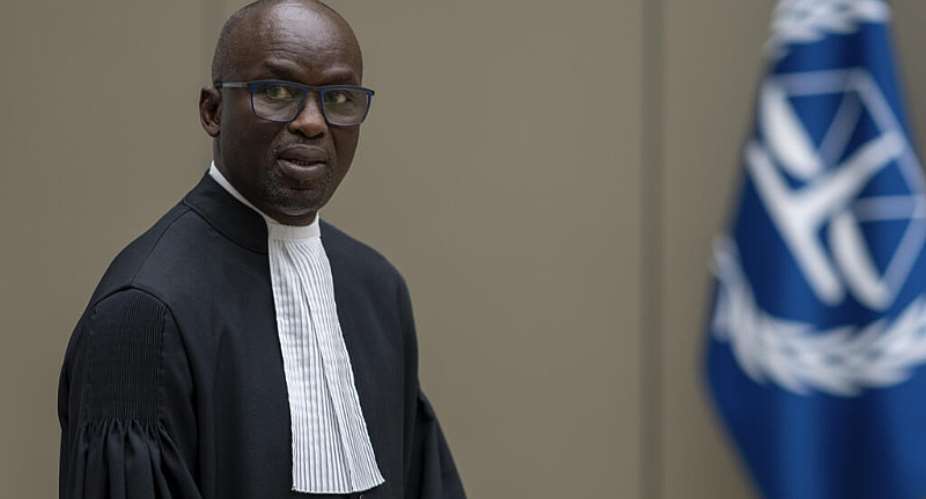
The Hague-based ICC was established in 2002, under an international treaty known as the Rome Statute, to prosecute individuals for the gravest international crimes when national courts are unwilling or unable to act.
The United States, which is not among its 125 members, has long opposed the Court exercising jurisdiction over its citizens or those of its allies.
Washington's latest sanctions campaign followed the ICC's 2024 decision to seek and issue arrest warrants over crimes committed in the Gaza conflict, including against Israeli Prime Minister Benjamin Netanyahu and former Defence Minister Yoav Gallant.
In August 2026 , the US expanded its economic sanctions to freeze the assets of ICC President Judge Tomoko Akane and a senior trial prosecutor.
To understand the impact of these decisions, RFI spoke to Mame Mandiaye Niang, the Senegalese magistrate who has taken over the ICC's Office of the Prosecutor from Karim Khan, who was dismissed over sexual abuse allegations he denies.
RFI: The United States says the ICC is a "corrupt and fatally politicised, supranational" court. Is it?
Mame Mandiaye Niang: A corrupt court? No. A supranational court – it depends how you interpret the word. What is certain is that it's a court created by the will of several states. Today, there are more than 120 of them.
Does supranational mean above nations? Does it mean having prerogatives over those countries? The answer is no.
We're here at the service of states, which can refer cases to us as an alternative when there's an absence of national justice.
RFI: The Americans say the Court is politicised because you launched proceedings against Israel's prime minister and former defence minister.
MMN : That doesn't mean it's a politicised court. We deal with crimes against humanity, war crimes or genocide. These are crimes that can sometimes have ideological, religious or political motivations.
But our approach is a technical one. We look at whether crimes have been committed and whether we have jurisdiction to try them.
International ire over Trump sanctions against ICC
RFI: When the Court issued the warrants in November 2024 against the two Israeli leaders, did you know this would provoke Washington's anger?
MMN: Certainly. It's in the nature of justice that our action often ends up upsetting people.
But there had already been a whole series of challenges surrounding the referral of this situation to our court, well before November 2024. There had even been legal challenges before our court.
RFI: Given the storm this has stirred up, do you ever think that, knowing what you know now, you wouldn't do it again?"
MMN: Writing history, in my view, is always the kind of exercise that lends itself to all sorts of speculation.
But what we can say is this: looking back at what we did, was it lawful and legitimate? And on that score, I don't think there's anything we'd take back. The world today is witnessing what is happening wherever we intervene, whether in Gaza or elsewhere. We may be criticised, but when you look at each of these situations, you cannot say that a judicial response isn't needed.
RFI: So you would do it again?
MMN: Yes. As I said, what we did was entirely legal. And even today, this situation continues to hold our attention.
France backs ICC after arrest warrant for Israeli, Hamas leaders
RFI: You are now under US sanctions, as are several other ICC magistrates. Does that mean, for example, that you can no longer use a bank card?
MMN: That's only one of the inconveniences. Our personal and daily lives are affected, but each of us tries to adjust as best we can.
RFI: So you cannot make purchases using credit cards?
MMN: No, we can't. There are services we would theoretically have access to but, because they require credit cards – booking a hotel, buying a plane or train ticket – most of those services are now difficult for us to use.
We have to go through a third party, including, for the moment, with the support of the court itself, which allows us to do certain things that are no longer possible individually.
The world is discovering that there is a very great dependence on technology or payment tools that are exclusively controlled by one country.
RFI: The United States?
MMN: Yes, absolutely, the United States. I lived until I was almost 35 or 40 without a credit card. It makes life difficult, but not impossible.
And I belong to a profession where we know that we must be prepared to face reprisals from people who do not like what we do.
Ghanaians ask ICC to investigate xenophobic violence in South Africa
RFI: Beyond your personal situation, are the sanctions hampering the work of your Office and its investigations?
MMN: I wouldn't say our work is being hampered. That said, we shouldn't underestimate the impact of threats, reprisals and especially possible future action. We can't say it has no impact.
But at the same time, for us, it's a test of resilience. We're doing our work and exploring alternatives to these technologies. We're also exploring other ways of working which may, in the short term, prove less efficient but which still allow us to carry out our extremely important work.
RFI: You still have access to American artificial intelligence tools?
MMN: We do, because the court itself has not yet been subjected to what they call institutional sanctions, which have been threatened for some time but have never been imposed.
So, institutionally, access to these tools is still possible.
RFI: Could the next step be US sanctions against the ICC itself?
MMN: Yes, absolutely. That's been threatened and discussed for some time.
It would lead to all these American tech companies being prevented from cooperating with the court as an institution.
For the moment, that's not the case.
RFI: The United States is also threatening to impose sanctions on lawyers and NGOs that work with you. Are you becoming increasingly isolated?
MMN: It's already the case. Some NGOs have already been sanctioned. But to say that we are isolated – no.
We cannot be isolated, we're the product of the will of more than 120 states. These states provide our budgets and, through their cooperation, allow us to function.
We're living through a storm, with some countries withdrawing here and there. But generally speaking, we still benefit from the support of all the states whose will brought us into existence.
RFI: Are other states providing financial support, particularly in Europe?
MMN: A very clear sign of support is that states have paid their contributions with great diligence.
Paradoxically, despite this situation that has been described as a storm, the court is in very good health in terms of liquidity.
ICC sentences Sudan militia chief to 20 years for crimes against humanity
RFI: Several African countries – Chad, Burundi, the Alliance of Sahel States – have announced they're leaving the ICC. Are you worried about that?
MMN: There have been a lot of misunderstandings around the arguments that have been put forward.
Some people have been frightened by being told that there were secret arrest warrants against them. In all these cases, that was completely false.
Niger and Burkina Faso are not even countries that the court is looking into. So it's not conceivable that arrest warrants could have been issued against anyone in those countries.
So apparently there have been many misunderstandings, including through vicious and underhand campaigns that misrepresent our mandate.
RFI: The ICC has more than 120 members, but three of the five permanent members of the UN Security Council – United States, Russia and China – are not among them. Other countries are starting to leave. Thirty years after its creation, is the Court facing an existential threat?
MMN: There can be upheavals and turmoil. Today, multilateralism as a whole is being shaken. But I find it difficult to believe that this is an existential crisis.
This court is the result of a constant and continuous effort going back for more than a century. Of course, there was a period of optimism at the end of the 1990s when consensus was relatively easy to achieve. Some of those consensuses are now being more or less disrupted.
But I believe we will overcome this because we represent an ideal that cannot be erased: the ideal of international justice cannot be swept under the carpet when the national or regional system fails.
RFI: So you're waiting for Donald Trump to leave the White House?
MMN: I wouldn't put it that way, because the United States has every right to elect whoever it wants. But what I'd say is that after these difficult times, calmer times will come.
RFI: Would the court need to compromise on pursuing citizens of non-member states to improve relations with Washington?
MMN: There are already many mechanisms that allow certain conflicts to be avoided.
We are a court that does not claim primacy, whoever the criminals are. If their country is willing to prosecute them, we are willing to step aside and let them do so.
That's what is called the principle of complementarity, which is at the heart of the Rome Statute. There is nothing rigid about our approach.
This interview has been adapted from the original version in French by Christophe Boisbouvier and edited for clarity.


 How IGP Yohuno led Police team to rescue victim, arrest four kidnappers in Assin...
 Akufo-Addo would have used Accra-Kumasi expressway for galamsey – Mahdi Gibrill
 Nigeria's Dangote refinery launches continent's biggest IPO
 Accra-Kumasi Expressway to cut travel time to 2hours, drive 120km per hour — Mah...
 'Our own money $2billion ready, we have not gone to borrow money from anywhere' ...
 Founder’s Day September 21 declared public holiday
 Council of State was not qualified to determine prima facie case against Torkorn...
 'Grounds for removal of Chief Justice and justice of superior court shallow, eph...
 Don't be a Bar that flips on principles but a Bar that is consistent — AG tells ...
 Prostate cancer may show no symptoms until advanced stage – Urologist warns


