




Three times this year I have argued in this space that Ghana's mental health response should start with the people already doing the work. Families who notice when someone stops eating. Pastors and imams who are called before any clinic is. Chiefs, queen mothers and family heads who hold a person through a crisis that no psychiatrist will ever hear about. Train them, supervise them, connect them to referral pathways, and you have a national workforce for a fraction of what it costs to build one from scratch.
The reply is always the same, and it is a fair one. With what money?
Ghana answered that question fourteen years ago, in its own statute, and then quietly unanswered it.
The Mental Health Act, 2012 (Act 846) does two things that matter here. Section 80 establishes a Mental Health Fund. Section 82 lists what may flow into it: money approved by Parliament, grants, gifts, voluntary contributions. And the Act charged the Minister for Finance with prescribing a levy to feed that Fund, to be given effect through a Legislative Instrument laid before Parliament. The Fund is the mechanism. The levy is the money. Neither has ever been operationalized, which is why a law that declares mental health care free of charge coexists with patients paying at the counter of Accra Psychiatric.
The reason is not obscure, and it is worth stating plainly because it changes what kind of problem this is. In March 2018, writing in Graphic to mark six years of the Act, the then Chief Executive of the Mental Health Authority, Dr Akwasi Osei, set it down in a single sentence: the parliamentarians, he wrote, insisted that they would not pass the Legislative Instrument until the Authority agreed to decouple its passage from the establishment of the levy. Parliament was prepared to pass the machinery on condition that the money came out of it. Dr. Osei's response was that an instrument without the levy would not change the Authority's financial fortunes, which was correct, and which is why he would not take the deal.
So this is not a story about a law that was forgotten in a drawer. It is a story about a specific, recorded refusal, and about a Ministry and an Authority that have been asked every year since to run a national service on the proceeds of that refusal. By 2022, at the Act's tenth anniversary, Dr. Osei was still writing that the levy was the thing on which the whole law turned. He is no longer in the post. The levy is still not there.
What it would cost is knowable, and smaller than the silence implies. Ghana's own Twelve-Year Mental Health Policy, 2019 to 2030, sets a target of at least 5 percent of the health budget for mental health services, and names the levy and a resourced Fund as the means of getting there. Independent estimates put the minimum package of mental health care for the country at somewhere between GH¢540 million and GH¢720 million. Set that against the 2026 budget: roughly GH¢34 billion committed to the health sector, GH¢22.8 billion approved for the Ministry of Health, GH¢600 million allocated to begin three new regional hospitals in Savannah, Oti and Western North. The entire national minimum package for mental health costs about what the country is spending to start three hospital buildings.
Measured against what is actually allocated, the gap is starker still. Government expenditure on mental health has been recorded at 0.05 percent in 2020, 0.07 percent in 2021 and 0.1 percent in 2022. Against an estimated 2.6 million Ghanaians living with a mental health condition and a treatment gap put at 95 to 98 percent, those are not small numbers. They are a rounding error.
Nor would the levy need to be heavy. The COVID-19 Health Recovery Levy sat at 1 percent, and when Parliament abolished it in the 2025 Value Added Tax overhaul, the government's own estimate was that it would return GH¢3.7 billion to individuals and businesses in 2026 alone. A dedicated mental health levy set at a fifth of that rate would, on the same arithmetic, cover the upper end of the minimum package. That is an illustration of scale rather than a revenue forecast, and the base and the incidence would have to be argued properly. But it establishes the order of magnitude, and the order of magnitude is the point. This is not a fiscal impossibility. It is a rounding decision.
Here the honest objection has to be met, because a piece that ducks it is not worth reading. Ghana is not short of levies, and the country has spent the better part of a decade deliberately unwinding them. The Earmarked Funds Capping and Realignment Act, 2017 (Act 947) capped statutory allocations from earmarked taxes at 25 percent of tax revenue, and a 2023 amendment cut that ceiling to 17 percent. The COVID-19 levy was abolished in January of this year and the relief was popular, as relief from a nuisance tax generally is. Walking into that room and proposing a new earmarked levy is walking against the direction of national fiscal policy, and anyone who pretends otherwise is not making a serious argument.
Two things answer it. The first is that earmarking exists precisely for the things that lose every annual budget negotiation, and mental health is the demonstration case rather than a hypothetical one. An analysis of every State of the Nation Address delivered between 2007 and 2021 found that not one of them named a single mental health disorder. A budget line that no president has ever had to defend in public, for a constituency that stigma keeps from lobbying loudly, does not win on merit against roads and hospitals. It loses quietly, at 0.05 percent, every year, and it has. The second is that the sum involved is small enough to sit comfortably under the existing cap. Nobody is proposing a second National Health Insurance Levy. The ask is a fraction of one.
And it matters enormously what the Fund is then spent on, because this is where the levy stops being an accounting question and becomes the argument I have been making all year. A capitalized Mental Health Fund should not be routed straight into more beds in the south of a country that already has all three of its psychiatric hospitals there. It should pay for the workforce Ghana already has and has never once paid: training for community and faith leaders, structured referral pathways, and above all supervision.
That last word is the one that costs money, and it is the one that gets cut. The evidence for community-delivered mental health care in this region is real. Zimbabwe's Friendship Bench, which trains lay health workers to deliver problem-solving therapy, has been costed at around 191 US dollars per year lived with disability averted, which is cheap by any standard a health ministry uses. But the same literature is blunt that task-sharing is not free: it depends on trained supervisors, protected time inside existing clinical workloads, and transport to reach the people being supervised. A workshop is a one-off expense that a donor grant can absorb. Supervision is a recurring cost, and recurring costs are exactly what a standing fund exists to carry and what project funding never does.
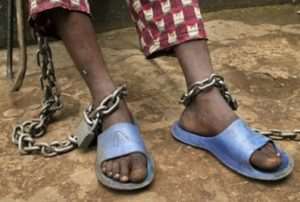
This is also the answer to the worry that resourcing community leaders means licensing whatever is currently done in their name. It does not, and I have written here before about the chaining that still happens in prayer camps nine years after it was banned. Enforcement and training are the same strategy, not competing ones, and both of them are recurring costs. Visiting Committees that can arrive unannounced in all sixteen regions, and community mental health officers attached to the camps they inspect, are line items. They exist in the Act. They have never had a budget. The Fund is where that budget was supposed to come from.
So the asks are narrow. Lay the Legislative Instrument, with the levy in it and not decoupled from it, which is the deal the Authority was right to refuse in 2018 and which no one should now accept out of exhaustion. Publish a costed minimum package at 2026 prices, because the GH¢540 million to GH¢720 million range predates the currency Ghanaians are actually living in. Write the community workforce into the Fund's disbursement guidelines before the first cedi moves, with supervision costed as a recurring line rather than training booked as an event. And put a date on the Twelve-Year Policy's own 5 percent target, because a target with no date is a sentiment.
Ghana has spent fourteen years asking aunties, pastors, elders and queen mothers to deliver the mental health care the state cannot afford, and calling the result a culture of care. It is a culture of care. It is also an unpaid invoice. The levy written into Act 846 is the country's own acknowledgement, in law, that this work has a price and that somebody has to meet it. Parliament is not being asked to decide whether that price exists. It is being asked to stop deciding, by silence, that families will go on paying it.
By Noah Boakye-Yiadom | [email protected]
The writer is a Ghanaian-Canadian mental health promotion researcher with the University of Calgary and an Assistant Professor of Psychology at Burman University.


 How IGP Yohuno led Police team to rescue victim, arrest four kidnappers in Assin...
 Akufo-Addo would have used Accra-Kumasi expressway for galamsey – Mahdi Gibrill
 Nigeria's Dangote refinery launches continent's biggest IPO
 Accra-Kumasi Expressway to cut travel time to 2hours, drive 120km per hour — Mah...
 'Our own money $2billion ready, we have not gone to borrow money from anywhere' ...
 Founder’s Day September 21 declared public holiday
 Council of State was not qualified to determine prima facie case against Torkorn...
 'Grounds for removal of Chief Justice and justice of superior court shallow, eph...
 Don't be a Bar that flips on principles but a Bar that is consistent — AG tells ...
 Prostate cancer may show no symptoms until advanced stage – Urologist warns


