




Across Africa, national space budgets have grown to $800 million (€702 million), up from less than $300 million (€258 milion) in 2018.
This is according to Temidayo Oniosun, founder of Lagos-based consultancy Space in Africa.
That is a tiny fraction of the world total, which was $132 billion (€113 billion) in 2024, 60 percent of it from the United States.
But the sector is growing: the African Union has a new continental space agency in Cairo, and the number of countries on the continent with a space programme has jumped from eight to more than 20 since 2018, Oniosun says.
For African nations, the questions of independence and access are crucial in an industry still dominated by non-African space agencies and firms.
Rwanda's President Paul Kagame insists that Africa must not only be a user of space capabilities, but also a contributor to science, research and global decision-making.
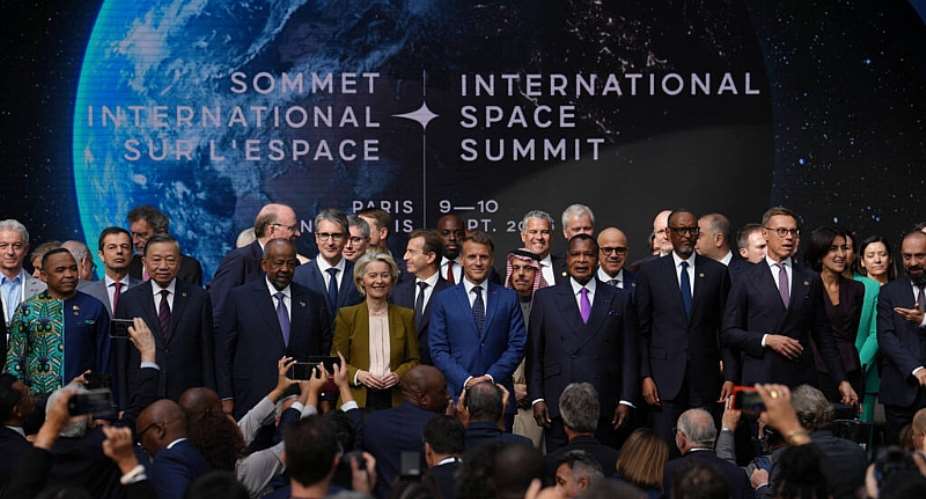
"Ultimately, we must avoid replicating in space the inequalities that exist in other domains," he told attendees at the first International Space Summit, hosted by French President Emmanuel Macron in Paris last week.
Satellite slots
The continent sent several sizeable delegations to the two-day event on 9 and 10 September underlining the sector's strategic importance for Africa.
Rwanda is very active in this field. It launched its first satellite in 2019 and established theRwanda Space Agency in 2020.
In June this year, Rwanda's Rwamagana ground station became the first in sub-Saharan Africa to be certified by the World Teleport Association, enabling the large-scale analysis of satellite data.
The rocket builder sending Kenyan kids' imaginations into orbit
"This is the work we do on a daily basis across various sectors, including natural disaster management, agriculture, healthcare, telecommunications," Adelin Kajangwe, project director at the Rwandan Space Agency told RFI.
Several African states, including Rwanda, supported the African Telecommunications Union's efforts to regain several orbital slots for the continent.
Faced with a rapidly expanding space industry, sometimes described as the 'Wild West', Kagame called for the continent to take its rightful place within it.
"As satellite constellations expand, competition for spectrum and orbital resources is also intensifying, putting developing countries at risk of losing access," Kagame noted.
"Technology transfer is equally important. Export restriction continues to limit access to knowledge and modern technologies. We therefore welcome partnerships that advance research and enhance local capacity," he said.
Environmental governance
Better satellite data is seen as key for urban planning and environmental monitoring, which are major issues on a continent whose cities are growing at a rapid rate and whose farmers and fishers are increasingly at the mercy of a changing climate.
Denis Sassou N'guesso, the President of the Republic of Congo told the space summit he wants to transform cutting-edge satellite technology into an indispensable tool for environmental governance across the whole of Central Africa.
Africa and Europe to join forces on sustainable space programmes
For Brazzaville, detailed environmental monitoring of the Congo Basin –the planet's second-largest rainforest – can no longer depend on fluctuating price structures or the goodwill of private Western or Asian operators.
"That is why we are committed to African cooperation and integration in the field of space policy, as we must, in this competitive sector, avoid developing 54 isolated space policies, when we can pool our infrastructure, data, expertise and investment," Sassou N'Guesso said in Paris.
He is demanding sovereign, direct and guaranteed access to high-precision satellite imagery – a "non-negotiable" security requirement for monitoring illegal deforestation.
Solidarity
Macron also reiterated France's commitment to making space a driver of climate solidarity between rich and poor nations.
He called for shared governance of space and space data – arguing that space science and its data cannot become the property of a single country or bloc.
In terms of investment, he said there would be an additional €40 million for an Earth-observation programme via the French national space agency CNES (Centre National d'Études Spatiales), on top of roughly €20 billion in broader European space investment pledged through 2030.
Macron calls for European crewed spaceflights within 10 years
"I think that, for Africa, the real challenge is to take control of its data, its own intellectual property, and what is done with the satellites," Kwaku Sumah, founder of SpaceHubs Africa, a consultancy specialising in the African space sector told RFI.
"It's also about being the first to access the data and retaining control over it. African countries rely heavily on open-source data. They can continue to make use of it whilst developing their local capabilities."
Senegal's rockets
Senegal is a relative newcomer to the sector but a fast-moving one: the country put its first satellite, GaindéSat-1A, into orbit in August 2024, designed and built by Senegalese engineers.
Maram Kairé, director general of the Senegalese Space Studies Agency (ASES) told RFI that his country is now exploring an offshore site to launch rockets from Senegalese territory.
Kairé, an astronomer who led the Senegalese delegation at the summit, defended the roughly $500 million invested annually in Africa's space programme because it can directly serve priorities like road planning, hospitals and agriculture.
Senegal joins space pact shaping the next era of Moon missions
"Advancing health care, a priority in Africa, requires the development of telemedicine. Investing in space technology is a concrete solution for leveraging telemedicine to overcome the distance-related challenges we currently face on the continent," he said.
For Kairé, satellites help to fill the dead zones, the gaps left by internet cable connection.
"We must ensure that access to the Internet is equitable and that every citizen, no matter where they are in the country, can have access to these services. Satellites provide access to these remote areas," he added.
Independence
He pushed back on the idea that African nations are financially or technologically dependent on outside powers.
"There is room for everyone, and we are simply working with the best. Every state is free to choose its partners. We, for example, have joined both China's lunar station project and the United States-led Artemis Accords for the return of humans to the Moon," he said.
Senegal is currently working on a joint satellite initiative with Rwanda, Ghana and Kenya.
"This shows how we are pooling our efforts and resources on the continent. And I believe this trend will continue as the African Space Agency begins its operations," Kairé said.
Côte d'Ivoire named its first space agency director last month and will host the African Space Expo later this month.

 How IGP Yohuno led Police team to rescue victim, arrest four kidnappers in Assin...
 Akufo-Addo would have used Accra-Kumasi expressway for galamsey – Mahdi Gibrill
 Nigeria's Dangote refinery launches continent's biggest IPO
 Accra-Kumasi Expressway to cut travel time to 2hours, drive 120km per hour — Mah...
 'Our own money $2billion ready, we have not gone to borrow money from anywhere' ...
 Founder’s Day September 21 declared public holiday
 Council of State was not qualified to determine prima facie case against Torkorn...
 'Grounds for removal of Chief Justice and justice of superior court shallow, eph...
 Don't be a Bar that flips on principles but a Bar that is consistent — AG tells ...
 Prostate cancer may show no symptoms until advanced stage – Urologist warns


