




There is a particular kind of silence that falls over a civilization right before it ends. Not sirens. Not headlines. Just merchants who stop showing up, ships that stop docking, and kings who keep issuing decrees to an empire that, unbeknownst to them, has already stopped listening.
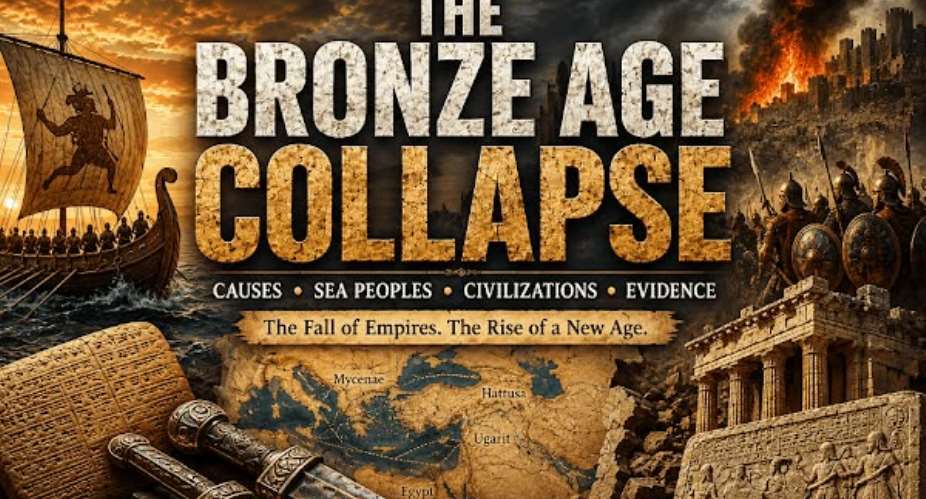
Around 1200 BC, that silence swallowed the Eastern Mediterranean whole. The Hittite Empire, the Mycenaean palaces of Greece, the city-states of Canaan and Cyprus — an entire interlocking trade network that anthropologists now compare to an early version of globalization — collapsed within decades of one another. Cities were abandoned. Writing systems vanished. What followed has been called, without exaggeration, a Dark Age.
Today, a Chinese-Canadian educator turned internet oracle wants you to believe we are watching the opening act of a sequel — and that the lead role this time belongs to the United States of America.
His name is Jiang Xueqin. And before we go one sentence further into his theory, you deserve — and I insist on giving you — the truth about who he actually is, because that truth changes everything about how seriously you should take him, without changing whether his questions are worth asking.
Who Is "Professor" Jiang, Really?
Here is the inconvenient headline his fans rarely put in bold: Jiang Xueqin is not a professor. He holds no PhD, no faculty chair, no tenure anywhere on earth. What he holds is a Yale College bachelor's degree in English literature, earned decades ago, and a long career as an education reformer in China — building study-abroad and critical-thinking programs at schools in Shenzhen and Beijing, later working as a researcher affiliated with Harvard's Graduate School of Education. He has also worked as a journalist and, by his own account, was briefly detained and later deported from China in the early 2000s while on a reporting assignment, on suspicion of espionage.
"Professor Jiang" is a nickname the internet gave him, not a title any university did. He built it through a YouTube channel called Predictive History, where he applies game theory and pattern-recognition from ancient history — the Peloponnesian War, the fall of Rome, the Late Bronze Age Collapse — to forecast modern conflicts, often illustrated with little more than a whiteboard and a map.
What earned him an audience of millions and invitations onto shows hosted by Steven Bartlett, Tucker Carlson, and Tom Bilyeu is that two of his loudest predictions landed: he called Donald Trump's 2024 election win in advance, and he called an escalation between the United States, Israel, and Iran before it happened. Critics — including geopolitical writers who have picked apart his methodology — point out that both calls tracked closely with odds already circulating on prediction markets like Polymarket at the time he made them, and that a forecaster who makes dozens of dramatic claims will inevitably get some spectacularly right. Being right twice does not make a framework true. It makes it interesting enough to interrogate.
So let us interrogate it honestly — separating the parts of his argument built on solid historical and economic ground from the parts that are simply one man's provocative bet on the future.
What a Bronze Age Collapse Actually Looked Like — And What Historians Still Argue About
Historians do not fully agree on why the Late Bronze Age world fell apart, and any columnist who tells you otherwise is selling you certainty history does not have. The leading explanations, debated for over a century, include a wave of invasions by the mysterious seaborne raiders known as the "Sea Peoples," a prolonged drought and resulting famine, a string of earthquakes, internal revolts by populations crushed under rigid palace economies, and — critically for our purposes — the collapse of the trade networks that had bound Egypt, the Hittites, Cyprus, and the Aegean into one interdependent economic system. Archaeologist Jesse Millek has also shown that many "destroyed" cities long cited as proof of violent collapse were in fact misdated or never destroyed at all — a caution against over-dramatizing the archaeological record.
What is agreed on is this: it was not one single knockout blow. It was several stresses arriving at once, hitting a system so specialized and so interconnected that no single kingdom could absorb the shock alone. Jiang's central metaphor — that hyper-specialization plus hyper-globalization produces spectacular growth but also spectacular fragility — is not a fringe idea. It is close to what historian Eric Cline argued in his widely read book on the subject: the very interconnectedness that made the Late Bronze Age a golden age of trade and innovation is what allowed the crisis to cascade.
The Petrodollar: The One Piece of This Story You Can Verify With Your Own Bank Statement
Here is where Jiang's argument moves from ancient metaphor to modern, checkable fact. Since the 1970s, the global economy has run substantially on US dollars, in large part because oil-producing nations — chiefly Saudi Arabia — agreed to price and sell crude oil in dollars, in exchange for American military protection and access to American markets and weapons. That arrangement, informally known as the petrodollar system, is a major reason central banks worldwide hold dollars in reserve and a major reason America has been able to run enormous trade deficits without a collapse in the value of its currency. Strip away the military guarantee that underwrites that arrangement in the Middle East, and you strip away one of the quiet pillars holding up the dollar's global dominance. This is not speculation; it is how the postwar financial order has been built and widely described by economists and historians of the oil trade for decades.
The Houthis: A Small Militia With an Outsized Grip on Global Trade
If you want proof that a handful of armed men in small boats can rattle the entire global economy, look no further than the Red Sea over the past two years. Since November 2023, Yemen's Iran-aligned Houthi movement has carried out dozens of attacks on commercial shipping in the Red Sea and Gulf of Aden, in stated solidarity with Palestinians in Gaza. The consequences have been measurable and severe: a US Defense Intelligence Agency assessment found container shipping through the Red Sea — a route that normally carries roughly 12 to 15 percent of global maritime trade — fell by around 90 percent between December 2023 and February 2024. War-risk insurance premiums for ships transiting the area jumped roughly tenfold. Shipping companies rerouting around Africa's Cape of Good Hope have absorbed roughly ten extra days and, at times, an additional million dollars per voyage. The International Monetary Fund separately estimated container traffic through the canal down close to 30 percent, with total transit volumes down over a third year-on-year at points in early 2024.
That is not a hypothetical "flashpoint." That already happened, is still happening in flare-ups today, and it is a small preview of what Jiang means when he argues that modern trade runs through a small number of geographic chokepoints any determined actor can threaten — the Strait of Hormuz, the Suez Canal, the Strait of Malacca — without needing a navy that can match America's.
Where the Article Must Be Honest: Jiang's Predictions Are Forecasts, Not Facts
This is the point at which I must, as a matter of professional integrity and plain honesty to you, draw a hard line — because everything above this line is documented history and verifiable economics, and everything from here on is one commentator's forecast, however well-argued.
Jiang's specific predictions — that Iran could disrupt global trade further, that immigration pressure could push Western politics harder right, that a future attack could target financial data infrastructure rather than physical buildings, that New York could face some form of siege, that China and Japan could edge toward conflict, that Russia could test the Baltic states, even his aside that Lionel Messi could become president of Argentina — are exactly that: predictions. Some are grounded in real, ongoing tensions reported by mainstream outlets (Iran's nuclear and regional posture, China-Japan maritime disputes, Russia-NATO friction in the Baltics are all real, active stories). Others, like a targeted "financial 9/11" against bank servers or a literal siege of an American city, are scenarios he constructs through analogy and game theory, not events any intelligence agency, journalist, or historian has confirmed are planned or imminent. Presenting forecasts as settled fact would not just be bad journalism; it would be irresponsible, and I decline to do it to you.
What I can say honestly is this: Jiang is asking real, serious people to take seriously a real, serious possibility — that an order built on American naval hegemony, dollar dominance, and an assumption of permanent unipolar peace is showing the same stress fractures that preceded past systemic collapses. Whether it actually breaks is not something any forecaster, whiteboard or no whiteboard, actually knows.
The Steel-Man: Why Serious Economists and Historians Push Back
Fairness demands the other side get real space, not a token paragraph. Many economists argue that predictions of dollar or American collapse have been made — and have failed — for decades; the dollar's share of global reserves has declined only gradually even amid sanctions, wars, and BRICS "de-dollarization" talk, precisely because no alternative currency offers comparable depth, liquidity, and rule-of-law protection. Historians of the Bronze Age Collapse itself warn against neat one-to-one comparisons across 3,200 years of radically different technology, institutions, and interdependence; unlike Late Bronze Age palace economies, modern states have far more diversified production, digital finance, and institutional redundancy. And critics of Jiang specifically note that a commentator who makes many bold, headline-grabbing claims will inevitably rack up hits, and that "prediction market arbitrage dressed up as historical genius" is a fair, testable critique of his methodology — not an ad hominem.
Collapse, in other words, is a live and worthy academic question. Certainty about collapse — from either the doomsayer or the dismisser — is not something either side of this debate has actually earned.
What This Means for Us, In Accra and Across the Diaspora
We in Ghana, and across the African diaspora reading this in London, Toronto, Berlin, and Houston, are not passengers on someone else's ship watching from the shore. A weakened petrodollar order and a more contested Red Sea shipping lane touch our fuel prices, our cedi, our remittance flows, and the cost of everything from imported rice to cement. A Western world turning further inward on immigration reshapes the calculus for every Ghanaian son or daughter weighing whether to travel abroad for opportunity. History has never asked our permission before reordering itself around us; the wisdom of our elders has always been to prepare the compound before the rains arrive, not after the roof leaks.
That, more than any single prediction about Manhattan or Messi, is the actionable truth in Jiang's framework: diversify what you depend on — your income, your currency exposure, your information sources — because concentrated dependence, whether a Bronze Age king's or a modern nation's, is what turns a shock into a collapse.
Author's Note
I do not write this to frighten you, nor to hand you a prophet to worship. I write it because a man with a whiteboard has asked an old question in a new century, and old questions deserve honest answers, not viral ones. Read him. Doubt him. Verify him. That is the only kind of "waking up" worth doing.
Sources:
- U.S. Defense Intelligence Agency assessment, cited in VOA News, "Houthi attacks take steady toll on international shipping," June 13, 2024
- BIMCO, "Cargo volumes in Red Sea area drop 21% due to attacks on ships," February 27, 2024
- USNI News, "Houthi Attacks Causing More Damage in the Red Sea, Merchant Traffic Through Suez Canal Down More than 50%," June 20, 2024
- AFP/IMF (Jihad Azour), reported in The Korea Times, "Red Sea container shipping down 30% over attacks: IMF," February 2024
- Coface Economic Publications, "Houthi attacks in the Red Sea: why maritime trade is (still) not smooth sailing," 2025
- Wikipedia, "Late Bronze Age collapse" — overview of Sea Peoples, drought, earthquake, and trade-disruption theories; Jesse Millek's revisionist destruction-site analysis
- World History Encyclopedia, "Bronze Age Collapse," and interview with Professor Eric Cline (author, 1177 B.C.: The Year Civilization Collapsed)
- All American Speakers, official biography of Jiang Xueqin
- Triple Ampersand, "Jiang Xueqin, the Polymarket Professor & the Perils of his Geopolitical Grift," April 17, 2026
- American Community Media, "Forget the Pundits. 'Professor' Jiang's Forecasts Are Going Viral," coverage of Jiang's Diary of a CEO interview with Steven Bartlett
- Background on the petrodollar system: standard economic history of the 1970s US-Saudi oil-for-security arrangement, as documented across mainstream financial and historical literature
About the Author: Chief Tutu Baffour Asare Brownsy Williams is an author, filmmaker, and opinion columnist writing on geopolitics, technology, and African affairs. He is the founder of Brownsy Silva Company, a multi-disciplinary creative platform.


 How IGP Yohuno led Police team to rescue victim, arrest four kidnappers in Assin...
 Akufo-Addo would have used Accra-Kumasi expressway for galamsey – Mahdi Gibrill
 Nigeria's Dangote refinery launches continent's biggest IPO
 Accra-Kumasi Expressway to cut travel time to 2hours, drive 120km per hour — Mah...
 'Our own money $2billion ready, we have not gone to borrow money from anywhere' ...
 Founder’s Day September 21 declared public holiday
 Council of State was not qualified to determine prima facie case against Torkorn...
 'Grounds for removal of Chief Justice and justice of superior court shallow, eph...
 Don't be a Bar that flips on principles but a Bar that is consistent — AG tells ...
 Prostate cancer may show no symptoms until advanced stage – Urologist warns


