




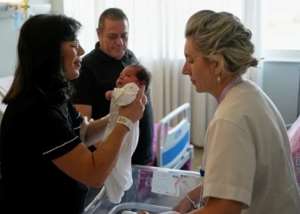
Athens, Greece A Greek couple has turned unimaginable loss into new life, welcoming a daughter born from an embryo that had been frozen for more than two decades a birth doctors are calling the longest documented gap between freezing and delivery anywhere in the world.
Cristina Rapti-Tzelepi, 54, gave birth to a healthy baby girl on Wednesday at the Genesis Athens Clinic, a private maternity facility in the Greek capital. The baby, named Georgia, weighed 3.49 kilograms (about 7 pounds, 11 ounces). Her father, 60-year-old Constantinos Raptis, was photographed cradling his sleeping newborn on his shoulder at the hospital days later.
A Race Against the Clock
The embryo used in the birth had been cryopreserved on March 17, 2004 more than 22 years earlier. According to the clinic, the span between freezing and birth stretched to 22 years, five months and 23 days, surpassing previous international benchmarks of roughly 18 years in Japan and 17 years in Israel.
The transfer itself took place on Christmas Eve of last year, but Rapti-Tzelepi was working against a hard deadline. Greek law caps the age at which a woman can complete IVF treatment and win approval from the country's national reproductive authority at 54. That gave her only a narrow window to act by her own account, roughly two and a half months from when she began the process.
Born From Grief
The pregnancy was born out of devastating circumstances. The same 2004 batch of embryos had already produced a son for the couple, born after their first IVF attempt succeeded on the first try. That son, Giorgos, died in a road accident in October at the age of 21.
In the aftermath, Rapti-Tzelepi and her husband decided to try again using one of the embryos still in storage from the original batch a decision she has described as a way of giving life a second chance and keeping their family's story going. Speaking from her hospital bed, she said her hope for her daughter is simply that she grows up healthy, happy, and full of joy, much like her late brother did.
Medical and Policy Reactions
The birth was announced by the family's gynecologist, Dr. Kostas Pantos, head of the Hellenic Society of Reproductive Medicine, in a social media post. Pantos, who is Australian-born, called the case a significant clinical and scientific milestone, while stressing that medicine must balance strict safeguards with compassion for families going through such journeys.
He has also used the case to renew calls for Greece to reconsider its IVF age limit, pointing to the country's sharply declining birth rate as a reason the rule may deserve review. Raptis, the baby's father, has separately appealed for the age cap to be lifted, arguing that older parents bring a depth of love and stability to raising children that statistics alone cannot capture.
The couple say they still have nine more embryos in storage from the same original batch. Under current Greek law, Rapti-Tzelepi is no longer eligible to use them domestically, though the family has said they have not ruled out pursuing further treatment abroad.
A Growing Global Trend
The case echoes a small but growing number of extreme long-term embryo storage stories worldwide. Last year, an Ohio couple welcomed a baby boy born from an embryo frozen for more than 30 years, a birth recognized by Guinness World Records under the term "embryo adoption." Greek doctors say the Rapti-Tzelepi case is now believed to be the longest such gap to result in a live birth globally.
Mustapha Bature Sallama
Medical/ Science Communicator,
Private Investigator, Criminal Investigation and Intelligence Analysis,
International Conflict Management and Peacebuilding. ( USIP)
[email protected]
+233555275880
Sources
Gatopoulos, Derek. "." Associated Press, September 11, 2026. https://abcnews.com/Technology/wireStory/after-tragedy-greek-couple-welcomes-daughter-born-embryo-136368715
"." CTV News, September 2026. https://www.ctvnews.ca/world/article/after-tragedy-a-greek-couple-welcomes-a-daughter-born-from-an-embryo-frozen-for-22-years/
"Greek couple welcomes daughter born from embryo frozen for 22 years." 1News, September 12, 2026. https://www.1news.co.nz/2026/09/12/greek-couple-welcomes-daughter-born-from-embryo-frozen-for-22-years/
"A mother, 54, gave birth after world-record 22-year embryo freeze." Neos Kosmos, September 2026. https://neoskosmos.com/en/?p=361493
"Woman, 54, gives birth from embryo frozen for 22 years after son's death." Newsweek, September 2026. https://www.newsweek.com/woman-54-gives-birth-from-embryo-frozen-for-22-years-after-sons-death-12424473
"Greek woman gives birth to 'miracle' daughter from 22-year-old embryo after losing son in road accident." Malay Mail, September 10, 2026. https://www.malaymail.com/news/world/2026/09/10/greek-woman-gives-birth-to-miracle-daughter-from-22-year-old-embryo-after-losing-son-in-road-accident/234691
Genesis Athens Clinic, Instagram/Facebook statement, September 2026 (via Dr. Kostas Pantos).


 Two Aduman SHS teachers remanded over alleged sodomy case involving two minors
 'What are the technical reasons for the new cedi notes?’ – Oppong Nkrumah questi...
 GES forwards 347 salary arrears cases of 2024 teacher recruits for payment
 No basis for rent increases in Ghana today – Kwakye Ofosu cites reduced building...
 2027 Budget: New Economy is ‘copy and paste’ of 24-hour policy – Amin Adam
 2027 Budget: Ato Forson contradicted himself on borrowing – Amin Adam
 Microsoft says it is 'deeply sorry' after widespread outages cause global chaos
 Microsoft outage causes global chaos
 The Nvidia affair: Are markets about to fall out of love with AI?
 'Too early to discuss presidential bid’ – Dr. Ato Forson



Comments
You should edit your story. 22 years is not the longest gap between embryo freezing and delivery. It's not even close. Last year, a couple who adopted through the Snowflakes Embryo Adoption Program in the U.S. had a child born 31 years after he was frozen as an embryo. It is a Guinness world record. You can also read about it in various outlets, including MIT Technology Review.