




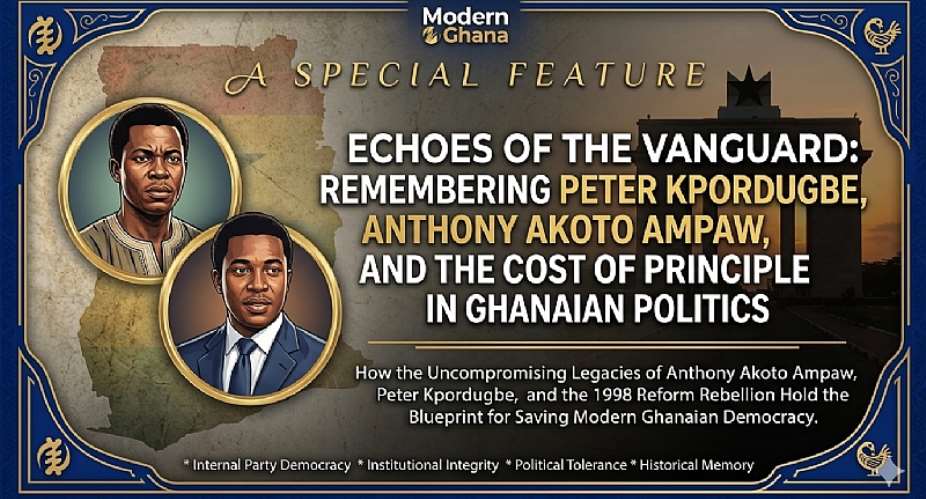
The history of Ghana’s Fourth Republic is often told through the grand narratives of ballot boxes, presidential handovers, and parliamentary debates, yet the true ideological scaffolding of our democracy was welded in the crucible of military rule and radical student resistance. Figures like Anthony Akoto Ampaw, who departed to the ancestral realm on 20 October 2023, and Peter Kpordugbe, the long-serving steward of the National Service Secretariat (NSS), represent a vanishing breed of public actors. They were part of a radical intellectual vanguard that fearlessly challenged the Provisional National Defence Council (PNDC) and later the National Democratic Congress (NDC), not out of a quest for political office, but from a fierce commitment to human rights, institutional integrity, and internal party democracy. As contemporary Ghana navigates its own socioeconomic and governance crossroads, revisiting the trajectories of these icons offers a sobering meditation on the price of political principle and the necessity of preserving our institutional memory.
The Crucible of Resistance: Akoto Ampaw and the Left-Wing Vanguard
The PNDC era under Jerry John Rawlings was a complex epoch of populist mobilization and severe civil curtailment. Within institutions like the University of Ghana and across national student fronts, young firebrands recognized that the transition from military dictatorship to constitutional rule required more than decrees; it demanded moral clarity.
- The Radical Activist: Anthony Akoto Ampaw, affectionately known as "Sheey Sheey," emerged as a legendary left-wing student leader whose unyielding opposition to authoritarian excesses earned him arbitrary political detention by the military regime.
- The Defender of Liberty: He did not dilute his convictions when the military regime morphed into a civilian administration. Instead, he transitioned his radicalism into a formidable legal career, eventually becoming a partner at Akufo-Addo, Prempeh & Co and serving as the lead counsel for President Akufo-Addo during the 2020 election petition. His life demonstrated that true patriotism is often adversarial to power, regardless of which party or leader occupies the seat of government.
The Rebellion for Democracy: Peter Kpordugbe and the Reform Movement
Parallel to this path of legal and civil resistance was Peter Kpordugbe, whose tenure at the helm of the National Service Secretariat in the 1990s redefined national youth mobilization. However, Kpordugbe etched his name permanently into the annals of political defiance in October 1998 under the NDC administration.
- The Swedru Fallout: Rather than acquiesce to executive fiat when President Jerry John Rawlings unilaterally announced the "Swedru Declaration"—anointing Professor John Evans Atta Mills as the party's automatic presidential successor without an open primary—Kpordugbe chose the turbulent path of dissent. For this, he was summarily fired from his role as National Service Director.
- The National Reform Party (NRP): Refusing to back down, Kpordugbe joined forces with other progressive NDC defectors, youth groups, and left-wing organizers to form the National Reform Party (NRP) in 1999 to fight for grassroots democracy. He served as the party's interim chairman alongside a powerful cadre of principled reformers:
- Augustus "Goosie" Obuadum Tanoh: The high-profile face and 2000 Presidential Candidate of the NRP.
- Kyeretwie Opoku: The central intellectual architect who served as the party's General Secretary.
- Festus Kosiba: The official vice-presidential running mate for the 2000 campaign.
- Wilfred Osei-Wusu: The former NDC Propaganda Secretary who was stripped of his roles for backing the movement.
Kpordugbe's fall from official grace was a testament to his belief that democratic principles must begin within the internal architecture of political parties before they can be expected to flourish in national governance. Following the early 2000s, Kpordugbe largely withdrew from active front-line politics, living a quiet private life away from public administration.
Key Historical Lessons for Modern Ghana
The collective legacy of Akoto Ampaw, Kpordugbe, and the Reformers provides critical lessons for modern Ghanaian statecraft:
- Principle over Patronage: Both men prioritized institutional integrity and democratic norms over personal career progression or political sycophancy, reminding us that public service loses its soul when dissent is penalized.
- The Danger of Elite Imposition: The 1998 fallout over succession politics remains a cautionary tale for modern political parties that attempt to bypass grassroots participation in favor of elite consensus or handpicked successors.
- Sustaining the Conscience of the Nation: A healthy democracy requires independent-minded intellectuals and legal minds who are willing to hold power accountable, even when it is uncomfortable or financially costly.
- Valuing Institutional Architects: Leaders who transform state organs like the National Service Secretariat into efficient vehicles for national development deserve historical acknowledgment rather than erasure when political tides shift.
Recommendations and Suggestions for the Fourth Republic
To honor the sacrifices of this pioneering generation and safeguard our democratic future, the following actions are urgently suggested:
- Enforce Strict Internal Party Democracy: Political parties across the spectrum must reform their constitutions to guarantee completely transparent, bottom-up primary processes, permanently eliminating the toxic centralization of power and monetization that alienates principled actors.
- Protect Public Servants from Political Victimization: Establish stricter constitutional guardrails that prevent the summary dismissal of institutional heads (like the NSS Director) purely based on their personal political convictions or party alignments.
- Document and Curate Activism in National Curricula: The Ministry of Education and Ghana Education Service should deliberately integrate the stories of civil rights advocates, student leaders, and political reformists alongside traditional political heroes, ensuring the younger generation understands that our freedoms were hard-won through personal sacrifice.
- De-polarize National Honors: Establish independent, non-partisan frameworks to post-humously or publicly honor individuals like Akoto Ampaw and Peter Kpordugbe for their civic contributions, decoupling national recognition from party loyalty.
The quiet retirement of Peter Kpordugbe and the physical absence of Anthony Akoto Ampaw must not translate into historical amnesia. They stood on the ramparts when the architecture of our current democratic dispensation was fragile, volatile, and contested. They proved that political parties are not religious sects demanding blind worship, but public vehicles that must submit to the rules of fairness, equity, and accountability. As Ghana continues to test the resilience of its democratic institutions, the ghosts and living consciences of the vanguard remind us that democracy is not merely a system of voting every four years, but a daily practice of courage, accountability, and unyielding fidelity to truth.
✍️ Submitted by:
Retired Senior Citizen
For and on behalf of all Senior Citizens of the Republic of Ghana 🇬🇭
Teshie-Nungua
[email protected]

 How IGP Yohuno led Police team to rescue victim, arrest four kidnappers in Assin...
 Akufo-Addo would have used Accra-Kumasi expressway for galamsey – Mahdi Gibrill
 Nigeria's Dangote refinery launches continent's biggest IPO
 Accra-Kumasi Expressway to cut travel time to 2hours, drive 120km per hour — Mah...
 'Our own money $2billion ready, we have not gone to borrow money from anywhere' ...
 Founder’s Day September 21 declared public holiday
 Council of State was not qualified to determine prima facie case against Torkorn...
 'Grounds for removal of Chief Justice and justice of superior court shallow, eph...
 Don't be a Bar that flips on principles but a Bar that is consistent — AG tells ...
 Prostate cancer may show no symptoms until advanced stage – Urologist warns


