




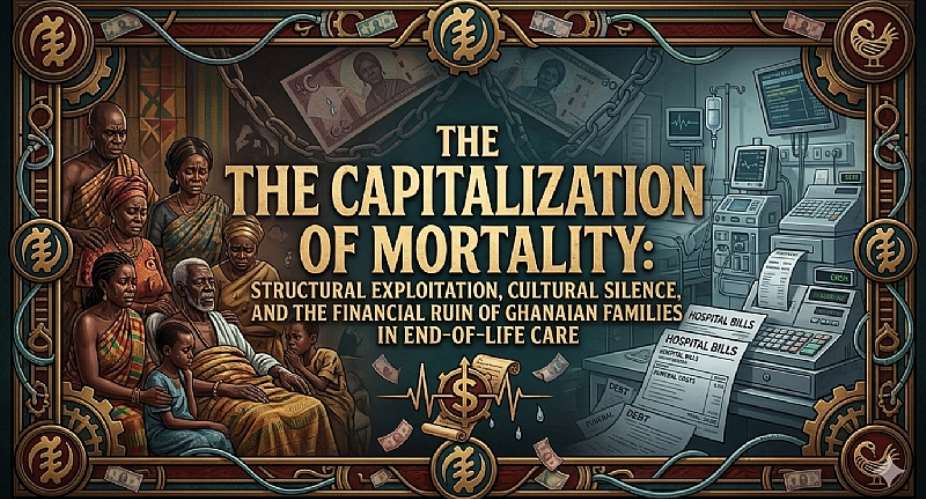
In contemporary bioethics and global health systems, the terminal phase of life is treated as a sacred window for compassionate transition. In many jurisdictions, clinical protocols mandate transparent prognostic communication. When curative interventions become futile, medical teams shift their mandate from aggressive treatment to palliative comfort—preserving the patient's dignity and shielding their family from catastrophic financial loss.
In Ghana, however, this transition is routinely subverted by a distressing synthesis of systemic institutional failure and unconscionable economic exploitation. Even when clinical markers clearly indicate that a patient is actively dying, the machinery of aggressive, high-cost medical care does not stop. Families are systematically subjected to relentless prescriptions for exorbitant medications, futile diagnostics, and intensive interventions that yield zero therapeutic value. Because our healthcare architecture relies heavily on family-funded out-of-pocket expenses, this practice inflicts profound emotional trauma and absolute economic devastation on relatives. This article deconstructs the structural and cultural incentives driving this institutionalized exploitation and outlines an urgent path toward ethical reform.
The Anatomy of End-of-Life Exploitation in Ghana
The structural perpetuation of futile medical care at the end of life is sustained by systemic, economic, and sociolinguistic mechanisms:
- Asymmetric Information and Financial Capitalization: The clinical relationship in Ghana is heavily paternalistic. Healthcare facilities and individual practitioners frequently exploit the informational asymmetry between doctor and patient. Desperate families, blinded by grief and a lack of medical literacy, are treated as financial resource centers. Out-of-pocket payments fund expensive, non-beneficial pharmaceutical lines, often tied to internal hospital revenue targets or pharmaceutical supplier incentives.
- The Sociolinguistic Taboo of Death: Anthropological frameworks in Ghana deeply stigmatize the explicit discussion of mortality. Pronouncing a terminal prognosis is culturally conflated with "cursing" the patient or abandoning hope. Clinicians, lacking formal training in breaking bad news, default to a continuous cycle of aggressive prescribing to avoid difficult conversations and deflect potential accusations of professional negligence.
- Structural Deficits in Palliative Infrastructure: Palliative care remains largely absent from mainstream clinical practice in Ghana, leaving roughly 86% of the population without access to meaningful end-of-life comfort. The National Health Insurance Scheme (NHIS) features broad exclusion lists for critical and advanced illnesses, completely leaving out late-stage oncological, renal, and intensive care treatments. Without a structured pathway to step down to comfort-oriented care, terminal patients are left in standard wards where high-cost acute interventions remain the default protocol.
Realities From the Wards: Ghanaian Case Studies
Case Study 1: The Liquidation of the Family Legacy (Korle Bu Teaching Hospital)
In Accra, a 64-year-old grandfather was admitted to a major referral ward with advanced, metastatic prostate cancer that had spread to his bones. The oncology team quietly acknowledged among themselves that the patient had less than three weeks to live. However, this prognosis was never communicated to his children. Instead, the family was handed daily "scratch cards" and emergency drug lists demanding expensive, third-line chemotherapy agents and specialized intensive care consumables.
Driven by filial duty and the desperate belief that the hospital was fighting for their father's life, the family sold two plots of ancestral land in the Central Region and exhausted the capital of the mother's retail business. The patriarch passed away while hooked to a ventilator, an hour after the family paid for another round of futile medications. Today, the family is financially broken, the children's tertiary education has been halted, and the widow faces destitution—all to fund a clinical illusion.
Case Study 2: The Toxic Intersections of Faith and Futility (Komfo Anokye Teaching Hospital)
In Kumasi, a 42-year-old mother of three presented with end-stage liver failure. Trapped between a medical team that refused to declare the futility of further interventions and a family belief system holding out for a divine miracle, a destructive cycle emerged. The medical team continued to prescribe daily, expensive albumin infusions and high-end antibiotics, despite clear clinical signs of multi-organ failure.
To meet these daily costs, the extended family took out high-interest loans from local microfinance institutions. When the patient passed away, the family was left with a body held hostage by the mortuary over outstanding bills, combined with a predatory debt cycle that has permanently compromised the financial security of her surviving children.
Recommendations and Suggestions for Systemic Reform
To dismantle this unethical paradigm and protect the economic integrity of Ghanaian households, we propose the following structural interventions:
- Institutionalize Mandatory Palliative Care Training: The Medical and Dental Council of Ghana and the Nursing and Midwifery Council must make training on end-of-life care, bioethics, and breaking bad news mandatory. Clinicians must be equipped to guide families toward affordable comfort rather than aggressive, futile interventions.
- Formulate a National Palliative Care Policy: The Ministry of Health must establish a clear National Palliative Care Policy. This framework must legally protect doctors who withdraw futile treatments and guarantee that the NHIS budget covers basic pain relief medications, such as oral morphine.
- Establish Community-Based Hospices: In partnership with the Christian Health Association of Ghana (CHAG) and Muslim medical networks, the state should fund community-based hospices. Shifting terminal care from expensive acute wards to community comfort centers will substantially lower costs for families.
- Enforce Independent Medical Audits: Hospital boards must implement independent peer-review audits for prolonged intensive care and high-cost terminal prescriptions. Medical professionals found to be intentionally over-prescribing non-beneficial treatments to terminal patients for financial gain must face strict disciplinary action.
- Launch National Media Sensitization Campaigns: Media institutions, led by premier analytical platforms like Modern Ghana, must actively de-stigmatize conversations surrounding death and advance care planning. The public must be educated to understand that choosing comfort care over financially ruinous, futile treatment is a profound act of love and dignity.
A healthcare system that capitalizes on terminal suffering and treats the deathbed as a profit center has lost its ethical foundation. Forcing families into multi-generational poverty to fund medical treatments that offer no curative value is a profound failure of the medical oath to "do no harm." Death is an inevitable transition, not an asset to be financially exploited. Ghana must urgently reform its approach to end-of-life care. We must replace predatory billing and institutional silence with clinical honesty, systemic support, and affordable palliative care. Our citizens deserve to bid farewell to their loved ones with peace and dignity—not under the crushing, artificial weight of institutional debt.
✍️ Submitted by:
Retired Senior Citizen
For and on behalf of all Senior Citizens of the Republic of Ghana 🇬🇭
Teshie-Nungua
[email protected]


 How IGP Yohuno led Police team to rescue victim, arrest four kidnappers in Assin...
 Akufo-Addo would have used Accra-Kumasi expressway for galamsey – Mahdi Gibrill
 Nigeria's Dangote refinery launches continent's biggest IPO
 Accra-Kumasi Expressway to cut travel time to 2hours, drive 120km per hour — Mah...
 'Our own money $2billion ready, we have not gone to borrow money from anywhere' ...
 Founder’s Day September 21 declared public holiday
 Council of State was not qualified to determine prima facie case against Torkorn...
 'Grounds for removal of Chief Justice and justice of superior court shallow, eph...
 Don't be a Bar that flips on principles but a Bar that is consistent — AG tells ...
 Prostate cancer may show no symptoms until advanced stage – Urologist warns


