




Deep Dive: Historical Context & Ghanaian Parallels
To seamlessly weave African history into this narrative, we look at the February 28, 1948, Crossroads Shooting Atrocity in Christiansborg, Accra.
Just as the Nazi regime used collective punishment and disproportionate state violence to suppress Czech aspirations, the British colonial administration under Governor Gerald Creasy panicked when faced with peaceful defiance.
- The Peaceful Protest: A disciplined, unarmed group of Ghanaian World War II veterans—led by Sergeant Cornelius Adjetey, Corporal Attipoe, and Private Odartey Lamptey—marched toward the Christiansborg Castle. Having fought for the British Empire in the jungles of Burma, they were simply marching to present a peaceful petition to the Governor regarding unpaid pensions and broken promises.
- The Disproportionate State Response: At the Christiansborg crossroads, a British colonial police officer, Superintendent Colin Imray, ordered his men to open fire on the veterans. When the Ghanaian policemen refused to fire on their own people, Imray grabbed a rifle himself and shot the leaders dead, sparking the historic 1948 Accra Riots.
- The Strategic Failure of Terror: Much like the destruction of Lidice backfired on the Nazis by generating global outrage and hardening Czech resistance, the killing of the veterans backfired on the British. It acted as the ultimate catalyst, shifting the Gold Coast's political struggle from mild reform to an unyielding demand for total independence, eventually birthing modern Ghana.
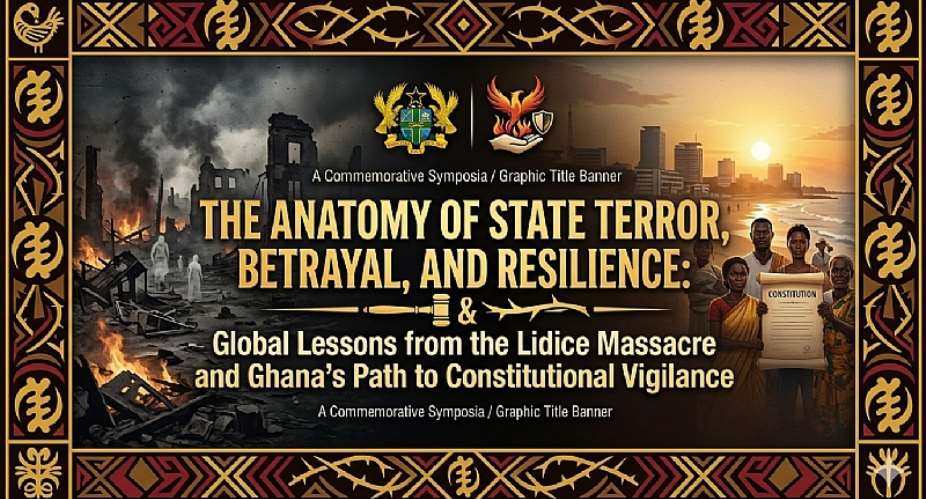
The Anatomy of State Terror, Betrayal, and Resilience: Global Lessons from the Lidice Massacre and Ghana’s Path to Constitutional Vigilance
From the Ruined Fields of Central Europe to the Christiansborg Crossroads: A Comparative Analysis of State Violence, the Price of Betrayal, and the Institutional Safeguards Needed to Protect Ghana’s Democratic Future.
1. The Universal Warnings of History
In the contemporary landscape of international relations and democratic consolidation, the study of history must transcend geographical isolation. For Ghana, a country globally recognized as a pillar of stability and democratic governance in West Africa, maintaining this prestige requires a continuous intellectual audit of how nations fall into tyranny, withstand institutional collapse, and overcome existential trauma. The complete erasure of the Czech mining village of Lidice and the hamlet of Ležáky by Nazi occupation forces in 1942 offers a profound, tragic masterclass in the dangers of unchecked state power and the catastrophic costs of internal betrayal. When analyzed alongside seminal moments in Ghana's own liberation struggle—such as the 1948 Christiansborg Crossroads shooting—history reveals a universal axiom: an armed state apparatus operating without strict constitutional, judicial, and moral boundaries will inevitably view its own populace, or the populations it occupies, as targets for extermination. This article presents a rigorous comparative analysis of these historical flashpoints, offering targeted strategic imperatives for Ghanaian politicians, military strategists, media practitioners, and academia to insulate the republic against the institutional decay that precedes tyranny.
2. The Mechanics of Nazi State Vengeance: Lidice and Ležáky
The tragedy of Lidice was birthed from the assassination of Reinhard Heydrich, the ruthless Nazi ruler of Bohemia and Moravia, by Czech paratroopers during Operation Anthropoid in May 1942. The response from the Nazi regime, orchestrated locally by Higher SS and Police Leader Karl Hermann Frank, was a chilling manifestation of institutionalized terror:
- The Execution of Lidice: On June 9, 1942, acting on completely fabricated intelligence suggesting the village harbored resistance fighters, Nazi forces surrounded Lidice. They systematically executed all 173 men and boys over the age of 16 against a barn wall, deported 203 women to the Ravensbrück concentration camp, and abducted 105 children, 82 of whom were later murdered in mobile gas vans at the Chelmno extermination camp.
- Total Physical Erasure: To enforce complete psychological subjugation, Adolf Hitler ordered the literal removal of Lidice from the map. Every house, school, and historic church was looted and dynamited; the village cemetery was dug up, the local river diverted, and the entire area covered in topsoil and converted into cornfields to remove any trace of human existence.
- The Destruction of Ležáky: Two weeks later, on June 24, 1942, the nearby hamlet of Ležáky was targeted because it was an actual hub for the underground resistance, hiding the Silver A team's secret radio transmitter. The Nazis executed all 33 adult men and women on the spot, sent their children to extermination camps, and razed the entire settlement to its foundations.
3. The Psychology of Internal Betrayal: The Fall of the Crypt
The ultimate downfall of the heroic Czech paratroopers who executed Heydrich provides a crucial lesson on the fragility of national security networks when confronted with internal moral collapse.
- The Informant's Treason: Despite a massive Gestapo manhunt, the paratroopers successfully hid inside the crypt of Prague's St. Cyril and Methodius Cathedral. Their position was exposed not by German espionage, but by Karel Čurda, a fellow Czech paratrooper who cracked under the pressure of Nazi terror campaigns.
- The Transactional Nature of Betrayal: Driven by fear and a massive 500,000 Reichsmarks bounty, Čurda walked into Gestapo headquarters and identified his comrades' personal belongings. His confessions triggered the brutal torture of the Moravec family, which ultimately forced out the exact location of the crypt, leading to a bloody final stand where the cornered paratroopers used their final bullets on themselves to avoid capture.
4. The Ghanaian Parallel: The 1948 Christiansborg Crossroads Shooting
The structural reliance of an oppressive administration on raw violence to maintain control is a theme deeply embedded in the soil of Ghana's colonial history. The events of February 28, 1948, mirror the operational panic of an elite relying on terror rather than legitimacy:
- The Veterans' Grievances: Unarmed Ghanaian veterans of World War II, having fought for the Allied cause in the jungles of Burma, marched peacefully toward the Christiansborg Castle in Accra to present a petition to Governor Gerald Creasy regarding unpaid pensions and systemic neglect.
- The Imperial Killings: At the Christiansborg crossroads, a British colonial police officer, Superintendent Colin Imray, ordered his troops to open fire on the peaceful veterans. When the local Ghanaian policemen bravely refused to shoot their own compatriots, Imray personally seized a rifle and shot the leaders dead—instantly killing Sergeant Cornelius Adjetey, Corporal Attipoe, and Private Odartey Lamptey.
- The Catalyst for Revolution: Much like the destruction of Lidice failed to break the Czech spirit and instead unified global condemnation against the Axis powers, the Crossroads Shooting completely fractured British colonial legitimacy in the Gold Coast. The resulting Accra Riots and political awakening transformed a moderate reformist movement into a radical, unyielding demands for total self-governance, directly accelerating Ghana's journey toward independence in 1957.
5. The Imperative of Memory and Institutional Shields
The historical intersections between the ashes of Central Europe and the liberation struggles of West Africa demonstrate that peace is never self-sustaining; it is preserved solely through the strength of a nation’s institutions and the historical consciousness of its people. Karl Hermann Frank, Kurt Daluege, and Karel Čurda were all eventually captured, tried before post-war tribunals, and executed by hanging—proving that while state terror can enjoy temporary impunity, the arc of justice inevitably bends toward accountability. Similarly, the names of Adjetey, Attipoe, and Lamptey outlived the empire that sought to silence them. Today, the rebuilt village of Lidice stands as a thriving, modern community directly adjacent to its preserved memorial park, serving as a monument to human resilience. For Ghana to secure its democratic future against the rising tides of global instability and governance failures, its leaders and citizens must internalize these lessons: guarding against internal betrayal, ensuring absolute civilian control over the military, and treating historical memory as an active national defense mechanism.
Strategic Recommendations & Policy Suggestions
For Politicians, Parliamentarians, and Policymakers
- Codify Absolute Civilian Oversight: Strengthen parliamentary defense committees to ensure that national security services, intelligence agencies, and police forces operate under rigid statutory transparency, eliminating any legal loopholes that allow for political misuse of the armed apparatus.
- Establish Constitutional Education Frameworks: Mandate the structural teaching of human rights, constitutional limits on executive power, and historical state-sponsored atrocities within all public service training institutions.
For the Ghana Armed Forces & Military Academy Students (MATS)
- Institutionalize Humanitarian Law in Tactical Doctrine: Elevate the study of International Humanitarian Law (IHL) from a secondary lecture topic to a core operational constraint in military training, explicitly detailing the legal obligation of personnel to refuse orders that mandate the targeting or collective punishment of civilian populations.
- Enhance Counter-Espionage and Institutional Trust: Integrate historical case studies of insider threats—such as the psychological profiling of Karel Čurda—into military intelligence curricula to build robust, ethical internal security structures that withstand external bribery or intimidation.
For Journalists and Media Practitioners
- Act as the Fourth Estate Against Governance Decay: Maintain strict investigative independence by identifying and exposing early warning signs of state overreach, arbitrary detentions, or police brutality before they become normalized state practices.
- De-politicize National Historical Discourses: Dedicate media airtime and print space to high-quality historical journalism, moving beyond daily partisan rhetoric to educate the Ghanaian public on the long-term institutional requirements of sustained freedom.
For Academia and Students of Comparative History
- Expand the Scope of Historical Curricula: Revise university history programs to include comprehensive, comparative modules analyzing European, Asian, and Latin American struggles against totalitarianism, allowing Ghanaian students to draw systemic parallels to continental African history.
- Fund Primary Research and Oral History Projects: Establish national grants for academic researchers to document the testimonies of Ghana’s independence era, ensuring that local lessons of patriotism, resistance, and governance are scientifically preserved for future policy formulation.
✍️ Submitted by:
Retired Senior Citizen
For and on behalf of all Senior Citizens of the Republic of Ghana 🇬🇭
Teshie-Nungua
[email protected]


 How IGP Yohuno led Police team to rescue victim, arrest four kidnappers in Assin...
 Akufo-Addo would have used Accra-Kumasi expressway for galamsey – Mahdi Gibrill
 Nigeria's Dangote refinery launches continent's biggest IPO
 Accra-Kumasi Expressway to cut travel time to 2hours, drive 120km per hour — Mah...
 'Our own money $2billion ready, we have not gone to borrow money from anywhere' ...
 Founder’s Day September 21 declared public holiday
 Council of State was not qualified to determine prima facie case against Torkorn...
 'Grounds for removal of Chief Justice and justice of superior court shallow, eph...
 Don't be a Bar that flips on principles but a Bar that is consistent — AG tells ...
 Prostate cancer may show no symptoms until advanced stage – Urologist warns


