




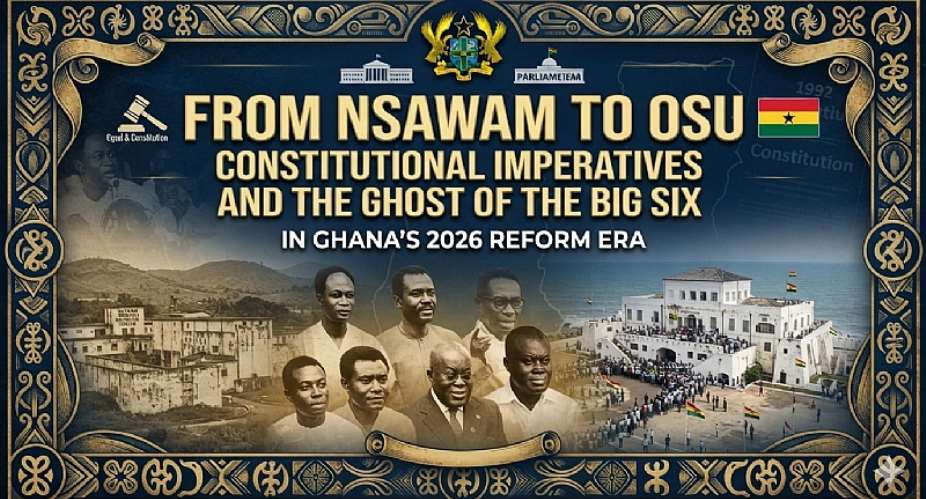
The Exhumation of History and Present Realities
The historical exhumation of Emmanuel Odarkwei Obetsebi-Lamptey’s remains from an unmarked grave by the Densu River in Nsawam to a state-honored reburial at the Osu Cemetery remains one of the most poignant metaphors in Ghanaian political history. Detained and ultimately broken under the heavy-handed security apparatus of the First Republic, Obetsebi-Lamptey embodied the tragic cost of an uncompromising, hyper-centralized unitary vision championed by Dr. Kwame Nkrumah. Nkrumah’s state sought absolute conformity in the crucible of nation-building, while Obetsebi-Lamptey and the liberal-conservative tradition pressed for pluralism, decentralization, and structural checks against executive overreach.
As Ghana moves through 2026, navigating the administrative and legislative wake of the government's recent White Paper on constitutional reform, this historical dialectic has re-emerged with startling relevance. The current national discourse—sparked by policy shifts under the Mahama administration and proposals emerging from civil society coalitions like CDD-Ghana—forces a rigorous re-examination of our supreme law. To honor the legacy of our founding fathers beyond political rhetoric, contemporary Ghanaians must evaluate specific provisions of the 1992 Constitution that continue to codify the imperial presidency and stifle local autonomy.
Dismantling the Imperial Presidency and Article 78
At the heart of the ongoing 2026 constitutional debate is the dangerous concentration of executive authority, a structural remnant that mirrors the unitarist anxieties of the early post-independence era. Under Article 78(1) of the 1992 Constitution, the President is mandated to appoint the majority of Ministers of State from among members of Parliament. From both a journalistic and institutional-analysis perspective, this provision creates an unhealthy conflation of powers, compromising Parliament's constitutional duty of horizontal accountability. When an MP harbors aspirations of executive patronage or cabinet appointment, legislative oversight becomes subservient to party discipline and presidential whim.
Reforming Article 78 to explicitly prohibit or cap the appointment of sitting MPs as ministers—a proposal recently advanced in contemporary governance reviews—would create a genuine separation of powers. By ensuring that the legislature stands as an independent counterweight rather than an extension of the Jubilee House, Ghana can institutionalize the very checks and balances that Obetsebi-Lamptey and his contemporaries argued were indispensable to preventing civil authoritarianism.
Local Democracy, Decentralization, and Articles 55 and 243
The debate over grassroots governance in 2026 has similarly brought Articles 55(3) and 243(1) of the 1992 Constitution into sharp relief. Article 243(1) vests the power to appoint Metropolitan, Municipal, and District Chief Executives (MMDCEs) solely in the President, effectively transforming local assemblies into administrative extensions of central government rather than autonomous entities responsive to local electorates. Concurrently, Article 55(3) restricts political parties from sponsoring candidates in district-level elections, a provision that has kept local governance in a nebulous state of non-partisan apathy.
A true democratization of our local governance architecture requires amending Article 243(1) to make the office of the MMDCE directly elective by the people, alongside an amendment to Article 55(3) to permit multiparty participation at the local level. Transitioning from a nominal decentralization to substantive regional and district autonomy addresses the core grievances historically raised by the federalist movement: that localized development and resource allocation cannot be efficiently micro-managed from a single political center in Accra.
The Legislative Mechanics and the Hurdle of Entrenched Provisions
As the Attorney-General’s office navigates the implementation framework for modern constitutional reforms—including proposed tenurial adjustments and ministerial caps—the nation must confront the procedural rigidity of Chapter 25 of the 1992 Constitution. Article 290 outlines the arduous multi-stage referendum process required to amend entrenched provisions, demanding high voter turnout and supermajorities. While this rigidity protects the foundational clauses of our democracy from whimsical legislative tinkering, it has historically paralyzed structural consensus-building.
The current 2026 policy climate, which contemplates aligning non-entrenched amendments with upcoming district-level exercises or targeted national referenda, requires careful civic mobilization. Civil society and political elites must treat this reform cycle not as a zero-sum partisan contest, but as an ongoing constitutional settlement.
Synthesizing Liberty and National Cohesion
The journey from the segregated shadows of Nsawam Prison to the national prominence of Osu Cemetery teaches a timeless lesson about political longevity: the suppression of ideological diversity is a fragile architecture that time inevitably dismantles. Ghana's democratic stability in 2026 depends on our collective willingness to transcend the winner-takes-all paradigm inherited from our early post-colonial anxieties. By strategically amending provisions like Articles 78 and 243, we can bridge the historical chasm between Nkrumah’s drive for national unity and Obetsebi-Lamptey’s demand for institutional liberty, securing a resilient republic for generations to come.
✍️ Submitted by:
Retired Senior Citizen
For and on behalf of all Senior Citizens of the Republic of Ghana 🇬🇭
Teshie-Nungua
[email protected]


 How IGP Yohuno led Police team to rescue victim, arrest four kidnappers in Assin...
 Akufo-Addo would have used Accra-Kumasi expressway for galamsey – Mahdi Gibrill
 Nigeria's Dangote refinery launches continent's biggest IPO
 Accra-Kumasi Expressway to cut travel time to 2hours, drive 120km per hour — Mah...
 'Our own money $2billion ready, we have not gone to borrow money from anywhere' ...
 Founder’s Day September 21 declared public holiday
 Council of State was not qualified to determine prima facie case against Torkorn...
 'Grounds for removal of Chief Justice and justice of superior court shallow, eph...
 Don't be a Bar that flips on principles but a Bar that is consistent — AG tells ...
 Prostate cancer may show no symptoms until advanced stage – Urologist warns


