




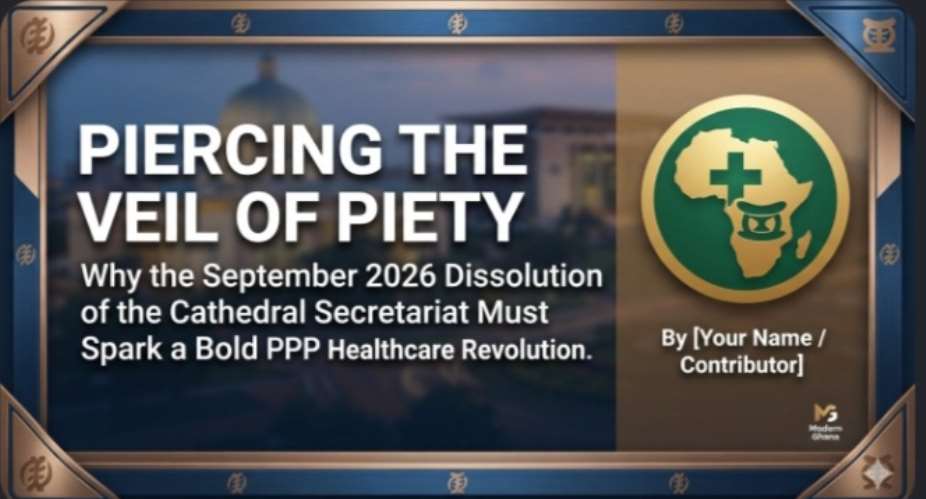
The Audacity of Abuse and the Demand for Pragmatism
On September 12 and 13, 2026, the conversation surrounding Ghana's most controversial infrastructure project shifted dramatically. Speaking during his high-profile citizens' engagement tour in the Upper West Region, President John Dramani Mahama explicitly announced that a forensic audit into the National Cathedral’s expenditure has been completed and is now sitting with the Attorney-General. Concurrently, the administration made the decisive move to dissolve the National Cathedral Secretariat, completely pulling the plug on taxpayer funding.
What was sold to Ghanaians as a "zero-cost" private campaign vow to the Almighty has mutated into one of the most brazen financial albatrosses in our history—cannibalizing nearly $97 million in scarce public funds only to leave a heavily excavated, stagnant pit in central Accra. As columnist Atitso Akpalu ruthlessly exposed in his definitive analysis, "The National Cathedral Chronicles," this personal vanity project completely ignored institutional procedures.
Building a house of worship is not a crime, but doing so by unlawfully demolishing judges' residences, bypassing the Public Procurement Act, and raiding the state treasury during a severe fiscal crisis is a profound institutional betrayal. True leadership requires the courage to pivot. To rectify this damage, we must aggressively enforce the audit's findings. Simultaneously, we must diplomatically unite our finest financial minds, medical leaders, and civil society watchdogs to transform this polarizing scar into an elite, multi-purpose socio-economic and health ecosystem via a robust Public-Private Partnership (PPP) framework.
The Diagnostics: Institutional Failure Masked as Piety
Drawing directly from Atitso Akpalu’s forensic indictments and the political realities of September 2026, the ongoing crisis is defined by three unpardonable failures:
- The $97 Million Deception: Siphoning massive state liquidity into a stalled crater while continually assuring the public that the project would be strictly privately funded.
- The Annihilation of State Assets: The short-sighted destruction of strategic infrastructure—including the Passport Office, the Judicial Training Institute, and prime judges' bungalows—creating artificial deficits for the state.
- Procurement Lawlessness: A total disregard for national checks and balances, setting a dangerous precedent where personal presidential wishes supersede the rule of law.
The Blueprint: A Specialist Children’s Hospital of International Standards
Rather than letting $97 million worth of prime land and excavation rot as a monument to greed, the landscape should be aggressively transformed. The crown jewel of this repurposed site must be a Specialist Children’s Hospital of International Standards, flanked by high-yielding socio-economic infrastructure:
- Advanced Paediatric & Neonatal Intensive Care Units (PICU/NICU): Equipped with state-of-the-art incubators, specialized paediatric ventilators, and continuous telemetry monitoring to handle high-risk pre-term deliveries and critical childhood illnesses across West Africa.
- Specialist Paediatric Surgery & Oncology Wings: Featuring ultra-modern operating theatres outfitted with specialized paediatric anaesthesia machines, micro-surgical instruments, and dedicated linear accelerators for advanced childhood cancer therapies.
- Child-Centered Outpatient & Developmental Diagnostics: Incorporating high-resolution paediatric MRI and CT scanners calibrated for low-radiation exposure, alongside specialized clinics for child psychology, neurodevelopmental disorders, and speech therapy.
- The National Innovation & Digital Hub: A portion of the landscape should house a state-of-the-art incubation center providing tech tools, coding bootcamps, and co-working spaces for Ghana's unemployed youth.
- The Interfaith Peace Park: A beautifully landscaped green space that honors the original spiritual intent while welcoming Ghanaians of all faiths, providing a healing environment for grieving families and recovering children.
The Stakeholder Coalition: Structuring the PPP Framework
Financing this grand pivot requires a firm embargo on public funds. Instead, the state must diplomatically engage a highly credible consortium of institutional partners:
1. Financial Lead Stakeholders (Tier-1 Local Institutions)
- GCB Bank PLC & Ecobank Ghana: To lead a syndicated commercial loan and structured equity fund, managing the commercial real estate and tech-hub segments.
- The Social Security and National Insurance Trust (SSNIT): To invest long-term capital into the healthcare infrastructure, guaranteeing returns for Ghanaian workers through premium medical services.
- Ghana Infrastructure Investment Fund (GIIF): To act as the state's technical advisor, ensuring the project aligns with the national PPP policy.
2. Accountability & Oversight Stakeholders (Civil Society)
- IMANI Africa & Ghana Integrity Initiative (GII): Placed directly on the steering committee to strictly monitor procurement, fight inflation of costs, and ensure absolute transparency.
- The Ghana Center for Democratic Development (CDD-Ghana): To ensure civic inclusivity and verify that public complaints regarding the landscape are continuously addressed.
3. Religious & International Partners
- The Christian Council of Ghana: To oversee the interfaith peace park entirely through voluntary, private donations, completely decoupling the state from religious financing.
- The International Finance Corporation (IFC): To provide structural transaction advisory services, keeping the bidding process clean, competitive, and globally attractive.
Direct Recommendations for Immediate State Action
- Pass the Site Re-Designation Act: Capitalize on the September 2026 momentum by passing a legislative instrument that re-designates the land from a religious site to a Special Economic, Civic, and Paediatric Health Zone.
- Launch a Competitive, Transparent Tender: Open a strict, internationally scrutinized bidding process under a Design-Build-Finance-Operate-Transfer (DBFOT) model, locking out politically exposed persons.
- Execute Criminal Prosecutions: The state must fully enforce the findings of the newly completed Deloitte & Touche forensic audit. Anyone responsible for the $97 million procurement violations belongs in a court of law, not a boardroom. As Atitso Akpalu rightly reminds us, accountability cannot be negotiated.
- Legislate the "Anti-Vanity" Bill: Enact strict parliamentary legislation that explicitly criminalizes the commitment of state lands, funds, or guarantees to personal, political, or religious pledges without prior, two-thirds parliamentary approval.
Reclaiming the Soul of the Nation
The true moral fabric of Ghana is not measured by the grandeur of a concrete monument, but by our fidelity to the rule of law and our care for the sick, the young, and the vulnerable. Leaving a $97 million pit in central Accra is an ongoing insult to every hardworking taxpayer.
By weaponizing the accountability principles championed by Atitso Akpalu and taking immediate advantage of the Secretariat's recent dissolution, we can turn this symbol of greed into a monument of resilience. Let us fill the pit not with more unvouched cash, but with life-saving pediatric wards, technology, and transparent commerce. That is how we honor God, restore public trust, and build a Ghana that belongs to all its children.
✍️ Submitted by:
Retired Senior Citizen
For and on behalf of all Senior Citizens of the Republic of Ghana 🇬🇭
Teshie-Nungua
[email protected]

 Thousands attend Kenya opposition rally amid anger over political violence
 Trump slams AI sceptics as Altman pauses OpenAI IPO plans over safety concerns
 WASSCE: School officials helped students cheat for years, but we now see the tru...
 Probe alleged military killing of lecturer in Bawku – Kusaug Youth demands
 ‘If we all pay GH¢1,000 each, we should be able to construct National Cathedral’...
 Mahama inspects proposed site for Upper West Regional Airport
 Mahama reiterates government's commitment to end double-track SHS system
 Police interdict officer over death of 23-year-old Ivan Baidoo on Tema Motorway
 Improved invigilation is exposing true performance of Ghanaian students — Mahama...
 There's no policy to introduce Arabic, Chinese in all public schools — Mahama


