




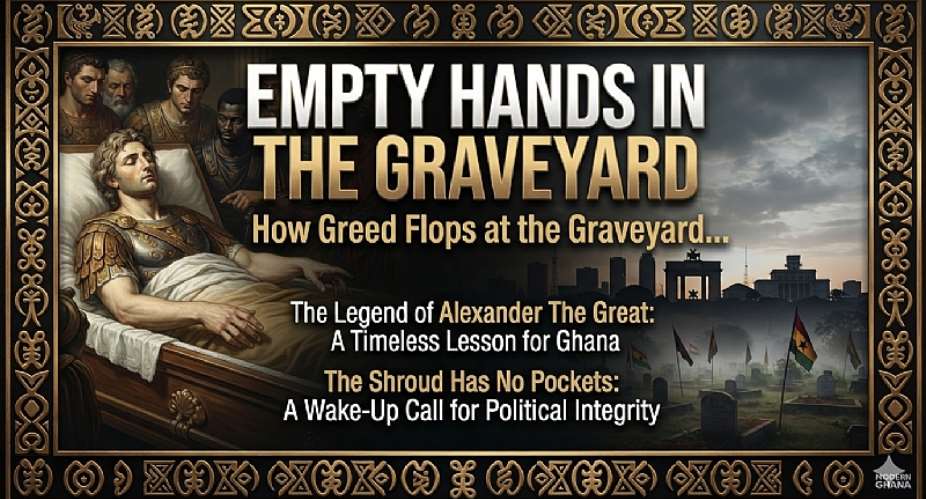
In Ghana today, our public discourse is constantly dominated by the pursuit of wealth, economic hardship, and the systemic plundering of national resources. We watch as public funds vanish, state assets are shared among a privileged few, and political leadership becomes synonymous with self-aggrandisement. Meanwhile, the ordinary Ghanaian is left to grapple with failing infrastructure, struggling hospitals, and skyrocketing costs of living.
Amidst this insatiable greed, we have forgotten the most fundamental truth of human existence: life is temporary, and death is the ultimate equalizer. As the timeless Akan proverb warns, "Owuo totrobonsu na osée mmaninsém" (Death, the great leveler, shatters all human arrogance). No matter how much wealth is hoarded or how many millions are diverted from the public purse, the shroud has no pockets. True wealth is not measured by a bank balance but by the breath in our lungs and the service we render to humanity.
The Timeless Lesson of Alexander the Great
History provides a sobering reality check for anyone consumed by greed. On his deathbed, Alexander the Great, the powerful military king who conquered most of the known ancient world, summoned his generals and gave three final, symbolic instructions for his funeral:
- Carried by Doctors: He ordered that his coffin be carried exclusively by the best physicians and surgeons of his time. He wanted the world to see that when your time is up, even the most skilled doctors have no power to save you from death.
- A Pathway of Treasure: He commanded that all the gold, silver, and precious stones he had amassed through bloody conquest be scattered along the road to his grave. This was to show that the riches we waste our lives accumulating stay behind on Earth.
- An Open Coffin with Hanging Hands: Finally, he insisted that his casket remain open with both his hands left loose, dangling outside for all to see. His message was profound: “Empty-handed I came into this world, and empty-handed I shall leave.”
A Wake-Up Call for Ghana’s Politicians and Public Officials
If a ruler who conquered empires left this world with absolutely nothing, what makes today's Ghanaian politician think they can take state funds to the grave?
- The Stolen Wealth Stays Behind: No matter how many luxury mansions you build in East Legon, how many V8 vehicles you acquire, or how many millions you hide in foreign offshore bank accounts, you will not take a single pesewa to your grave. It brings to mind the direct wisdom of 1 Timothy 6:7, which reminds us: "For we brought nothing into the world, and we can take nothing out of it."
- The Illusion of Power: Our leaders act as if their political appointments grant them eternal ownership over the state. They should heed the words of the Roman philosopher Seneca, who wrote: "We are all born unequal, but we die equal."
- The Mortuary is a Leveler: Walk into any Ghanaian mortuary, and you will see the physical manifestation of the proverb, "Owuo kwan bue kwan" (Death's road is open to all). Death makes no distinction between an honorable Member of Parliament, a wealthy businessman, or an ordinary street hawker. We all end up in the exact same cold state.
Recommendations and Suggestions for National Reflection
To change the course of our nation, we must reorient our mindset toward gratitude, accountability, and the value of human life:
- Politicians Must Shift to Impact-Based Governance: State officials must remember that their names will be written in gold only if they improve the lives of Ghanaians, not if they empty the national coffers. As Luke 12:15 cautions: "Watch out! Be on your guard against all kinds of greed; life does not consist in an abundance of possessions."
- Citizens Should Ground Themselves in Perspective: When financial anxiety drives us to despair, we should remember our health. Our elders say, "Sika nni nkyene gu so aa, ényé dé" (If you have money but no health to enjoy it, it is useless). Visiting a hospital or looking closely at the fragile nature of life helps reset our gratitude. If you have your health and your life, you possess a foundational wealth that money cannot buy.
- Institutional Memory Over Materialism: Civil society, religious bodies, and media outlets—like Modern Ghana—must continue to amplify stories that champion integrity. We must reject the dangerous narrative that wealth equals righteousness, echoing the great Mahatma Gandhi, who noted: "The world has enough for everyone's need, but not everyone's greed."
We must stop treating national life as a competitive race to amass unearned riches. The political elite who abuse power and strip Ghana of its wealth are chasing a mirage. They would do well to meditate on the sobering question asked in Mark 8:36: "What good is it for someone to gain the whole world, yet forfeit their soul?"
When the final trumpet sounds, the grandest funeral brochure, the fleet of mourning cars, and the most expensive caskets are merely theater for the living. The body inside remains completely empty-handed. Let us hold our leaders accountable, protect our collective resources, and cherish the gift of life and health. True success is leaving Ghana a better place than we found it—because when we depart, our good deeds are the only currencies that echo into eternity.
✍️ Submitted by:
Retired Senior Citizen
For and on behalf of all Senior Citizens of the Republic of Ghana 🇬🇭
Teshie-Nungua
[email protected]

 Thousands attend Kenya opposition rally amid anger over political violence
 Trump slams AI sceptics as Altman pauses OpenAI IPO plans over safety concerns
 WASSCE: School officials helped students cheat for years, but we now see the tru...
 Probe alleged military killing of lecturer in Bawku – Kusaug Youth demands
 ‘If we all pay GH¢1,000 each, we should be able to construct National Cathedral’...
 Mahama inspects proposed site for Upper West Regional Airport
 Mahama reiterates government's commitment to end double-track SHS system
 Police interdict officer over death of 23-year-old Ivan Baidoo on Tema Motorway
 Improved invigilation is exposing true performance of Ghanaian students — Mahama...
 There's no policy to introduce Arabic, Chinese in all public schools — Mahama


