




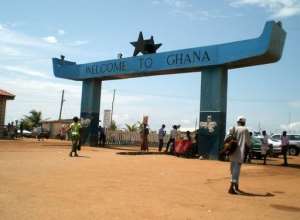
From the Durand Line to Paga, history’s deadliest insurgencies were not born in national capitals; they metastasized in the seams between sovereign states. Burkina Faso, a nation that recorded a single terrorism-related fatality in 2015 only to become the most terror-impacted state on earth by 2024, burns on Ghana’s doorstep. Ghana’s northern border towns can no longer be viewed as mere peripheral trading posts. They represent the frontier where the republic will either be defended or quietly undone.
In a prior observational study conducted in collaboration with a Ghana Immigration Service officer, border corridors across northern Ghana, including key sectors such as Bawku, Oriyanga, Paga, and Kulungugu were monitored. Empirical observations of cross-border activities within these apex transit zones highlight critical vulnerabilities that warrant significant national and regional security concerns.
Dawn at Paga reveals a reality that challenges conventional security paradigms. The markets on either side of the frontier open at the same hour, in the same language, serving communities whose grandmothers were born on both sides of a line neither family ever drew. The Burkinabè trader does not glance at the Immigration post because his cousin’s shop stands a hundred meters beyond it, and his aunt prays in the adjacent mosque. This is the world as it is actually lived, and it is precisely this human borderland that violent extremist organizations (VEOs) seek to exploit first.
If we are to understand the mechanics of contemporary violent extremism, we must shift our analytical focus away from state capitals and toward these vulnerable margins. Every major jihadist insurgency in modern history grew not in a city, but on a seam. The border town presents a profound security paradox: legally, it represents the edge of state authority, but socially and economically, it is the center of local life. Residents do not live strictly in Ghana, Burkina Faso, or Togo—they inhabit a borderland. They share languages, intermarry, pray together, and trade daily. The state, meanwhile, remains distant. And where the state is far, hostile actors move close.
History repeats this structural pattern with chilling consistency across distinct geographic theaters. Drawn by British authorities in 1893 to divide Pashtun tribal lands, the 2,640-kilometer Durand Line between Afghanistan and Pakistan remains a textbook case of a boundary no local community honors. For over four decades—from the anti-Soviet mujahideen to Al-Qaeda, the Afghan Taliban, and Tehrik-i-Taliban Pakistan (TTP)—border towns like Parachinar, Waziristan, and Chaman functioned as crucial strategic rear bases. Fighters conducted attacks in Afghanistan and slept in Pakistan; arms were procured in one jurisdiction to be deployed in another. Neither Islamabad nor Kabul could project full sovereign authority into the Federally Administered Tribal Areas (FATA), creating a vacuum that evolved into an extremist emirate.
In the summer of 2022, a field research I conceived methodologically as both an experiential journey and an empirical inquiry, was conducted across volatile border zones from Guyana through the Darién Gap to Tijuana, Mexico, allowing for direct observation of acute instability, systemic crime, and human insecurity.
In South America’s Tri-Border Area connecting Brazil, Argentina, and Paraguay, Ciudad del Este emerged as a global hub for illicit trade, arms trafficking, and Hezbollah financing precisely because three sovereign jurisdictions intersected without unified oversight. Weak customs enforcement, a vast cash economy, and porous borders allowed extremist financiers to hide illicit capital flows inside ordinary commercial smuggling. The lesson is universal: where formal paperwork cannot track money, money will always find paperwork-free corridors.
The Kenya-Somalia border provides a direct parallel to Ghana’s current security threat. Following the collapse of the Somali state in 1991 and the subsequent rise of Al-Shabaab, Garissa transformed from a quiet pastoral trading post into an operational corridor. Al-Shabaab did not need to launch a conventional military invasion; it instrumentalized kinship. The same Somali clans span Kismayo and Garissa, sharing language, social identity, and historic grievances against central authorities in Nairobi. Recruitment was initially logistical: hiding a relative, moving fuel, or acquiring supplies. The tragic climax occurred on April 2, 2015, when the Garissa University massacre left 148 people dead—an attack planned across an invisible boundary where one of the key gunmen was the son of a Kenyan county official from Mandera.
In the Sahelian border belt across Mali, Niger, and Burkina Faso, groups like Jama'at Nusratul-Islam wal-Muslimin (JNIM) and the Islamic State in the Greater Sahara (ISGS) have executed a precise borderland strategy since 2012. Rather than attempting to hold capital cities like Bamako, they seized forest reserves and frontier market towns—such as Djibo, Tillabéri, Oursi, and Falagountou. By establishing control over border intersections, they tax livestock trade, exploit artisanal gold mines, and evade national armies by crossing political lines. In October 2025, JNIM executed one of its deadliest assaults on the Djibo–Namsiguia axis, proving that the border-triangle tactic remains highly lethal.
Suffice it therefore to state extremists do not cross borders; they live in them. They exploit what political geographers call the "sovereignty gap”, the spatial disconnect where the central state asserts formal capital jurisdiction, conventional forces, and distant bureaucracy, yet fails to provide functioning courts, schools, clinics, or agricultural extension officers. In this void between distant capital authority and marginalized borderland communities—marked by shared ethnicity, transnational kinship, and informal cash economies—extremists construct an operational corridor driven by exploited kinship, smuggling networks, safe havens, and co-opted local feuds.
Data from the Global Terrorism Index confirms this dramatic geographical shift. Over the past two decades, the epicenter of global terrorism moved decisively from the Middle East to the Sahel. In 2005, the Sahel accounted for just 1% of global terrorism fatalities.
This figure rose steadily to 5% by 2012, expanded to 20% by 2018, reached 35% in 2021, and culminated in the Sahelian belt directly north of Ghana accounting for roughly 50% of all terrorism deaths worldwide by 2025–2026. Anyone who believes this violent tide stops at Ghana's survey pillars misreads both the map and the material evidence.
Ghana itself is circumscribed by three distinct border ecosystems, each presenting a specialized risk profile. Spanning areas such as Paga, Pussiga, Bawku, Garu, Tempane, Hamile, and Tumu, the northern border with Burkina Faso represents Ghana's most urgent national security priority. Historically an economic and familial corridor for Kusasi, Mamprusi, Bissa, and Mossi populations, the area previously experienced minor commercial contraband. However, between 2015 and 2024, as Burkina Faso disintegrated from 1 terror death in 2015 to 1,935 deaths in 2023—ranking as the world's most terror-affected nation in both 2023 and 2024—border hubs like Bittou, Bagré, and Hamile-Burkina became operational staging grounds for JNIM.
JNIM's infiltration strategy into northern Ghana relies on three tactical pillars. First is forced displacement and infiltration: more than 17,000 Burkinabè asylum seekers have entered Ghana's Upper East, Upper West, and Bono East regions, with nearly 10,000 biometrically registered in government reception centers at Tarikom and Zini. While predominantly refugees, this influx presents critical intelligence challenges regarding spotters and forced informants. Second is the co-optation of local grievances: extremist networks active in Burkina Faso instrumentalize existing farmer-herder and chieftaincy disputes in places like Bawku and Garu, reframing resource access and ethnic tension into religious narrative frameworks. Third is the monetization of informal logistics: smuggling paths previously used for uncustomed goods now move fuel, motorbikes, and precursor materials. Official security reports reveal that between 2023 and 2025, Ghanaian security forces recorded 47 cross-border incursions and executed over 300 arrests linked to extremist logistics and recruitment in the north. Complicating this landscape, on January 29, 2025, Burkina Faso, Mali, and Niger formally exited ECOWAS to establish the Alliance of Sahel States (AES), severely disrupting the regional intelligence-sharing frameworks that Ghana's northern defense relied upon.
Along the western border with Côte d'Ivoire—spanning Elubo, Enchi, and Sefwi—the security dynamics historically centered on illegal cocoa trade and artisanal gold mining. Following the June 2020 attacks on the Kafolo gendarmerie post in northern Côte d'Ivoire, the risk profile evolved. Border ecosystems near Comoé National Park serve as logistical back-offices where actors obtain unregistered SIM cards, convert gold into liquid cash, and secure non-lethal supplies. In late August 2025, a localized land dispute in Gbiniyiri in the Savannah Region killed about 31 and displaced over 50,000 people, sending about 13,000 refugees into Côte d'Ivoire. This demonstrated how rapidly rural grievances generate humanitarian chaos—the precise environment in which recruiters operate.
Meanwhile, the eastern border hubs with Togo and Benin, such as Aflao and Dzodze, move tens of thousands of travelers daily. Rather than armed guerrilla operations, this urban-religious frontier faces risk from radical ideological dissemination. Itinerant reformist preachers bypassing formal oversight bodies like the National Chief Imam's office can exploit these dense transit corridors to establish roots in urban zongo communities, promoting exclusionary ideologies that erode traditional communal resilience.
Across these distinct frontiers, field research throughout West Africa reveals five underlying structural drivers that enable violent extremists to convert borderlands into operational staging grounds. The first driver is administrative absence. Border districts like Pusiga lack basic civil infrastructure; state courts sit infrequently, whereas non-state actors maintain a daily, visible presence. Socio-politically, this generates institutional vacuums where extremist shadow governance, alternative social services, and ad-hoc dispute arbitration can take root. The second driver is the transnational kinship shield. Because cross-border family, clan, and ethnic ties take precedence over state citizenship and formal boundary enforcement, local residents naturally protect their extended families, refusing to inform on relatives residing across the border line. The third driver involves licit-to-illicit pipelines. Pre-existing commercial contraband networks moving fuel, cocoa, and gold provide ready-made infrastructure. Extremists do not need to build new supply lines; they simply buy into established local smuggling routes.
The fourth driver is the youth socioeconomic vacuum. Border regions suffer from severe youth unemployment, with the average age of northern detainees hovering around 23. This dynamic provides an abundant pool of vulnerable young men who are recruited primarily through financial incentives and economic survival rather than pure ideology. The fifth driver is the ideological narrative vacuum. When the central government fails to clearly address or explain local economic hardships, land disputes, or chieftaincy conflicts, hostile actors fill the void by reframing localized socioeconomic grievances into compelling frameworks of religious duty or structural resistance.
Recognizing border towns as epicenters of threat must not lead to suspecting their residents of treason. The same kinship that shelters contraband also provides refuge for fleeing family members and feeds local markets. When the state treats borderlands with collective suspicion—executing heavy-handed raids and arbitrary sweeps—it actively drives the populace into the arms of extremist recruiters. Heavy-handed policing hardens frontiers; visible, empathetic civil governance disarms them.
To preserve national integrity, security strategy must evolve from viewing borders as physical fences to governing them as living human communities. Recommended policy actions require prioritizing civil governance over a purely military posture by deploying functional magistrate courts to Garu, health clinics to Hamile, and economic development resources alongside armed patrols. State presence must signify consistent service delivery, not merely armed checkpoints. Furthermore, intelligence assets like the National Signals Bureau must integrate deep linguistic and cultural fluency in Mòoré, Hausa, Fulfuldé, and Bissa, as effective intelligence gathering relies on understanding local grievances in the native languages spoken along the seam. Marginal trade infrastructure must also be formalized to transition informal border traders into the legitimate economy, preventing petty cross-border commerce from being criminalized and pushed into shadow economies controlled by organized crime. Finally, resilient bilateral intelligence cooperation must be sustained directly with security personnel in Ouagadougou, Niamey, and Bamako—bypassing broader diplomatic ruptures to maintain real-time operational data sharing.
The empirical realities of regional insurgencies underscore this necessity. In the Lake Chad Basin, marshes and border areas straddling Nigeria, Niger, Chad, and Cameroon continue to serve as strongholds for the Bakura Doro faction of Boko Haram (JAS), utilizing dense terrain to execute cross-border operations beyond the reach of conventional military units. Similarly, within the Sambisa Reserve and Mandara Mountains corridor, insurgent factions exploit vast forest canopies and natural cave networks along the Nigeria-Cameroon border to conceal logistics hubs from heavy armored forces. In Nigeria's northwest and northcentral expansion vectors, extremist elements have moved west into Niger and Kwara States around the Kebbi-Kainji-Borgu triangle, embedding within non-ideological criminal bandit networks and demonstrating how rapidly violent extremism mutates when state presence recedes.
The border is not where the republic ends—it is where it will be defended or lost. Maps depict borders as thin, static lines, but at dawn in Paga, the border is a living world of cousins, shared markets, and historical grievances. The authority that genuinely governs that human landscape secures it; the authority that abandons it inevitably loses it—first the customs post, then the night, and ultimately the youth.


 Thousands attend Kenya opposition rally amid anger over political violence
 Trump slams AI sceptics as Altman pauses OpenAI IPO plans over safety concerns
 WASSCE: School officials helped students cheat for years, but we now see the tru...
 Probe alleged military killing of lecturer in Bawku – Kusaug Youth demands
 ‘If we all pay GH¢1,000 each, we should be able to construct National Cathedral’...
 Mahama inspects proposed site for Upper West Regional Airport
 Mahama reiterates government's commitment to end double-track SHS system
 Police interdict officer over death of 23-year-old Ivan Baidoo on Tema Motorway
 Improved invigilation is exposing true performance of Ghanaian students — Mahama...
 There's no policy to introduce Arabic, Chinese in all public schools — Mahama


